Schools
Ashford Avenue Bridge Plans Travel Rough Road
After a preview look at the county proposal, residents call its scope too small and traffic volume too large.
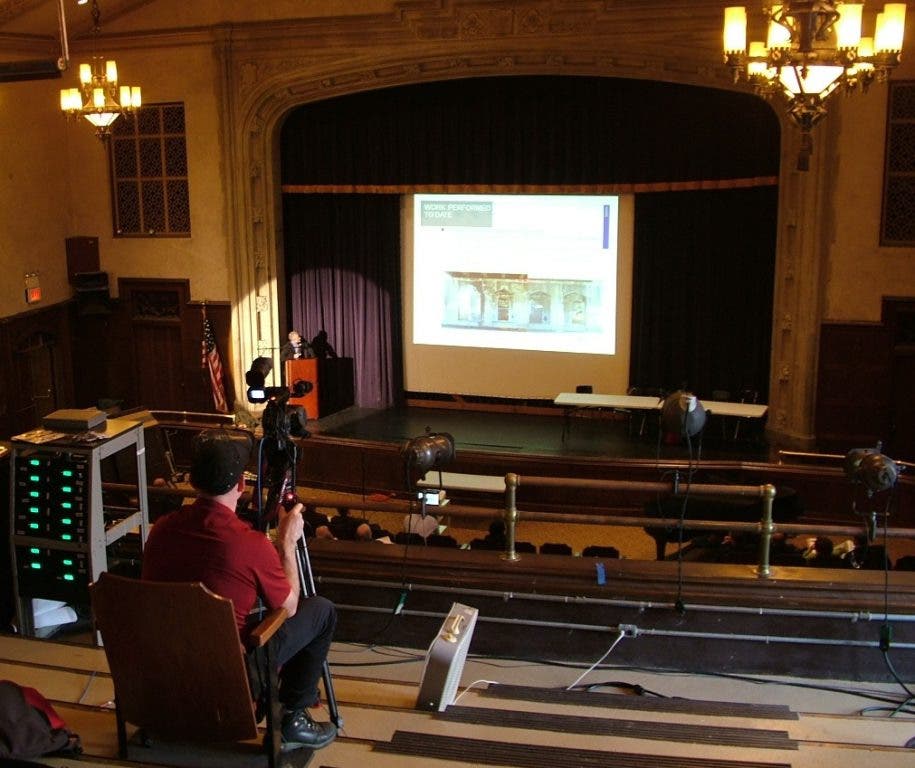

The Ashford Avenue bridge, which spans two major arteries to link the villages of Ardsley and Dobbs Ferry, is considered, County Legislator Mary Jane Shimsky said Wednesday, “the worst county-owned bridge in Westchester—and not by just a little.”
But if proposed remedies unveiled Wednesday were aimed at whipping up enthusiastic public support for the county’s plans, they appeared to miss their target—and not by just a little.
To be sure, no one doubts the need to refurbish this crumbling, 62-year-old structure, its quaint, midspan, right-angle ramp tying it to the busy Saw Mill River Parkway below. But the bridge was not in imminent danger of falling, said Shimsky. Still, said the District 12 lawmaker—who pointed out the state’s unflattering assessment of the span—the county must begin planning now for repair or replacement. No one in the Dobbs Ferry High School audience seemed to question that.
Find out what's happening in Rivertownsfor free with the latest updates from Patch.
So, first they listened as, by turns, county public works officials and their consultants outlined a number of plans, including one that appeared most likely to be implemented. Specifics of the plan were scheduled to be available Thursday on the county’s website.
David Weiss, from the Briarcliff Manor office of the multinational traffic engineering firm WSP Sells, reviewed a number of rehabilitation options but homed in on a middle-ground plan. Estimated to cost $16.6 million, it went beyond simple repair or rehab options but stopped far short of being a major overhaul, including widening. Called option three, the project would replace, in effect, what’s been there for more than half a century.
Find out what's happening in Rivertownsfor free with the latest updates from Patch.
After the presentations, after they’d listened, the residents spoke. Polite but unhappy, they questioned both the scope of the project and the traffic it seems certain to generate. “We’re basically getting back the same bridge we had 50 years ago,” Stephen Wittenberg of Ardsley said. “Is that correct?”
A longtime member of his village’s traffic committee, Wittenberg said he was “a little disappointed” that a replacement option had been chosen before residents had any say in the matter. “Our committee has been working for years and years,” he said, to find traffic solutions.
Officials assured him that a final decision had not been made, saying the various options were contained only in a “design-approval document.”
Like many others in the audience, Wittenberg said he preferred the grander—but more expensive—alternative that would, among other things, widen the bridge. To accommodate a wider span, Westchester would have to condemn at least some of the surrounding land, then compensate the owners. How much the county might have to pay can only be guessed, forcing the estimated final cost of “option four” into a range of about $30 million to $35 million.
Another option-four fan, Dobbs Ferry resident Don Mara, noted that “tremendous disruption” seemed inevitable no matter which alternative is chosen. “Let’s do it right,” he suggested, urging officials to “get creative with financing.”
Westchester must put any bond over $10 million to a referendum, meaning a project the size of option four would require not just creativity but countywide voter approval. Officials expressed confidence that they could piece together enough creative funding—highway aid and other sources, for example—to keep a bond for the more-modest option under $10 million. They said, however, that the larger project would almost certainly require the countywide vote.
Regardless of the money being spent, traffic remained the central concern of residents in the cavernous school auditorium. Numbering fewer than 100, they sat widely dispersed in a hall built to hold more than 500.
“I’ve been here for 71 years . . . before the Thruway, the bridge,” Larry Nardecchia of Ardsley said. The village trustee believes “we should be getting some traffic improvement for our dollar.”
When Saw Mill River Parkway access is denied during the bridge’s reconstruction, detours would route traffic south, to Lawrence Street. The diverted cars are slated to travel over Ogden Avenue and Saw Mill River Road, drawing protests over the potential volume those residential streets will be asked to handle.
“Can you give me a number?” asked Ogden Avenue resident Matthew McCormick. Told that estimates ran to more than 300 cars per hour in one direction and almost 200 in the other, he cracked, “Has anyone here tried to thread a needle with a rope? That’s what you’re trying to do.”
Another Ogden resident, Rita Kennedy, questioned whether county plans take into account the Rivertowns Square project and an Elm Street sports complex. She was assured those projects were included in the county's considerations.
But McCormick suggested that bottlenecks would result if the envisioned mall and bridge projects were undertaken simultaneously. “If they’re both going on at the same time,” he predicted, “nobody drives through.”
McCormick urged officials to continue their review, saying, “You need to seriously think about a number of options.”
Dobbs Ferry Trustee Donna Cassell, for example, suggested that officials examine ways not simply to divert the auto traffic but reduce it as well, turning to things like carpooling and increased Bee-Line bus service.