Community Corner
Astrophysicist Lectures at Sachem Public Library
Gives class on how to build your own telescope.
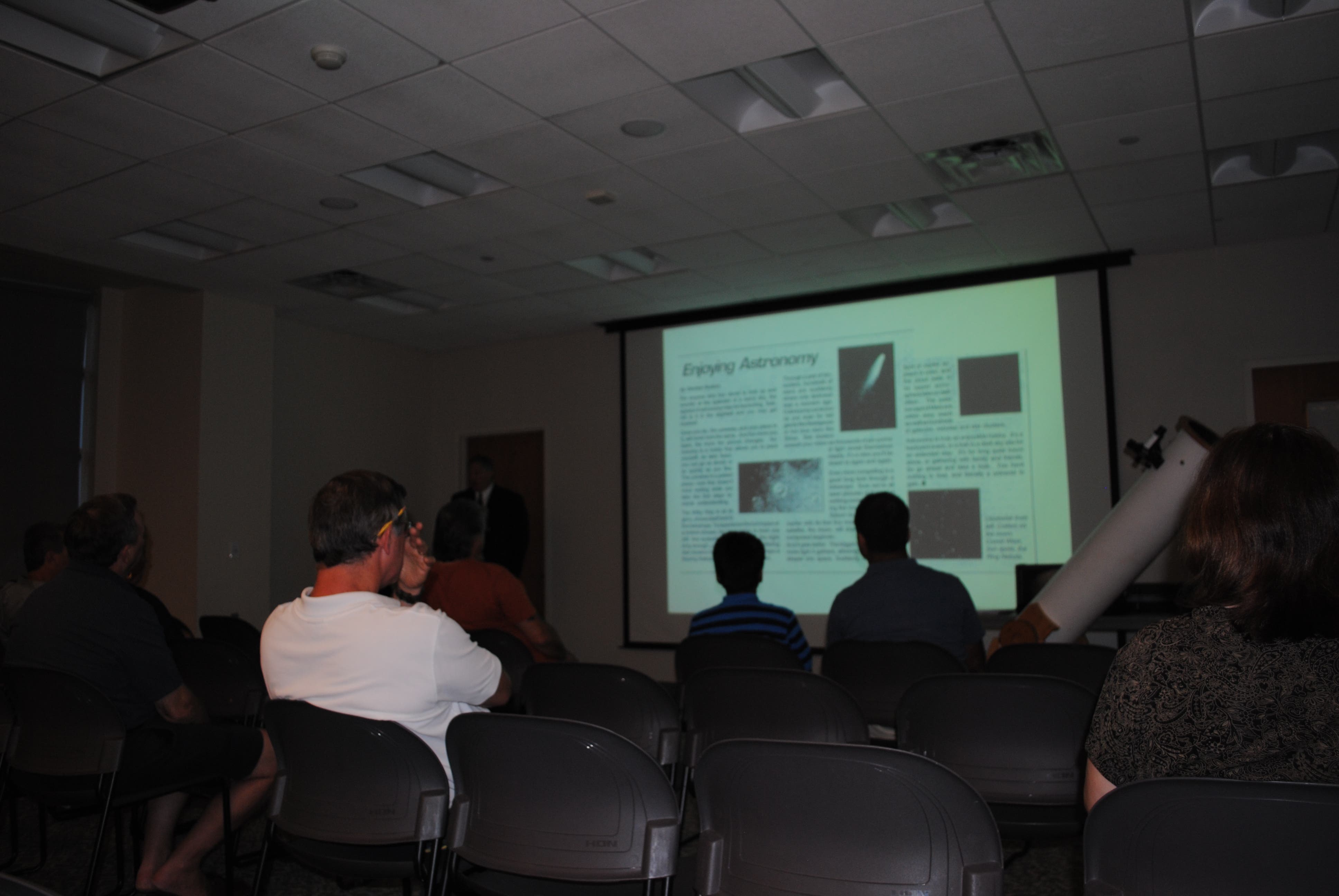


The Sachem Public Library held a how-to seminar on building your own telescope Tuesday night.
About a dozen individuals came down for Dr. Kevin Manning's presentation, eager to learn just what goes into building a telescope at home. The lecture also included an introduction of the different types of telescopes and their functions.
Dr. Manning, an astrophysicist, has worked as a consultant for NASA and has also worked with the Chandra X-Ray Observatory. On the side he likes to build telescopes.
Find out what's happening in Sachemfor free with the latest updates from Patch.
"I have built about seven throughout my career," he told the group.
The telescope he brought with him on Tuesday had an 8-inch mirror. He also showed a photograph of a much larger telescope he made with a 12-inch mirror that is over 10 feet tall.
Find out what's happening in Sachemfor free with the latest updates from Patch.
Manning began by reviewing the five functions of a telescope: to gather sufficient light, give sufficient resolution, provide magnification, field of view and to have good definition. He also added that there are two types of telescopes: refractor and reflector. The telescope he brought with him was a classic Newtownian Reflector.
The presentation also included full step-by-step photo imagery of the labor and process that goes into building a telescope. He suggests using oak for the mount of the telescope because it is a very durable hardwood and painting the inside with flat black paint so it will be anti-reflective.
Dr. Manning pointed out the further benefits of viewing the sky through a telescope when he showed that the naked eye can typically see around 6,000 stars on a clear night. Using an 8-inch telescope would allow an individual to see about 45 million stars. As Manning further pointed out, the naked eye has a visual limit of approximately +6 magnitude while an 8-inch telescope has a visual limit of approximately +14 magnitude.
When viewing the sky through a telescope, individuals have the opportunity to see celestial objects like Jupiter, Mars, the moon, globular clusters, double stars, constellations and with the aid of a solar filter sun spots.
"A telescope allows you to see the invisible," he said.