Arts & Entertainment
Picasso at the Sachem Public Library
Lecture given on artist famous for "Guernica" and promiscuity.
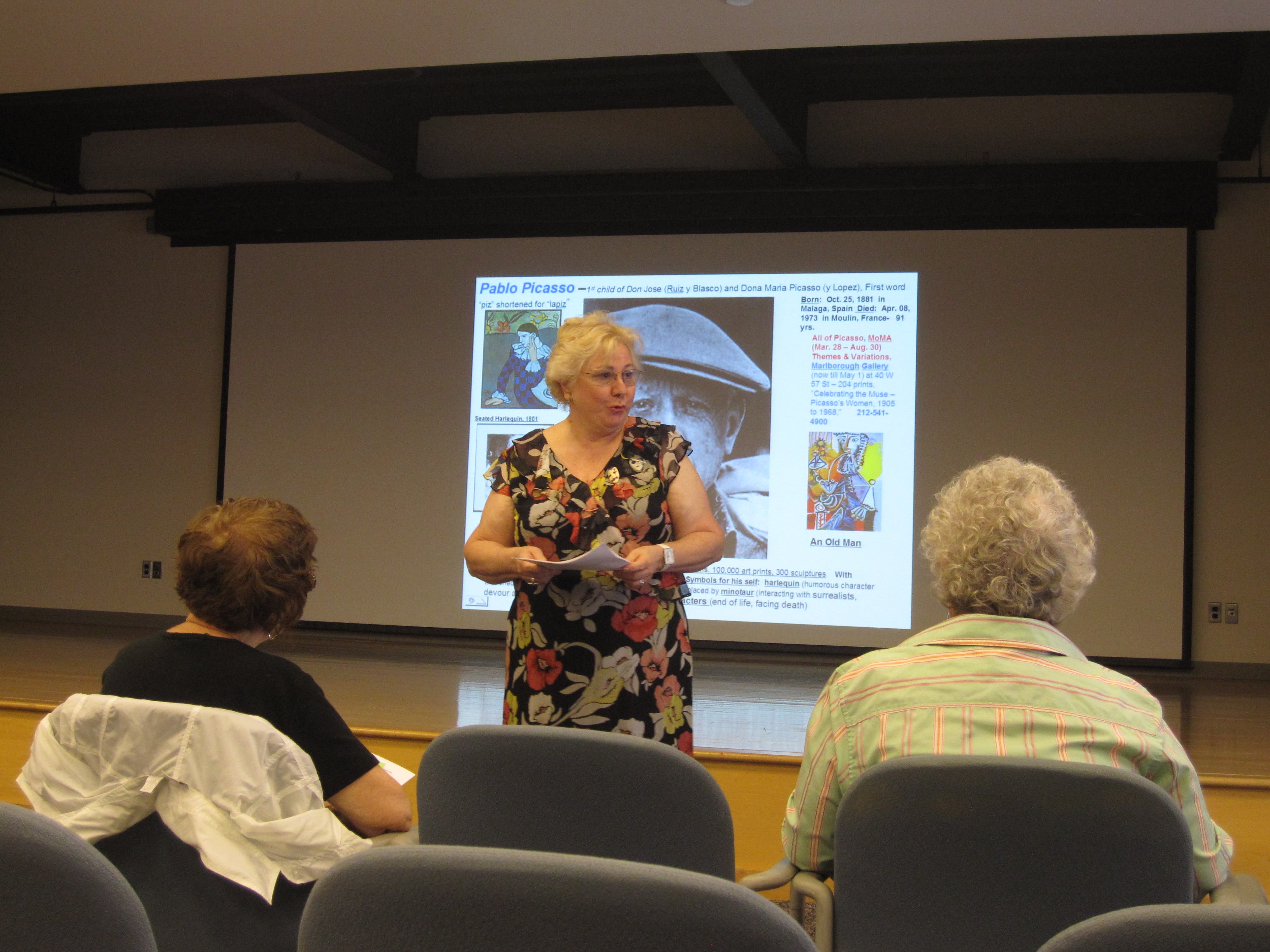

At the Sachem Public Library, artist and educator, Emilia Rabito Baer, enlightened the Sachem community with a lecture on Spanish artist Pablo Picasso based on the exhibits currently running in New York at the Metropolitan Museum of Art, the MOMA, and the Marlborough Gallery. Baer covers Picasso's nearly 22,000 pieces of artwork including paintings, prints, drawings, sculptures and ceramics as well as his personal and love life in relation to his work.
"When he saw people in the street he started laughing uncontrollable out loud," said Bear on the genius who sometimes crossed the line between insanity and intelligence, "because he saw his own bowl movements on top of their head."
According to Baer, on Oct. 25, 1881 in Malaga, Spain, Picasso was a stillborn baby until the smoke from his uncle Louis's cigar blew into his face causing him to awaken and cough. His first word was "piz", a shortening of lápiz, the Spanish word for pencil, which he used in many of his paper drawings. From then on it was fate that he be an artist, with a drawing teacher of a father, Don José Ruiz y Blasco, at Escuela in San Telmo.
Find out what's happening in Sachemfor free with the latest updates from Patch.
RELATED: Emily Rabito Bear talks fashion at the Library
Picasso's work is heavily ingrained with symbolism. All of his works have hidden messages through physical objects, people or the structure of the composition. His many themes include: portraits, death and war, copies of other masters' work, hats, beaches, mothers, children and the idea of family, lovers, animals, relationships and the naked body.
Find out what's happening in Sachemfor free with the latest updates from Patch.
The exhibit at the MET, Picasso in The Metropolitan Museum of Art running from April 27 to August 15, is more of a showcase of all of Picasso's work. The Marlborough Gallery's exhibit, Pablo Picasso: Celebrating the Muse: Women in Picasso's Prints from 1905-1968, running from March 23 to May 8, is a collection of 200 prints in a variety of techniques including etching, dry point, linocut and lithography that exhibit the symbolism of women in his art work. MOMA presents Picasso: Themes and Variations running from March 28 to August 30, an exploration of the symbols and meanings behind the masterpieces.
Picasso broke down his work into periods, or groupings of the same technique in the same time period reflecting on where and who he was with at the time. He started with portraiture including many self-portraits, his mother, and his father and at the age of 13, his sisters' first communion in "The First Communion."
His Blue period, 1901 to 1904, was influenced by the suicide of his friend Carlos Casagemas. The paintings from this period were melancholy and he used several shades of blues and greens, as seen in "The Blind Man's Meal," and "The Absinthe Drinker."
The Rose period, 1904 to 1906, saw happier times and colors like rose and orange and depictions of the harlequins in France. Examples of the Rose period include, "Boy With the Pipe," "Family of Acrobats with Monkey," and Woman With a Crow."
The time between 1907 and 1909 saw the famous painting, "Les Demoiselles d'Avignon," and other paintings inspired by African artifacts. The paintings in this short time period led into his next phase, cubism.
Cubism, the style Picasso invented with Georges Braque, was about using monochrome brown and neutral colors. Analytical cubism, 1909 to 1912, created an analytical look at objects in terms of their shapes. Synthetic cubism, 1912 to1919, featured fragments of wallpaper or a newspaper page pasted into compositions. "Three Musicians" and Le Guitariste" are examples from this period.
"Picasso always said you have to read his symbols, you have to make it what you want it to be," said Baer on the artist who kept several mistresses in addition to his wives, who often turned up in his artwork.
Baer said of Picasso that he always started with a line and went from there, because the shapes always change but the line remains the same.