Arts & Entertainment
'Rippling' Glass Sculpture from Westchester Artist
David Licata has a singular sculpture at Kenise Barnes Fine Art.


Walking along Palmer Avenue, I did a double-take in front of Kenise Barnes Fine Arts gallery. Was I seeing ripples of water? On the wall?
Suspended from the ceiling were a thousand thin glass loops, interconnected in the way of paper chains, forming a large, draping sculpture. Its transparency was glowing from the street lamp, casting shadows on the interior gallery wall that suggested ripples. A man behind me said he saw clouds.
It's the work of David Licata, 28, who grew up in White Plains.
Find out what's happening in Scarsdalefor free with the latest updates from Patch.
His glass orchids are in the collection of Oscar de la Renta. A section of glass chain mail is with Katherine Entemann, whose husband Klaus is president of Daimler Financial Services.
After completing a masters program at the prestigious Cranbrook Academy of Art, and having been in a number of prominent shows, Licata is skipping the artist trend of moving to Brooklyn and instead has decided to stay put in Westchester.
Find out what's happening in Scarsdalefor free with the latest updates from Patch.
In fact, one of his first stops after graduation was Larchmont. And one of his upcoming destinations will be teaching art at Fox Lane High School in Bedford Hills.
Calling on Larchmont
Barnes had included an installation of Licata's in the 2008 show she curated at Westchester Arts Council called "Local Growing Conditions," before he left for Cranbrook. "I was always very taken with his work," she says.
This May, after receiving his MFA and moving back home to his parents' house in White Plains, Licata paid Barnes a visit.
"He walked into the gallery and asked, 'Remember me?' He said he was eager to do some work. I mentioned that I was having a photography show in six days, and would like a clear glass sculpture in the corner that wouldn't interfere with the photographs. I asked if he could do it in such short time."
He did. Licata torched one thousand loops ranging in size from two to twelve inches in diameter.
"I'm kind of enamored of it," says Barnes. "It looks different throughout the day and night—the way the light moves through it, and the shadows it casts."
Glass work
At Cranbrook, Licata combined his initial love of metal working with his growing interest in glass. "During a metal-smithing class, a graduate student showed me how to make glass beads using a torch. I realized that I really loved working with glass."
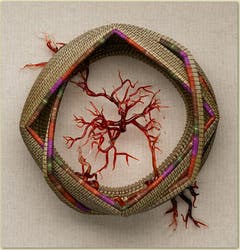
He began making glass trees, exploring aspects such as root systems, which led to a collaboration with artist Debora Muhl. Muhl weaves sweet grass into sculptural vessels into which Licata inserts his glass creations.
Licata evolved into "weaving" glass chain mail created by linking small glass loops, creating necklaces and glass garments. The work was included in the much-watched SOFA show in New York City in 2008.
Nesting
The piece in the Larchmont gallery is part of Licata's "nesting" series. "The shapes of the glass comes from a combination of things, from chain mail to rock-climbing carabiners." (A carabiner is an oblong metal ring with a hinged side.)
And the mood? "I think of it as nesting, or a cocoon," he says. "Since it's glass, it's about something beautiful that's fragile."
Some of the links are open, some are closed—allowing them to be arranged in different ways. "The piece are interchangeable and adaptable to an environment," says the conceptual artist. While it lists for thousands of dollars, sets of ten links are $100.
Roots
"My roots are in Westchester," says Licata, whose love for nature takes him on walks that inspire his work, and who is a frequent visitor to Manor Park.
He'll be nesting at his parents' house a while longer as he gets settled into teaching this September.
Licata was inspired by his high school art teacher, Robert Dincik. "He's a terrific teacher who's an artist. His art shows demonstrated to us what it meant to be a working artist. I realized that teaching art, and making art, are two things that are essential to my nature, too."
While the piece can be taken to another location, Licata uses the structure of a space to support the links, so each installation will cause the links to be arranged in a new way.
"It's unique to the space it's in, always evolving."
Through Labor Day. Kenise Barnes Fine Art, 1955 Palmer Ave., Larchmont; (914) 834-8077. Summer hours, Wednesday to Saturday 10 a.m. - 5:30 p.m., and by appointment. www.kenisebarnesfineart.com