Community Corner
The Crazy Like a Fox Case
New discovery sheds light on local 19th Century case, a text book staple.

If you Google Pierson v. Post, you’ll find a whole host of hits and even a Wikipedia entry.
The court case has been widely taught in first-year property law classes since the turn of the 20th century and the New York State Supreme Court ruling of 1805 has been well documented in most of the South Fork history books. One of the earliest mentions of the case was made by Bridgehampton’s Judge Henry P. Hedges, a legal authority in Suffolk County, who wrote about it in in 1895. But even so, in these parts the story has become more local lore than legal precedent.
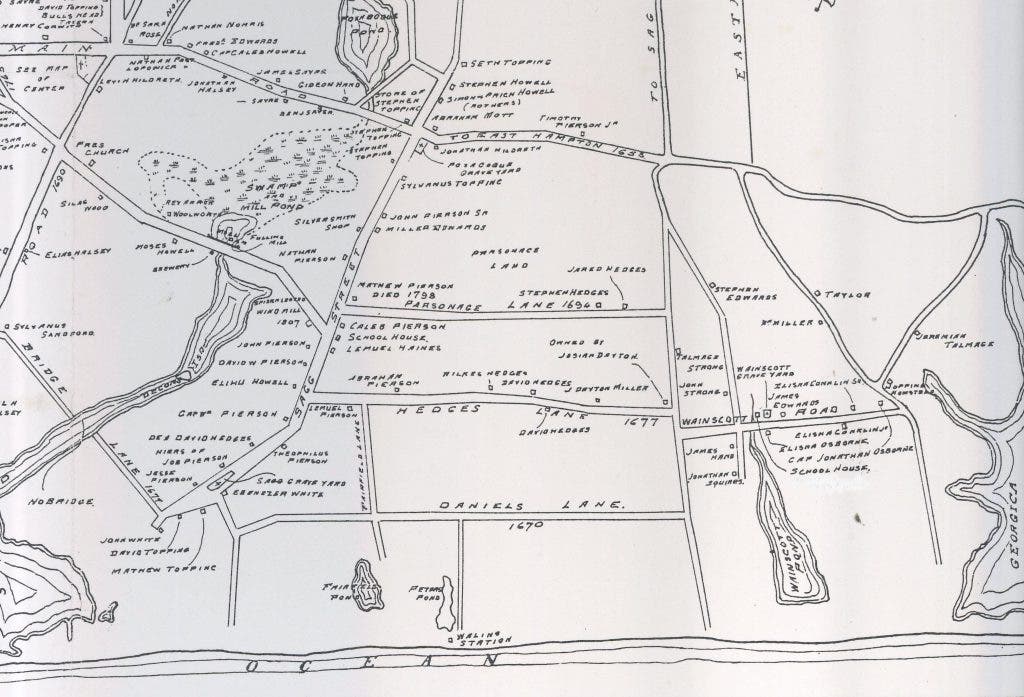
In 1802, Lodowick Post, son of the master mariner and merchant Nathan Post, was engaged in a fox hunt with hounds and other riders on horseback. The fox had been chased down to Peter’s Pond at the edge of the beach in Sagaponack, where Jesse Pierson, son of Capt. David and part of the agrarian clan of Piersons, was walking home from a day of teaching in Amagansett. Jesse spied the fox and, using a club, killed it and claimed it as his own. Lodowick was outraged. For the families it became a fight between “old” (Pierson) and “new” (Post) money.
Find out what's happening in Southamptonfor free with the latest updates from Patch.
Recently, Angela Fernandez, a law professor and legal historian at the University of Toronto, unearthed the missing link, the “judgment roll” document from the original trial here in 1802. Until now little was known of the local court case other than that it ruled in favor of Post. This document shows that the trial got under way not long after the dispute with Post bringing suit with Judge John N. Fordham presiding, at the home of Hugh Gelston Jr. (presumably in Southampton Village). The jury was comprised of people from families such as Cook, Halsey, Jessup, Havens, Topping and Sayre. In ruling in favor of the pursuer Post, the court fined Pierson 75 cents for interfering with the fox hunt. Unhappy, Pierson then sued Post, which brought the case to the New York Supreme Court in 1805. The Supreme Court reversed the lower court’s ruling in favor of Pierson, saying, in effect, that “possession is nine-tenths of the law.”
With this new discovery over 200 years later, Pierson and Post might be happy to know that their famous fox case lives on.
Find out what's happening in Southamptonfor free with the latest updates from Patch.
At a meeting held in April of 1791, the Freeholders and Inhabitants of Southampton voted in favor of giving four shillings for every fox killed during the spring months. (Southampton Town Records Vol. III.) Foxes at that time were considered vermin and a nuisance to farmers. One can speculate that money might have been a motivating factor in Pierson’s decision to kill the fox, but after a long legal battle the fox, it seems, was of little consequence.