Business & Tech
'Mansions' Return to Tarrytown’s Wilson Park But Pale in Comparison to Majestic Estates of Past
First of 14 new homes under construction on land locals sought to preserve.
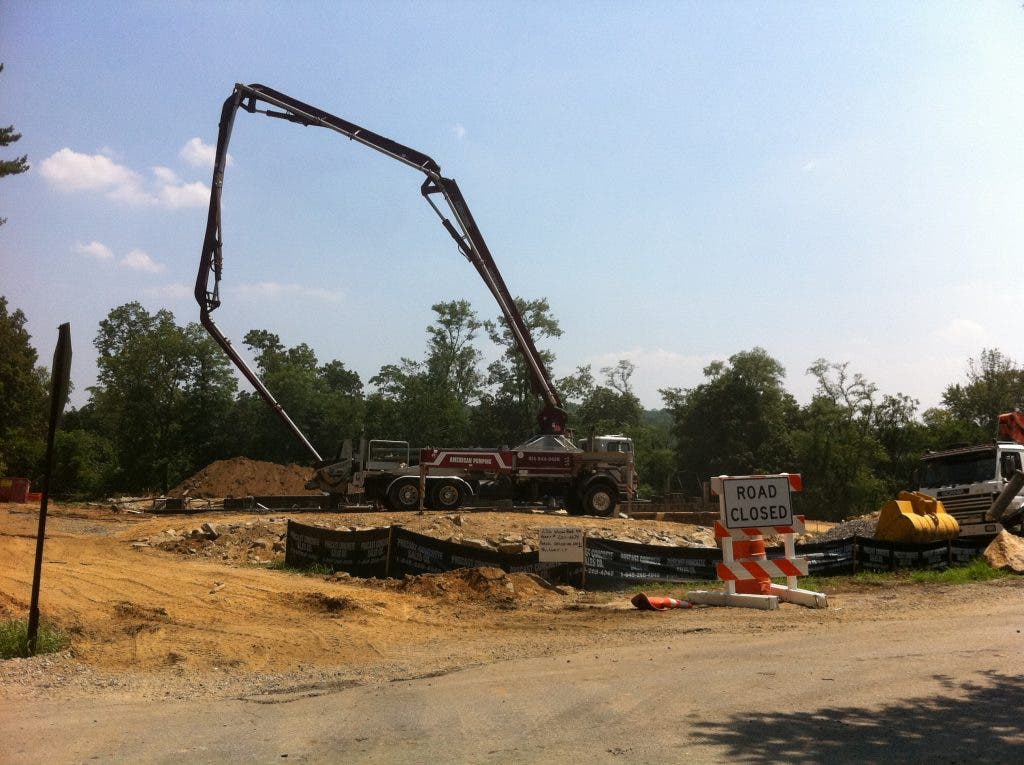


The wild raspberries are ripe at Wilson Park and the apples on the one-hundred-year-old trees are just showing the first blush of red. Red tail hawks circle the sky while deer and coyotes compete for survival. Interrupting this lush scene is the sound of heavy machinery ripping up earth and roads as construction begins on the first of 14 houses to be built on what has been mostly open space since 1960.
The onset of construction and especially the large hole in the ground which will become the foundation for the first house at the intersection of Wilson Park Drive and County House Road are harsh reminders that the development residents tried to stop or reduce in size for more than six years is finally happening.
“It makes me sick what they are doing at Wilson Park,” said Cobb Lane resident Paddy Fisher. “I wouldn’t mind so much if the size of the houses were more in keeping with the character of the neighborhood.”
Find out what's happening in Tarrytown-Sleepy Hollowfor free with the latest updates from Patch.
The house currently under construction is a 6,200 square foot center hall colonial on a 1.74 acre lot. The house being erected by Toll Brothers, Inc., a builder of luxury homes based in Pennsylvania, will serve as a model home for 13 others to be built on lots ranging in size from .7 of an acre to 2.18 acres.
“Most people here live in houses that are between 2,700 and 3,000 square feet, but these new houses are more than twice that size,” said Warner Lane resident Melinda DeRocker. “It detracts from the quaintness and uniqueness of Tarrytown and brings a whole different look.”
Find out what's happening in Tarrytown-Sleepy Hollowfor free with the latest updates from Patch.
While residents lament the construction of large new houses that are out of scale and out of character with the rest of neighborhood, big houses and big money were once the norm at Wilson Park. So much so that it was given the nickname “millionaires' colony.”
The area was named for William S. Wilson, a New York City merchant, who built a stunning brick mansion on twenty acres on Wilson Park Drive near the top of Beech Lane sometime before 1878. He called his estate Pleasance. The house survives today as part of the administration building for the nuns of the Religious of the Sacred Heart of Mary.
Wilson’s neighbor to the south was an equally grand house known as the Reynard Mansion, which in 1907 became the first Marymount College, now Marymount Convent for retired and infirm nuns.
The large empty field sandwiched between Marymount Convent and Warner Lane is the future home of four of the 14 houses and an 11-acre village park. The park came about because the Tarrytown Planning Board negotiated the purchase of 11.38 acres from the developer to preserve it as open space, thereby reducing the number of building sites from the requested 20 to 14.
In the early 1900s, three grand mansions were situated on this stretch of land: the homes of Dr. Charles Brace, Frank Wright and Worcester Warner who built the Warner Library. Two new homes are slated for construction on the old Warner estate next to the Ice House, the only surviving building from the estate, now owned and occupied by Rob and Melinda DeRocker. The Warner House had an observatory on the top floor as he was the manufacturer of telescopes. The Brace family home near the top of Cobb Lane was built in 1910 out of granite quarried from the property. It was abandoned by the family in 1945 during World War II due to a lack of heating oil. The remaining bits of the Brace estate are unlikely to survive the new construction: an apple orchard which still produces apples and a small stone service house slated for demolition after it serves as the construction office.
The land and houses were acquired in 1960 by Laurence Rockefeller, grandson of John D. Rockefeller Sr., founder of the family fortune, who also bought the property near County House Road where the new houses were built in 2004 and where the remaining 10 houses in the new development will be built. At the turn of the century the land was occupied by an orphanage called the Institution of Mercy. Apparently its huge red roof was visible from Kykuit, the Rockefeller’s hilltop home just to the north, because in 1908 John D. Rockefeller asked if he could paint the roof green at his own expense. The nuns accepted. In 1945 the building became Our Lady of Victory Academy high school and across the street on Wilson Park Drive, near the spot where the foundation for the model home is being dug, was the school’s barn.
Tarrytown resident Barbara Muldoon was a student at Our Lady of Victory. “I loved my school,” she said. “We used to walk past the barn and down into the woods to smoke!”
After Rockefeller bought the land, Our Lady of Victory moved to Dobbs Ferry, and the school and outbuildings were razed. Later, in 1984 after a brief battle with preservationists, the Warner, Wright and Brace mansions were demolished. The land sat empty and wild for many years until it was acquired by WCI Spectrum Communities in Valhalla who built 11 new homes in 2004 on the site of the former orphanage and school.
Public hearings and negotiations with the Tarrytown Planning Board for the current development began in 2005 and resulted in an agreement for the 14 homes, the 11 acre park and the restoration of the soccer field on the lowest part of the property next to the Tarrytown Lakes. But WCI went bankrupt in 2008 and the property was limbo until it ws purchased in December, 2010 by Toll Brothers. Moving quickly, the company broke ground in June for the model home, executing the plan that WCI and Tarrytown had already agreed to.
The model home is expected to be completed by October. The northern part of Wilson Park Drive, which has been closed since construction began, will reopen before school starts and remain open for the duration of construction.
“What happens next depends on what lot sells first,” said Toll Brothers project manager Chris Badger, referring to the fact that houses will not be built until the lots are sold. Home style and size will be dictated by the property owner.
It could be worse, said local historian Henry Steiner.
“Wilson Park has always been a toney neighborhood,” he said. “The silver lining is that while these are large houses, at least they are not squeezed onto really small parcels, but I wish it had remained a field. I remember picnicking there with my late wife and getting into trouble there with my friends when we were teenagers.”
One benefit of the site development is the half million in tax revenue that it is expected to generate for the village each year. Another is a restored soccer field, accessible by foot along the Old Putnam County Railroad hiking trial owned by the village. As stipulated by the agreed upon development plan, Toll Brothers are leveling the field and correcting drainage problems at their own expense. The work must be completed within six months of the start of construction at which time it will be conveyed to the village.
The 11-acre park owned by the village will remain in its natural state with some sort of demarcation, such as a low stone wall, between public and private land.
“The Planning Board really hung in there and did a good job at helping shape this project,” said DeRocker.
Board members said that each parcel in the development would undergo the rigorous scrutiny of the Planning Board before any actual construction is approved.
"You will have a chance to comment on each of the houses that will be built," said Planning Board Chairman Stanley Friedlander.