Neighbor News
Neuberger Museum of Art Presents Plastic: Art in an Era of Material Innovation
Mid-twentieth century works by Roy Lichtenstein, Andy Warhol, Louise Nevelson, Leroy Lamis, Robert Rauschenberg and more.

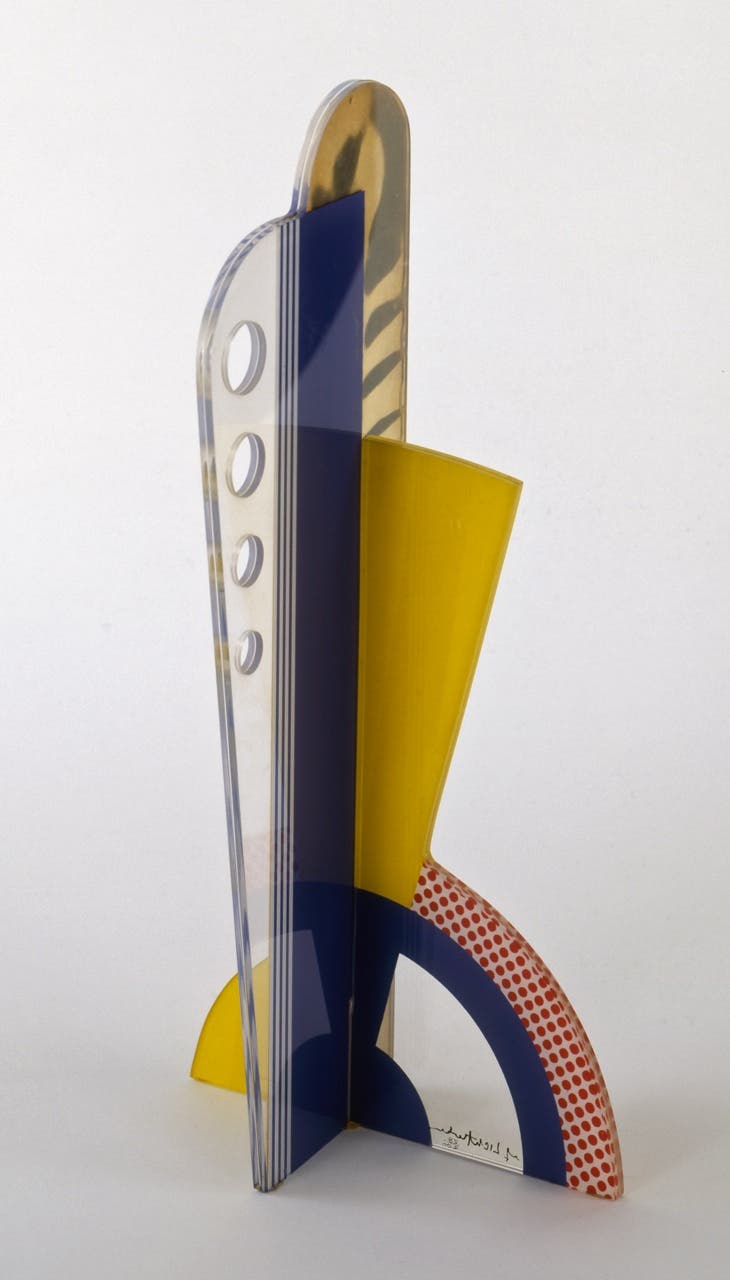
Photo credit: Roy Lichtenstein, “Modern Sculpture with Apertures,” 1967, Plexiglas with foil and painted paper, 28 from an edition of 200, Gift of Roy R. Neuberger, c. Estate of Roy Lichtenstein.
In the 1967 film The Graduate, Mr. McGuire dispenses fatherly advice to recent college graduate Benjamin Braddock. “ I want to say one word to you, Benjamin. Just one word. Are you listening? Plastics! There’s a great future in plastics. Think about it. Will you think about it?”
He did. So did many of America’s artists, who, fascinated by the technology, seized on its potential and incorporated the material into their work as technological and commercial developments in plastics flourished.
Find out what's happening in Tarrytown-Sleepy Hollowfor free with the latest updates from Patch.
Plastic was malleable, thin, translucent, lightweight, and could be stitched together or spliced, glued, melted, colored, and molded. For artists and designers, plastic in all its forms promised the possibility of creating unprecedented forms. At the same time, as it became the “material of modernity,” plastic was embraced as a vehicle to comment on ideas about disposability, as society began to use synthetics for everyday objects and then just throw them away.
So, whether encouraged by industry, or responding to behavior, or just excited by plastic’s inherent qualities, artists created works that showcased the medium’s diverse, expressive, and complex qualities.
Find out what's happening in Tarrytown-Sleepy Hollowfor free with the latest updates from Patch.
Between May 9 and September 20, 2015, the Neuberger Museum of Art will present Plastic: Art in an Era of Material Innovation, an exhibition drawn from the Museum’s permanent collection of more than thirty works dating from the late 1950s to the early 1970s that were fabricated from, epoxy, Plexiglas, polyester resin, polyurethane, vinyl and other synthetics by approximately 20 artists including Roy Lichtenstein, Andy Warhol, Louise Nevelson, LeRoy Lamis, and Robert Rauschenberg. The styles range from Conceptualism and Minimalism to Op and Pop Art, and illustrate artists’ fascination with new materials and their desire to comment on its implications.
“Spanning the dominant art movements of the mid-twentieth century, the show demonstrates the unique versatility and dominance of plastic in art at its apex,” explains Grace Converse, exhibition curator and a Neuberger Curatorial Fellow and graduate student in the Purchase College MA Program in Art History, Criticism, and Theory. “While negative connotations about plastic being a cheap medium and the use of it for that very reason are polemical, we want to embrace the negative as part of the conversation.”
During World War II, the push to create new industrial materials encouraged the chemical industry to develop new synthetic materials. “A paradigm for innovation was set: if it could be imagined, it could be created,” notes Converse. “Because artists of the time were not confined by imperatives to make better consumer or military products, they were able to more fully explore the material’s potential and question the ramifications of its use...The fact that plastic was a manifestation of chemical and technological innovation, it [became that much more] appealing to many artists. Working with the material...allowed them to participate in, reflect upon, and actively shape the course of this new technological development.”
By the 1960s, the excitement about using synthetic plastic to make art reached a fevered pitch. As artists experimented with the shapes, colors textures, dimensions, and luminosities made possible by this medium, exhibitions specifically focused on art and plastic abounded across the United States. And while certain critics hesitated in celebrating the use of synthetic materials, artists explored its exceptional properties and the plastics industry press, exhibition catalogues, and curators touted the value of artists’ experiments. Geometric works, for example, called attention to the unique properties of the material and in Pop art conventional connotations of it as cheap, disposable, mass-produced, and commonplace contributed to the overall message communicated by the work.
Plastic: Art in an Era of Material Innovation revisits plastic as a curatorial theme. “Exhibiting these works today provides an experiential means to understand the excitement and controversies that surrounded plastics when they were first exhibited,” says Converse. “The significance of art to and within the history of technological development is equal to the contemporaneous scientific and technological innovations themselves – and in this exhibition, they are presented as such. We can take from it many lessons on how artists and the rest of us can approach cresting waves of innovation.”
Plastic: Art in an Era of Material Innovation is organized by the Neuberger Museum of Art of Purchase College, curated by Grace Converse, a Neuberger Curatorial Fellow and graduate student in the Purchase College MA Program in Art History, Criticism, and Theory, and is overseen by Patrice Giasson, Neuberger Associate Curator of the Art of the Americas.
The following program has been planned in conjunction with the exhibition:
Saturday, May 9
Family Second Saturdays: Plastic is Art! | 1 - 4 pm
Consider how artists used plastic in the mid-twentieth century, when it was a new material. We’ll look at the work of Robert Rauschenberg and experiment with plastic art works of our own.
Family Second Saturdays feature art experiences for the whole family, with conversations and hands-on workshops. The workshops are for kids, tots to ten, accompanied by an adult.
For more information about Family Second Saturdays and other education programs, call 914-251-6110. Free admission for all program participants.
----
The Neuberger Museum of Art, Purchase College, State University of New York is the premier museum of modern, African, and contemporary art in the Westchester/Fairfield County area. An outstanding arts and education institution, the Museum was conceived wit
h the dual purpose of serving both as an important cultural resource to its regional, national, and international audiences, and as an integral part of Purchase College. Support for the Museum’s collection, exhibitions, publications, and education programs is provided by grants from public and private agencies, individual contributions, the Friends of the Neuberger Museum of Art and its Board of Directors, the Purchase College Foundation, and the State University of New York.
The Museum is located at 735 Anderson Hill Road in Purchase, N.Y. (Westchester)
914-251-6100
Museum Hours
Tuesday through Sunday, 12 noon to 5 pm
Closed Mondays and major holidays
Group tours by appointment only on Tuesdays through Fridays, 10 am to 12 noon
For persons with special needs, designated parking is available at the south end
of the Museum building. Call ahead for wheelchair accommodations.
Walk-in Public Tours
Tuesday–Friday, Gallery Talk, 1 pm
Sunday, Topic Tour, 2 pm
Sunday, Gallery Talk, 3 pm
Gallery talks offer fresh insights into the Museum’s special exhibitions and permanent collection, while Topic Tours explore different aspects of the permanent collection.
Museum Store
Open during Museum hours. The store features a broad selection of art books,
art cards, handcrafted jewelry, children’s items and one-of-a-kind limited edition gifts.
Admission
$5.00 General Public
$3.00 Seniors
Free admission for Museum members, children 12 and under, and Purchase College students, faculty, and staff
Directions
The Neuberger Museum of Art is easily accessible by car or bus, and may also be reached by Metro-North. By car: From the North or South - take the Hutchinson River Parkway to Exit 28. Head north on Lincoln Avenue to Anderson Hill Road. Turn right onto Anderson Hill Road. Left at first traffic light into Purchase College campus. From 684 - take Exit 2 South on Route 120 to Anderson Hill Road. Turn left onto Anderson Hill to 2nd traffic light. Turn left at Purchase College campus. From the East - take Route 287 (Cross Westchester Expressway) to Exit 8E. Take second left over Expressway onto Anderson Hill Road. Follow signs to SUNY Purchase.
Handicap Parking
On the Purchase College campus, park in Parking Lot #1 and proceed to the underpass at the Performing Arts Center. The handicap elevator is located across from the entrance to the Performing Arts Center. Take the elevator to the second level, then exit to the left. The entrance to the museum is located diagonally across, about a city block away.