Crime & Safety
What To Know About The UES Legionnaires' Outbreak
Health officials answered questions about the disease and when the outbreak's source would be identified at a town hall meeting.


UPPER EAST SIDE, NY — With 28 people sickened in the Upper East Side's Legionnaires' disease outbreak, city health officials spent Monday night answering residents' questions about where the bacteria may be coming from, who's most at risk and what to do if symptoms develop.
According to the latest numbers, 21 people remain hospitalized. The confirmed cases are spread across the Upper East Side ZIP codes 10028, 10128 and 10075.
During the town hall, officials from the New York City Department of Health and Mental Hygiene answered questions about how the disease spreads, who's most at risk and what Upper East Siders should know while the investigation continues.
Find out what's happening in Upper East Sidefor free with the latest updates from Patch.
Here's what health officials said residents should know.
What Is Legionnaires' Disease?
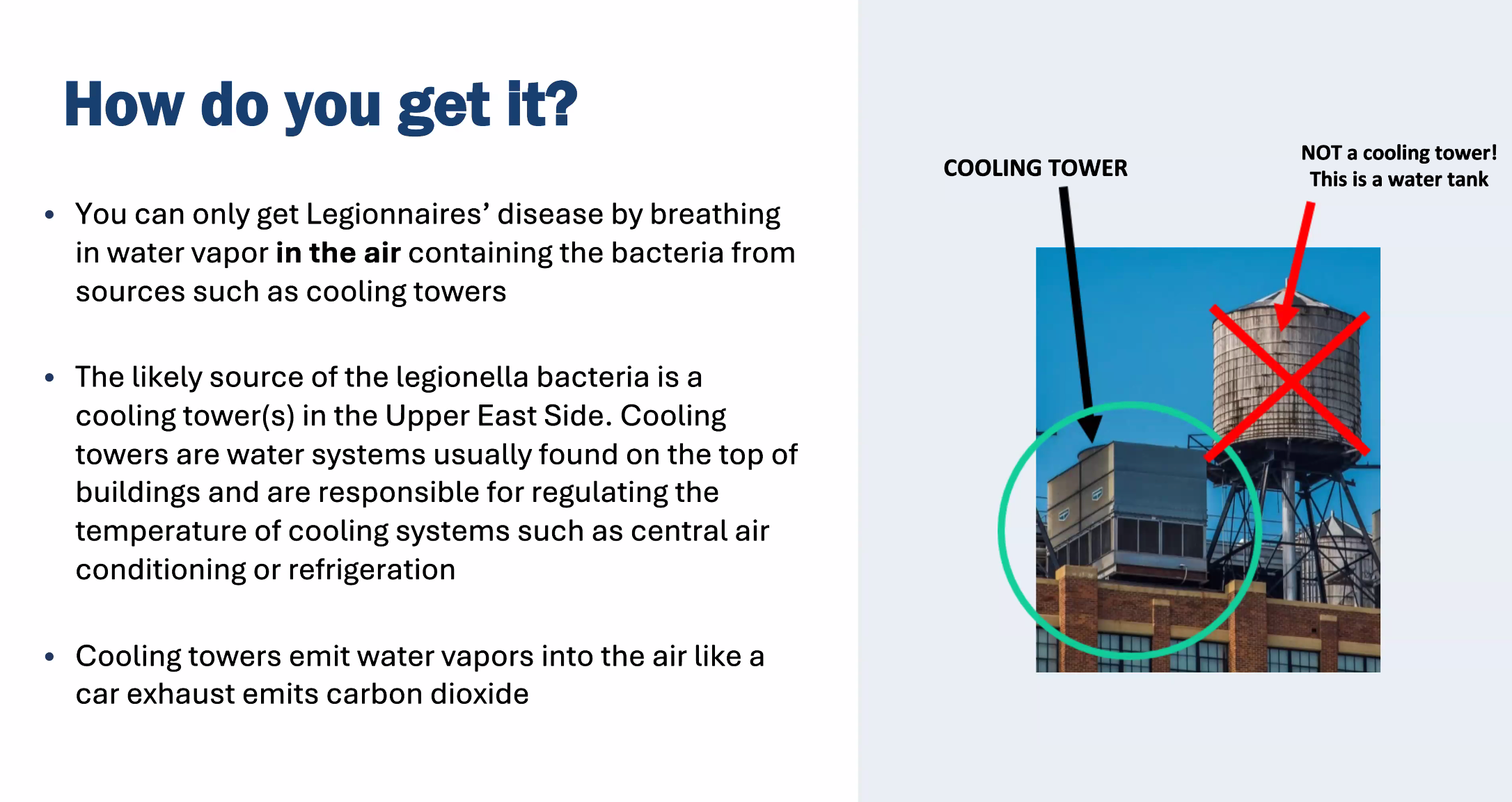
Legionnaires' disease is a type of pneumonia caused by Legionella bacteria, which thrive in humid environments such as cooling towers. Cooling towers help cool buildings by cycling warm air through water, creating conditions where the bacteria can grow.
Find out what's happening in Upper East Sidefor free with the latest updates from Patch.
Who Is Most At Risk?
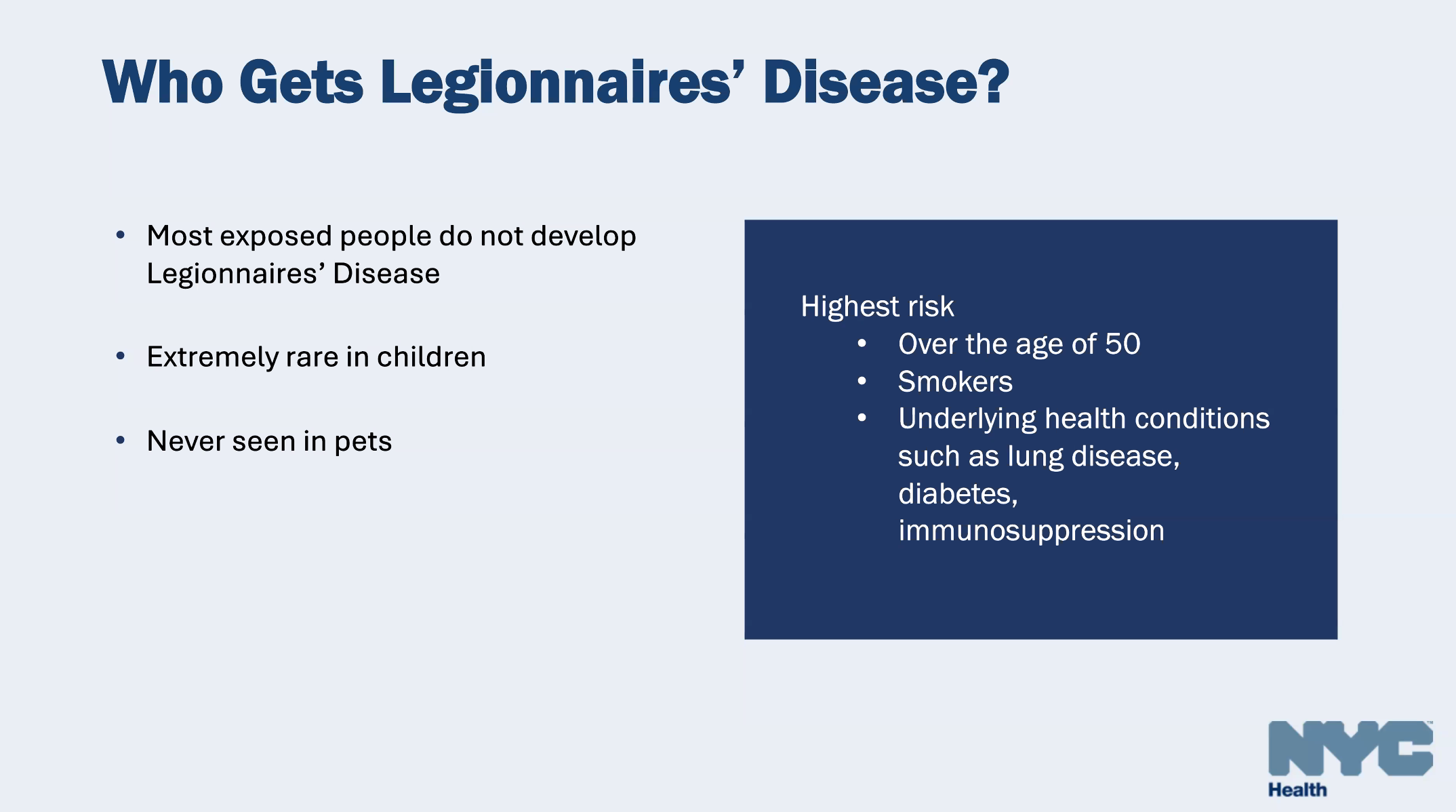
People who are 50 or older, smoke or vape, have chronic lung disease or have weakened immune systems are at the highest risk of becoming seriously ill, officials said.
In addition to residents of the three affected ZIP codes, anyone who visited the east side of Central Park between East 76th and East 97th streets since late June should monitor themselves for symptoms, officials said.
The disease is extremely rare in children, and never present in pets, health officials said.
How Does Legionnaires' Disease Spread?
The disease spreads by inhaling contaminated mist, but it does not spread from person to person, officials said.
City health officials said no special actions need to be taken, other than monitoring for symptoms.
What's Still Safe?
Drinking tap water, showering and using your air conditioner are all safe, officials said.
Health officials also said splash pads, swimming pools and playground sprinklers are safe to use.
What Are The Symptoms?
Symptoms include fever, chills, muscle aches and cough. People may also experience headaches, fatigue, loss of appetite, confusion or diarrhea.
How Can I Get Help?
Legionnaires' disease is treatable, but early detection is critical, health officials said.
"The number one thing we want people to do is to monitor their symptoms and to seek care immediately if they have symptoms suggestive of Legionnaires’ disease," Dr. Andrea Howard, Deputy Commissioner for Disease Control, said. "It is a treatable disease, and it’s important that people get evaluated by their physician and get their antibiotic as soon as possible."
To find a free or low-cost provider, call 311.
What About The New Law Mandating More Frequent Cooling Tower Checks?
The new rules, which took effect on May 8, mandate building owners to test for harmful Legionella bacteria every 31 days when the cooling tower is operating, which is three times more frequently than was previously required.
The new laws also increase fines for property owners who fail to comply with the testing schedule, health department officials said.
However, a little more than two months in, NYC Health Commissioner Dr. Alister F. Martin said the full effect of the law hasn't been felt yet.
"My hope, and my expectation, is that in the future we will see that tighter regime really make an impact, and at the same time, it’s only been about a month and a half, and so I don’t think that the full impact of that really, really important law has fully been felt yet in this," Martin said.
When Will We Know Where The Outbreak Is Coming From?
The remaining cooling towers on the Upper East Side will be tested within the next 24 hours, officials said.
It could be several weeks until the "smoking gun" is found, Martin said, but the health department will release the addresses of all the buildings whose cooling towers test positive for the Legionella bacteria, Mayor Zohran Mamdani said on Tuesday.
"When there’s a public health threat, New Yorkers deserve urgency and transparency from their government, "Mamdani said. "That’s why we’re using every tool available to protect people by moving quickly to identify potential sources of exposure, requiring immediate remediation and making sure New Yorkers have the information they need to keep themselves and their families safe."
Those buildings are ordered to immediately drain, clean and disinfect their cooling towers to reduce the risk of further exposure.
A positive test confirms that there is a presence of the bacteria in the water, but a bacterial culture test, which can take up to two weeks, will show where the actual source of the infection is coming from.
For questions, email Miranda.Levingston@Patch.com.
Get more local news delivered straight to your inbox. Sign up for free Patch newsletters and alerts.