Politics & Government
Redrawing New York
Gerrymandering is a problem. And this tool lets you see how it can affect your Congressional representation.


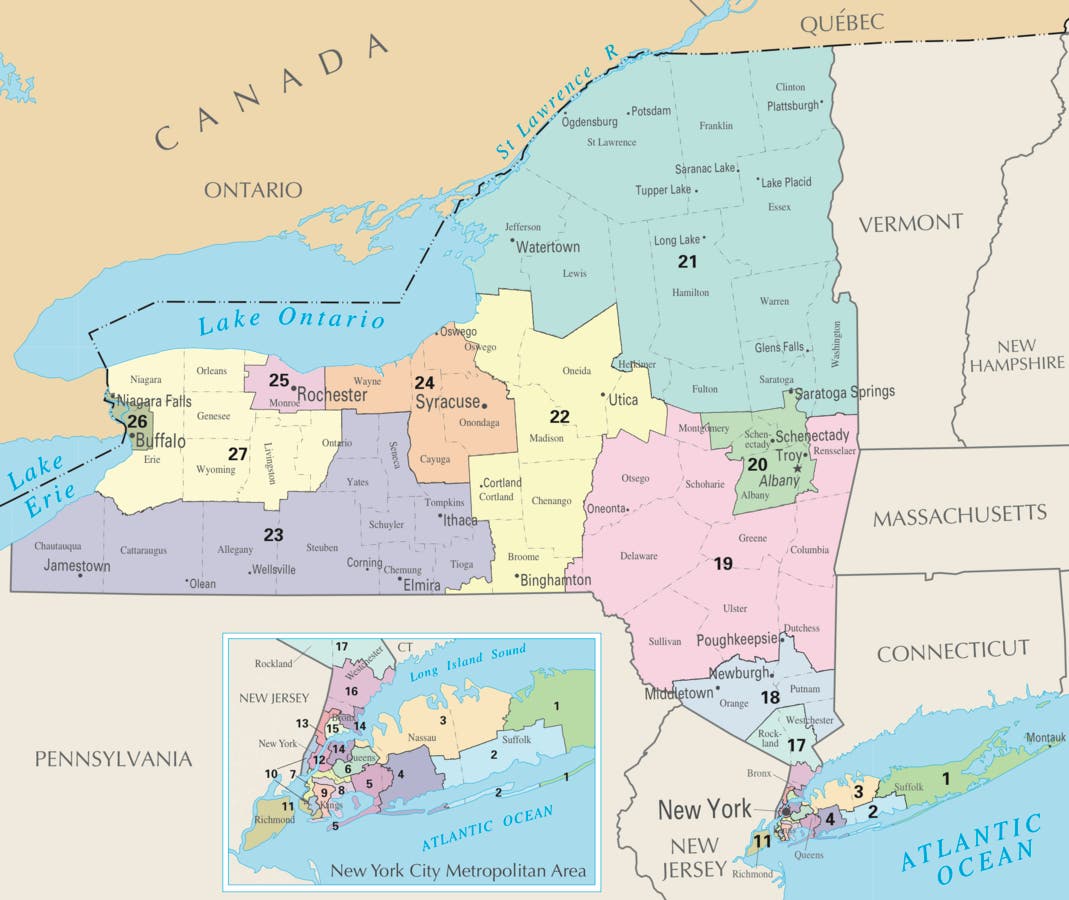
With Supreme Court and other federal court cases making headlines, gerrymandering is something that people are talking about more and more these days. It's also something that just about everyone hates. The website fivethirtyeight took an in-depth look at gerrymandering, and also at different ways to redraw Congressional districts to benefit certain parties.
So how can you redraw New York? Lots of ways, it turns out.
Every 10 years, by law, states have to redraw their Congressional districts. That is because the U.S. Census is done every 10 years, and states have to adjust the districts to better reflect the ebb and flow of people across the state. Some states with population booms may gain districts, while other states with shrinking populations lose them. And the boundaries of districts can also shift as populations change.
Find out what's happening in Wantagh-Seafordfor free with the latest updates from Patch.
Gerrymandering is what happens when that system is abused by whichever party is in power in order to keep them in power. Districts could snake through a state and connect two disparate areas that really have nothing in common, except for the fact that the majority of people in the areas vote the same way.
This is great for politicians, because it helps them guarantee their party gets more seats in elections. But it's bad for constituents, because they could wind up with a representative who lives miles away and really has no idea what's going on in their area.
Find out what's happening in Wantagh-Seafordfor free with the latest updates from Patch.
Fivethirtyeight took a look at the district maps and redrew them in many different ways. And depending which way you look at it, our state's representation could really change.
As it stands now, New York's 27 Congressional districts are pretty well-rounded. According to fivethirtyeight, there are 15 that usually go Democratic (thanks in large part to New York City), three upstate districts that usually go Republican, and the remaining 9 are competitive races, where no one party has a distinct advantage. You can see this last on Long Island, which has two Democratic and two Republican Representatives.
Each of the districts that fivethirtyeight created follow two rules: the district boundaries must be contiguous, and they must be within 1,000 people of the state's ideally sized district (which is based on the population from the last census divided by the number of districts).
But the map tool from fivethirtyeight allows you to redraw districts in a variety of ways, and for every state. You can gerrymander the state for either party (which would make 21 seats go Democratic or 11 go Republican), you can break them down to make races super competitive, and you can even make them more "naturally" follow residential boundaries.
Photo: Department of the Interior
Get more local news delivered straight to your inbox. Sign up for free Patch newsletters and alerts.