Politics & Government
Wantagh Fire Department Houses Forum on Hurricane Preparedness
Assemblyman Dave McDonough and Nassau County's Office of Emergency Management hosted a forum on hurricane and emergency preparedness.
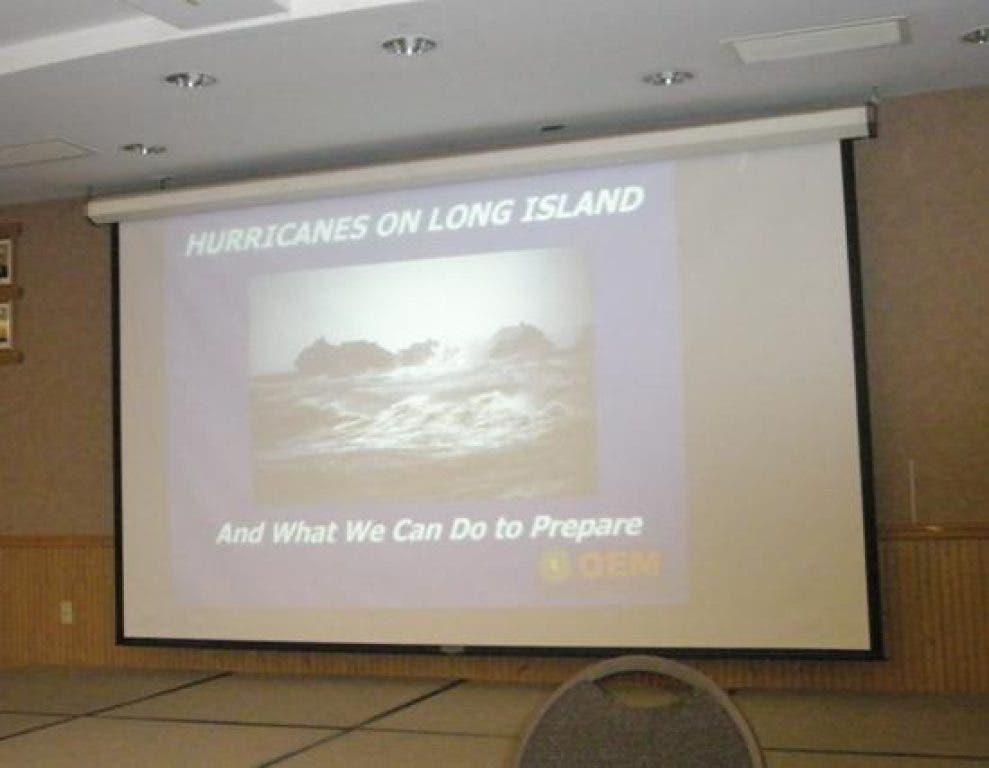


Hurricanes strike Long Island roughly every 17 years, with state officials predicting one this year.
To teach evacuation measures and safety procedures "for combatting" this natural disaster, State Assemblyman Dave McDonough, R-Merrick, hosted a hurricane preparedness forum Monday night at the headquarters.
Despite rainy weather, locals filtered in, as McDonough introduced the Office of Emergency Management (OEM) for Nassau County, represented by acting commissioner Craig Craft, and community service representative Raquel Wolf.
Find out what's happening in Wantagh-Seafordfor free with the latest updates from Patch.
“All of you have an idea of what comes with a hurricane,” Wolf said. “Once you hear from us that it’s time to go to higher ground, take it seriously… Hurricanes are categorized by the strength of their winds—a category 1 storm means a threshold of 74 miles per hour to 95 miles per hour.”
She explained that hurricanes are classified into five categories, based on sustained wind and expected amount of damage, though on Long Island, “category 3 is really what we plan for”, meaning winds of 111 miles per hour up to 130 miles per hour.
Find out what's happening in Wantagh-Seafordfor free with the latest updates from Patch.
The OEM representative recapped past hurricanes which had devastated the suburban area, including the 1938 “Long Island Express”, which altered the landscape and killed over 600 people—50 on the island alone. Then there was 1985’s Hurricane Gloria and more recently, 2010’s Nor eastern, which despite being ranked below a category 1 storm, still resulting in property damages and power outages.
Wolf warned that when hurricanes hit, storm power outages could span 30 days or longer, while water contamination is also possible.
“One of our real concerns because of our geography is storm surge,” she explained. “In a category 3 storm, water would be inundated until sunrise highway…when we talk about evacuation [that’s] everyone who lives south of Sunrise Highway.”
Wolf said that Nassau’s local government had prepared evacuation routes to help stabilize the roadways, listing Wantagh Parkway as one of the routes which are supported by emergency personnel in the event of natural disasters. In addition, the County has equipped local buildings with Red Cross supplies, designating them “hurricane relief shelters” with the total capability of holding 38,000 people.
Still, Wolf stated, there were further steps people could take to prepare themselves and others. Besides actively watching weather forecasts, she suggested maintaining relationships with “out- of- town contacts for check in”, as well as composing a list of emergency contact numbers. She added that it was useful to store items such as battery powered flash lights, matches, cash and a first aid kit. She added that it was equally important to store water and non-perishable food, as well to consider investing in flood insurance.
“Hazards come in many forms, such as storm surges, high winds, flooding and tornadoes,” McDonough reminded his audience, after thanking the OEM presenters. “Being aware of your surroundings and using common sense can avoid catastrophes.”
Those who were unable to attend the forum can view a summarized video version of the presentation online by clicking here.