Community Corner
Heart Attack On The Train: Life-Saving Work By GCT Fire Brigade
Two Westchester residents on the Fire Brigade at Grand Central were among the heroes who saved a rider's life on the New Haven Line.


It was only two minutes after the 4:45 p.m. New Haven Line train left Grand Central on July 19 that a rider knocked on the door of the head cab. Another rider had passed out, maybe had a seizure.
Conductor John O’Brien raced to assess the situation. The train’s engineer, Danielle Bonge stopped the train and called the rail control center, advising them a customer was in medical distress and that the train might have to return to the Terminal.
“When I got back to the train car, I saw a man lying in the aisle, and another customer, who identified himself as a doctor, administering CPR. The doctor told me that this man was having a heart attack,” said O’Brien.
Find out what's happening in White Plainsfor free with the latest updates from Patch.
O’Brien climbed over seats to get around and made his way to the nearest cab with a radio. He placed a second radio call to the rail control center, identifying the problem as a heart attack and confirming that the train needed to reverse back to Grand Central.
The rail control center cleared Bonge to make the move and alerted the MTAPD, EMS and the Grand Central Terminal Fire Brigade to meet the train.
Find out what's happening in White Plainsfor free with the latest updates from Patch.
Andrew Seicol, Assistant Fire Chief, GCT Fire Brigade, and James Tipa, Fire EMS Officer, GCT Fire Brigade, jumped into action. Seicol and Tipa grabbed their gear and drove one of the Brigade’s unique fleet of electric carts, customized for medical and fire emergencies, from the unit’s firehouse inside the Terminal to meet the arriving train on the platform.
Bonge saved precious seconds by stopping the train short at the Terminal to meet waiting MTAPD officers. O’Brien kept the doors closed so that medical services and the police would have a clear path to the car. Seicol and Tipa spotted the MTAPD officers on the platform, and less than three minutes after receiving the radio call, they were inside the vestibule of the train administering life-saving first aid to the customer.
Seicol began ventilations with a bag valve mask, providing the man in cardiac arrest with supplemental oxygen, while three medical professionals who happened to be on board the train continued administering CPR.
As Seicol managed the man’s breathing, Tipa applied AED (automated external defibrillator) to analyze his heart rhythm. After delivering a single jolt, and several more cycles of chest compressions, one of the assisting medical professionals located a pulse.
Then the man regained consciousness.
“It was a great outcome.” said Tipa, a Mount Kisco resident. “The man suddenly regained consciousness, and he seemed lucid and aware. The train’s engineer, the MTAPD, the good people on the train, the Fire Brigade, we all came together and averted a tragedy.”
At that point an FDNY EMS team arrived at the platform to transport him to an area hospital.
“I’ve been an EMT for eleven years and a firefighter for more than twelve years,” said Seicol, a White Plains resident who also serves as a volunteer firefighter. “I’ve responded to a number of cardiac events like this one, and this is the first one where a patient completely regained consciousness while we were still on-scene. It was great team work and a remarkable moment.”
At a recent meeting of the MTA Board’s Metro-North Railroad Committee, Metro-North Acting President Catherine Rinaldi thanked the employees for their extraordinary efforts.
“Quick access to CPR and AED often has a great influence on the outcome of incidents like this one,” said Jonathan Lee, Chief, GCT Fire Brigade, who was on the scene assisting and overseeing his crew. “Grand Central Terminal is a vast and unique building, covering over 12 city blocks above and below street level. The Brigade and MTAPD are first on the scene for emergencies at the Terminal, and we coordinate closely with FDNY so that the proper resources and personnel get to the incident location as quickly as possible.”
In 2016, the Grand Central Terminal Fire Brigade responded to 1,514 calls, and over 1,200 thus far in 2017.
“Customers, employees and visitors to Grand Central Terminal should feel assured that in the event of an emergency, Metro-North train crew members, the MTAPD and the GCT Fire Brigade stand ready to assist at a moment’s notice,” said Rinaldi. “This incident underscores the exemplary professionalism, skill and compassion of our employees. I’m proud to recognize Danielle, John, Andrew, James and Jonathan, and extend my thanks for their efforts.”
Metro North Railroad also has fire brigade units at the North White Plains, Croton-Harmon, Brewster, Stamford and New Haven train yards. These units are staffed by employees from Metro-North who hold other jobs at the railroad and participate because they care about giving back and making a difference at their workplace. All brigade members undergo intensive, initial training that involves 130 hours at one of the regional training centers for firefighting. Emergency Medical Technicians complete 175 hours of initial training, and they must recertify every three years.
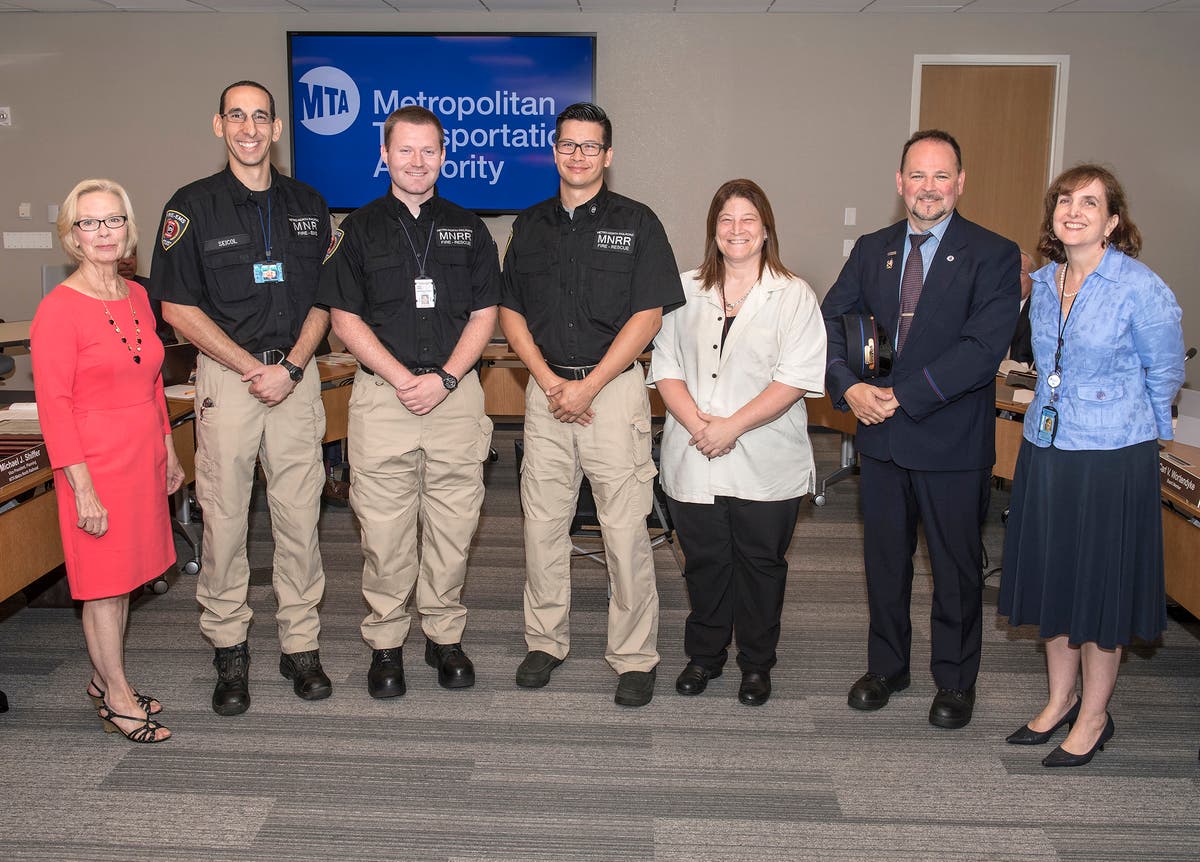
Photo caption, left to right, Susan G. Metzger, Chair Metro-North Railroad Committee; Andrew Seicol, Assistant Fire Chief, GCT Fire Brigade; James Tipa, Fire EMS Officer, GCT Fire Brigade; Danielle Bonge, Metro-North Railroad Engineer; John O'Brien, Metro-North Railroad Conductor; Catherine Rinaldi, Acting President, Metro-North Railroad/ contributed
Get more local news delivered straight to your inbox. Sign up for free Patch newsletters and alerts.