Politics & Government
Practice Makes Perfect at Public Safety Academy
White Plains Police stress the benefits of repetition.


No White Plains Police officer has discharged a firearm in the line of duty since 1993, according to Sgt. Roberto Dominguez, yet training continues year-round not just for pistols and other weapons, but also for tactical procedures. Dominguez explained to the White Plains Public Safety Citizen's Academy Tuesday, that the key is to keep officers fresh so that making good decisions in pressure situations becomes second nature.
The same is true for Emergency Medical Technicians and Paramedics, said Jozeph Salhab, a supervisor at TransCare, a private agency that provides ambulance and emergency medical services to White Plains, New Rochelle, Mount Vernon, Mount Pleasant and the Westchester Medical Center campus.
The best way to ensure that his EMT’s and Paramedics provide effective medical procedures under pressure is repetition, he told last evening’s class for the academy, a program that gives citizens a behind the scenes glimpse of the City’s fire, police and ambulance services.
Find out what's happening in White Plainsfor free with the latest updates from Patch.
Attendees at last evening’s program spent an hour with each instructor, learning about what it takes to keep officers and medical first responders on their toes and ready to efficiently handle the daily challenges of their jobs.
Salhab outlined the view from the other side of an emergency medical call to 911. In 2010, TransCare handled 6,300 calls in White Plains. By contrast, his company responded to 800 calls in Briarcliff Manor.
Find out what's happening in White Plainsfor free with the latest updates from Patch.
He outlined the certification requirements of responders, along with the regulations governing the service. According to state Department of Transportation rules, ambulances cannot go wherever they want when their sirens are blaring.
“In the old days, it was like the Wild West, but now we have strict rules,” he said. Ambulances are equipped with drive cameras and telemetry machines so that the route taken to every call can be retraced.
The technicians operate under strict guidelines form doctors as to how to treat certain medial and trauma conditions. EMT’s provide basic life support while Paramedics provide advanced life support functions.
Practice makes perfect, said Salhab, noting that the hectic call schedule in White Plains kept the skills of medical responders fresh. He told about how he practiced inserting breathing tubes in operating rooms, “one after the other.” He even practiced on animals, especially cats, since their air passage is similar to that of children.
“If you don’t practice these skills, you start to forget them,” he said. “The governing bodies stay on top of us to make sure we train and retrain.”
He offered interesting insights into the limitations of GPS for emergency responders (they’re great for finding a restaurant, but they don’t tell you if there’s construction blocking a route) along with the hazards of calling 911 from a cell phone (calls sometimes end up at police agencies many miles away from the caller’s destination and it can be difficult if not impossible for the answering department to determine the location of the call).
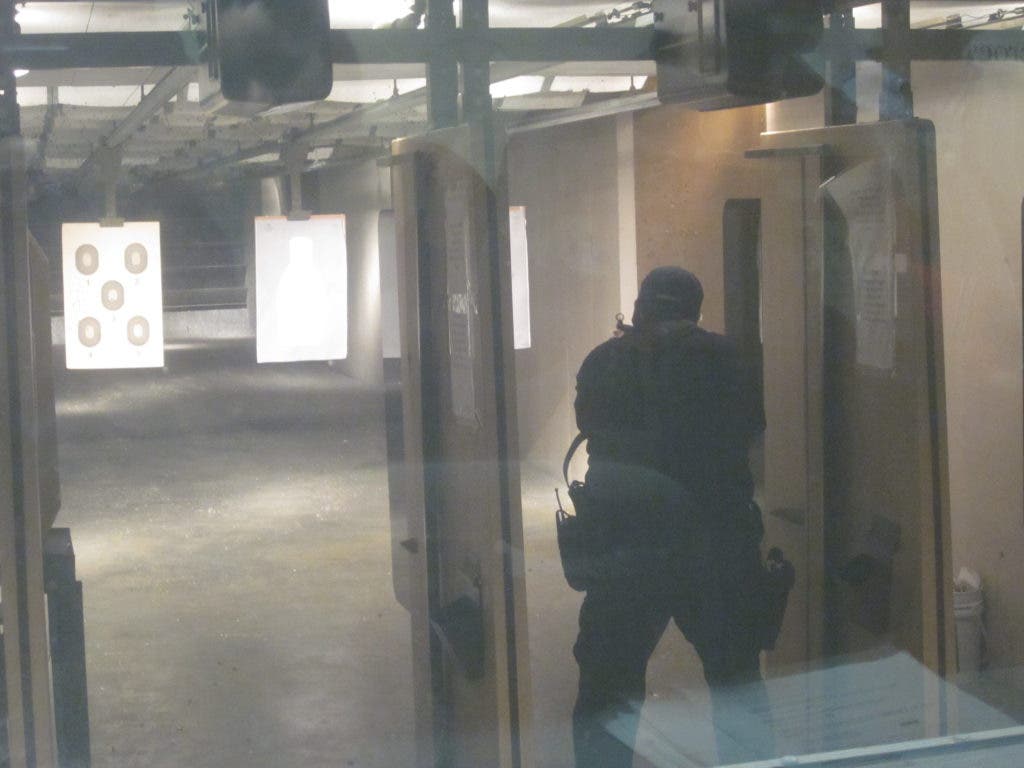
Students also got to visit the indoor firing range within the public safety building. Every officer from the chief on down is required to pass a shooting test once a year, said Sgt. Dominguez, who spoke about the pressures of police work and how important it is to have officers stay on top of their game.
“We want to make sure that no one gets stale,” he said. “When an officer stays inside for ten years or so, they don’t have a clue what’s going on outside. We need to have everyone fresh.”
That involves firing guns at the city’s outdoor range, training at Camp Smith near Peekskill and participating in exercises that are videotaped and evaluated.
Students stared as he took a submachine gun into the firing range and blew holes into a paper target hanging a few feet away. Sparks jumped out of the gun muzzle, bullet casings flew around his head and an acrid smell filled the control room.
“When split second decisions are involved, we want to make sure our officers make the right choices,” he said. The department is in line to receive a grant to institute a Reality Based Training program, which provides real world scenarios and interactions rather than shooting at static targets.
When it comes through, “we’ll pull officers off the street and have them go through different situations, including a car stop, a domestic situation and a suspicious person call,” he said.
The role play will be videotaped and “at any time we can stop it and pull the guy aside to ask ‘what were you thinking?’ so we can instruct him to transfer their skills to the street if they come across the same scenario.”
Dominguez recalled a training exercise where an officer did everything right in a particular situation, including protecting himself and reloading under pressure, though he had no recollection of what he had done.
“Officers in situations where they have to draw their guns get tunnel vision,” said Dominguez. “They tend to focus on whatever they are dealing with at the moment and it’s the repetition that’s going to stick and protect them and the public.”
Like us on Facebook (facebook.com/WhitePlainsPatch) and follow us on Twitter (twitter.com/WhtPlainsPatch)