Politics & Government
Race to cut carbon emissions outlined at Pace Energy Summit
State and local environmental leadership organizations discuss timelines and initiatives for state's plan to reduce carbon emissions
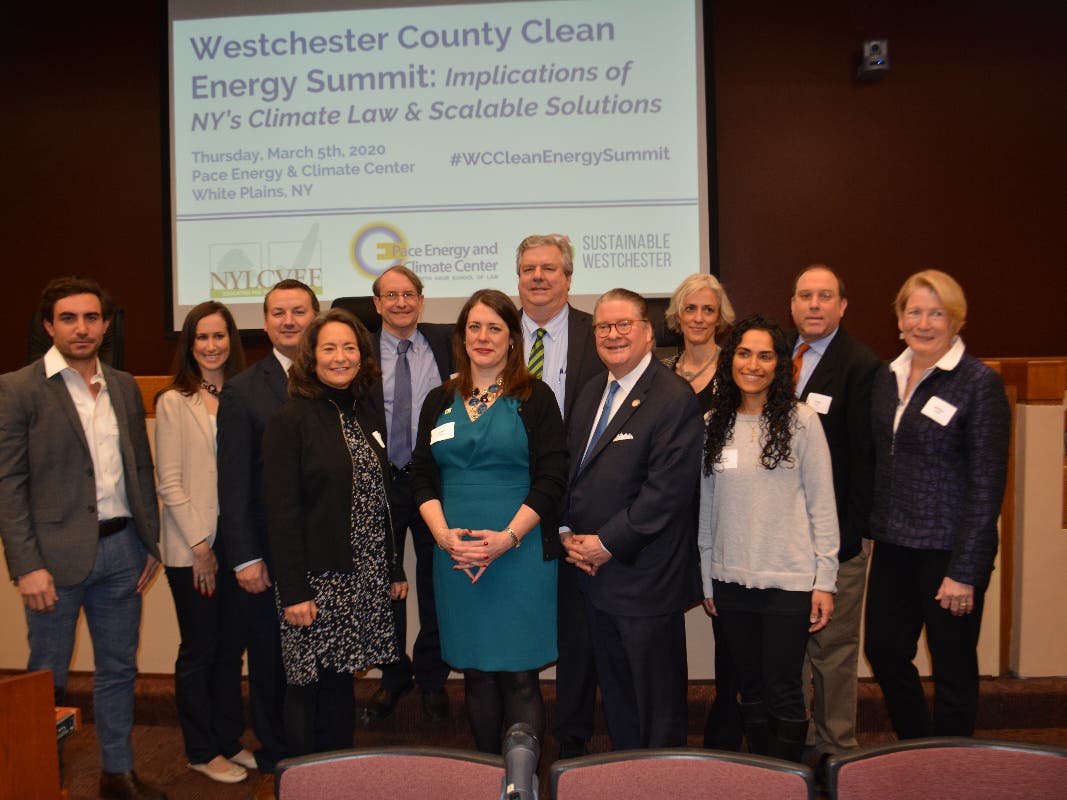

WHITE PLAINS, NY – March 2020 - The race to cut carbon emissions in time for the 2030 and 2050 deadlines set in the state’s Climate Leadership and Community Protection Act is on according to dozens of state and local officials, environmentalist and industry and energy experts who attended a conference at Pace University’s Elisabeth Haub School of Law.
Participants in two panels held on March 5 as part of the Westchester Clean Energy Summit described a flurry of activity pushing ahead the state’s law: from public hearings set for a scoping plan that will lay out actions and timetables to dozens of local initiatives to bolster renewable energy. The law passed in June will require a 40 percent reduction in emissions by 2030 and an 85 percent reduction by 2050.
The Pace Energy and Climate Center at the Elisabeth Haub School of Law at Pace University sponsored the summit in partnership with the New York League of Conservation Voters and Sustainable Westchester. The Elisabeth Haub School of Law at Pace University has been ranked #1 Environmental Law program by US News and World Report.
Find out what's happening in White Plainsfor free with the latest updates from Patch.
“Climate change is the most pressing issue of our time,’’ said the program’s moderator Julie Tighe, President of the New York League of Conservation Voters. “New York is moving full speed ahead because we know that climate change is an issue we need to take the lead on.’’
New York State Senator Peter Harckham, who co-sponsored New York’s Climate Leadership and Community Protection Act, opened the program, said the closing of the Indian Point nuclear power plants has put Westchester in the unique position to be a test case for future closings of fossil fuel plants. “A just transition as we change these plants is going to be very important to protect our communities and protect our workers,’’ he said.
Find out what's happening in White Plainsfor free with the latest updates from Patch.
Justice was also discussed in relation to communities that have been historically left behind or adversely affected by pollution due to unfair environmental policies. That is why it is so important for everyone to be involved in the process, said Kara Allen, senior advisor, policy and regulatory affairs for New York State Energy Research and Development Authority (NYSERDA).
Allen said advisory panels representing different areas of expertise would be providing recommendations on what should be included in a scoping plan, which will ultimately be the subject of regional public hearings.
Radina Valova of the Pace Energy and Climate Center spoke about the climate justice elements of the CLCPA and independent expert Anjali Sauthoff, Ph.D., spoke about climate impacts to local communities and disparity of environmental hazards.
Following the first panel discussing New York State goals, the summit’s second panel moderated by Craig Hart, Executive Director, Pace Energy and Climate Center presented technology and policy solutions appropriate to Westchester – from community aggregation of solar power to fleets of electric cars and buses – some of which are already underway in many communities.
The summit highlighted the leadership of Westchester communities in addressing climate change. Peter McCartt, Director of Energy Conservation & Sustainability, Westchester County, and Westchester County Legislator Nancy Barr said the county now has a fleet management system that has been successful in converting most vehicles in the bus system and the county fleet to electric or hybrid. They are working on a shared services program to make the purchase of these vehicles more affordable for villages and towns. County bus depots and other large properties are being assessed for solar aggregation programs. McCartt added that the county has a $30 million energy efficiency program, but there is a lot of work ahead to modernize wastewater treatment plants and other facilities whose upgrade has been ignored in recent years.
Mamaroneck Town Supervisor Nancy Seligson, said her community has enthusiastically embraced climate actions. She described the town’s journey to modernize the Hommocks Ice Skating Rink and how the use of an energy performance contract allowed them to do this. This, she said, led to a larger green campaign to install solar panels, electric charging stations and the purchase of electric vehicles. Seligson urged other communities to rely on volunteers to write grants and harness their expertise. “We did it,’’ she said. “You can do this.”
Other speakers included:
- Vennela Yadhati of the New York Power Authority and Nina Orville, Director of Solar Programs, Sustainable Westchester, spoke about how site limitations, local regulations and cost have limited the number of individual homeowners’ ability to install solar panels.
- Michel Delafontaine of Sustainable Westchester, and Brad Tito, Program Manager for Communities and Local Governments, NYSERDA, spoke about the potential for community choice aggregation to scale up renewable energy to support New York decarbonize its power supply.
- NYSERDA’s Marilyn Dare spoke about New York’s stretch code solutions driving technology adoption for emissions reductions beyond national codes and standards.
- Ryan Boniello, Operation & Sales, Boniello Development talked about how his company has built a housing development in Somers that relies on underground heat pumps for heating and cooling.
- The Pace Energy and Climate Center, which operates the U.S. Department of Energy’s NY/NJ CHP Technical Assistance Center, presented on combined heat and power solutions.
About the Elisabeth Haub School of Law at Pace University: Pace University’s Elisabeth Haub School of Law (Pace Law) offers J.D. and Masters of Law degrees in both Environmental and International Law, as well as a Doctor of Juridical Science (SJD) in Environmental Law. The school, housed on the University’s campus in White Plains, NY, opened its doors in 1976 and has over 8,500 alumni around the world. The school maintains a unique philosophy and approach to legal education that strikes an important balance between practice and theory.
The Elisabeth Haub School of Law at Pace University launched its Environmental Law Program in 1978; it has long been ranked among the world’s leading university programs. Pace’s doctoral graduates teach environmental law at universities around the world. Pace’s J.D. alumni are prominent in environmental law firms, agencies and non-profit organizations across the U.S. and abroad. In 2016, the Law School received a transformational gift from the family of Elisabeth Haub, in recognition of its outstanding environmental law programs. For more information visit http://law.pace.edu.
The Pace Energy and Climate Center is a project of the Elisabeth Haub School of Law at Pace University. As a non-partisan legal and policy think tank, Pace develops cost-effective solutions to complex energy and climate challenges, seeking to positively transform the way society supplies and consumes energy. For more than thirty years, Pace has been providing legal, policy, and stakeholder engagement leadership in New York, the Northeast, and other jurisdictions.
About Pace University: Pace University has a proud history of preparing its diverse student body for a lifetime of professional success as a result of its unique program that combines rigorous academics and real-world experiences. Pace is ranked the #1 private, four-year college in the nation for upward economic mobility by Harvard University’s Opportunity Insights, evidence of the transformative education the University provides.
From its beginnings as an accounting school in 1906, Pace has grown to three campuses, enrolling 13,000 students in bachelor’s, master’s, and doctoral programs in more than 150 majors and programs, across a range of disciplines: arts, sciences, business, health care, technology, law, education, and more. The university also has one of the most competitive performing arts programs in the country. Pace has a signature, newly renovated campus in New York City, located in the heart of vibrant Lower Manhattan, next to Wall Street and City Hall, and two campuses in Westchester County, New York: a 200-acre picturesque Pleasantville Campus and a Law School in White Plains.