Neighbor News
White Plains Hospital Unveils New Simulation Lab To Advance State of the Art Medicine in the Community
Unique Inter-professional Simulations Promote Teamwork and Communication to Solve And Treat Most Difficult, Complex Cases

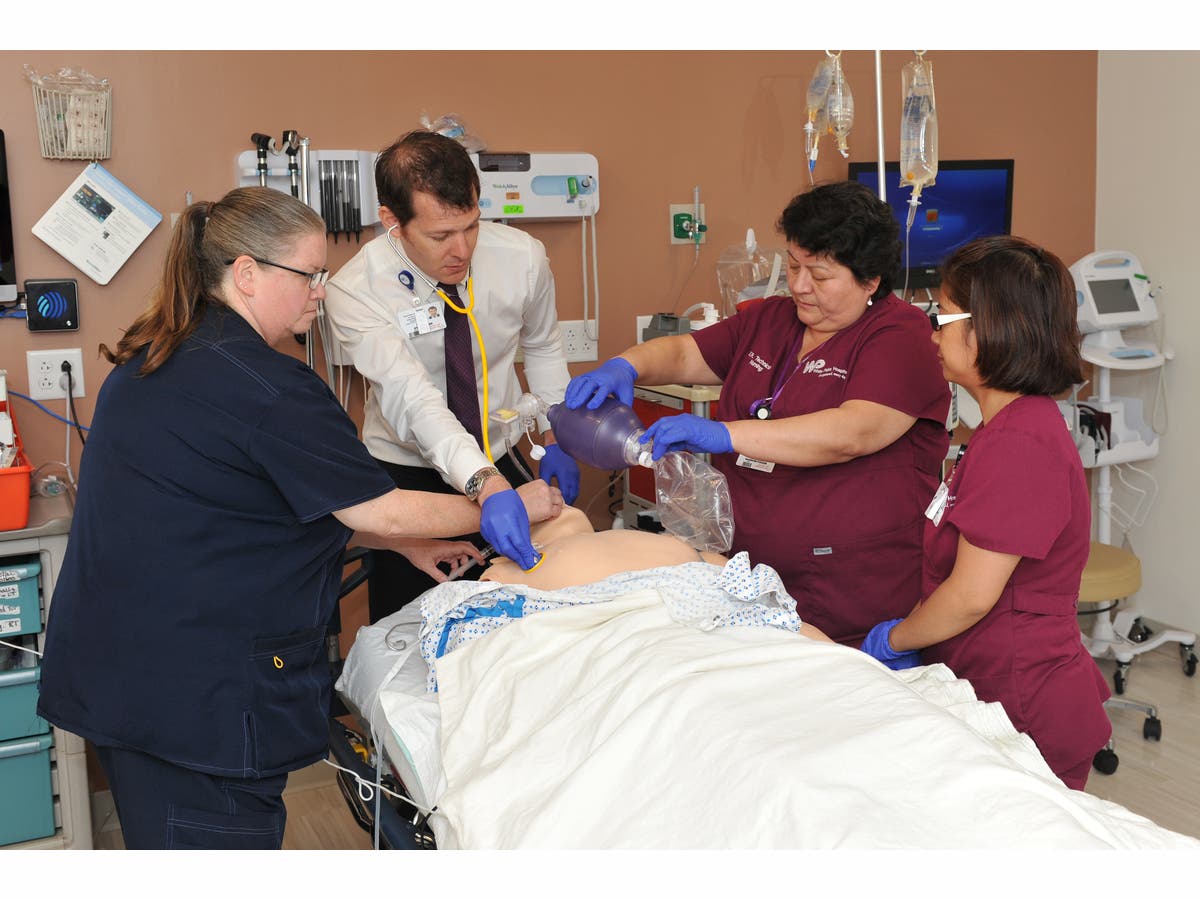
The “patient” exhibits an exceptionally high fever and is lethargic and unresponsive. Concerned family members try to recall and relay vital information. Meanwhile, the patient’s blood pressure drops as the medical team races to save his life.
This scene plays out in emergency departments across the country every day. But today, at White Plains Hospital, this scene is playing out at the hospital’s new state of the art simulation lab. As a professional team of physicians, nurses, and nursing technicians work frantically to diagnose and treat the “patient” – in this case, a high tech mannequin—they are perfecting a critical element of emergency care: this medical team is honing its teamwork and communication.
“Most simulation labs at teaching hospitals are used to train one group—whether its physicians or nurses,” says Farrukh Jafri, MD RDMS, Assistant Director of Education and Simulation in the Emergency Department of White Plains Hospital, which has the busiest emergency department in Westchester County. “But, what we’re doing at White Plains Hospital is bringing our full staff together to run high-risk scenarios that are about more than just the medicine. They focus on how we can better work together to advance outcomes.”
Find out what's happening in White Plainsfor free with the latest updates from Patch.
According to Dr. Jafri, communication is vital to emergency care. “In a busy emergency department, things move quickly,” he says. “The most important aspect of these simulations is when we step back afterwards and talk about how we performed as a team. It creates a constant process of improvement that’s crucial to providing the best care to the community.”
White Plains Hospital first unveiled its new simulation lab in May 2017 to run procedural modules for high risk, low frequency procedures, such as intubating difficult airways, central venous access insertion, and chest tube placement. Dr. Jafri, along with a collaborative of Physicians and Nurses including Rafael Torres, MD, medical director of Emergency Medicine, Dean Straff, MD, Associate Director, Doreen Mirante, Clinical Nurse Educator and Ertha Small-Nicolas, Nurse Manager, decided to employ the lab’s state of the art technology in a novel way—to recreate the most challenging emergency scenarios and engage providers and nurses at all levels in the sessions.
Find out what's happening in White Plainsfor free with the latest updates from Patch.
Through this collaborative, a group of 5-6 staff members that would reflect a typical ER team—physicians, nurses, physician’s assistants, and nursing technicians—is enlisted for each simulation. The team is sent an online module to review in advance. Then, they run through a case featuring volunteers who act as concerned family members and a high fidelity mannequin “patient” that can bleed, sweat, and communicate. The mannequin’s gender can be adapted and its vital signs can change abruptly. As the team performs the simulation, high definition video and audio records the session. At the conclusion, they all meet in an adjacent conference room to “debrief” and discuss the session.
“Because we are working with high level staff and state of the art technology, we can make these cases very difficult and complex. The twists and turns are important because the team has to react and communicate in real time,” notes Dr. Jafri. But it’s the debrief after that’s the crux of it,” he says. “You don’t get that luxury in real life scenarios. Through the simulation and the debrief, the simulation lab provides a safe space for staff to hone their skills and focus on improved communication. This gives all levels of the care team the opportunity to speak up and be proactive in patient care and safety.”
Simulation courses will run at least four times a month and will include full day sessions. The pilot session, starting in July, will focus on sepsis and will involve teams from the emergency department. In the future, simulations will be offered to teams throughout the hospital.
The simulation lab will also advance medical education among pre-med students. Drs. Jafri, Torres, and Straff are Assistant Professors at Albert Einstein School of Medicine and will use the lab to teach students to conduct physical evaluations of patients. In addition, the lab will be utilized for a college student intern program, and will eventually offer community lifesaving courses, such as pediatric life support and the Stop the Bleed campaign.