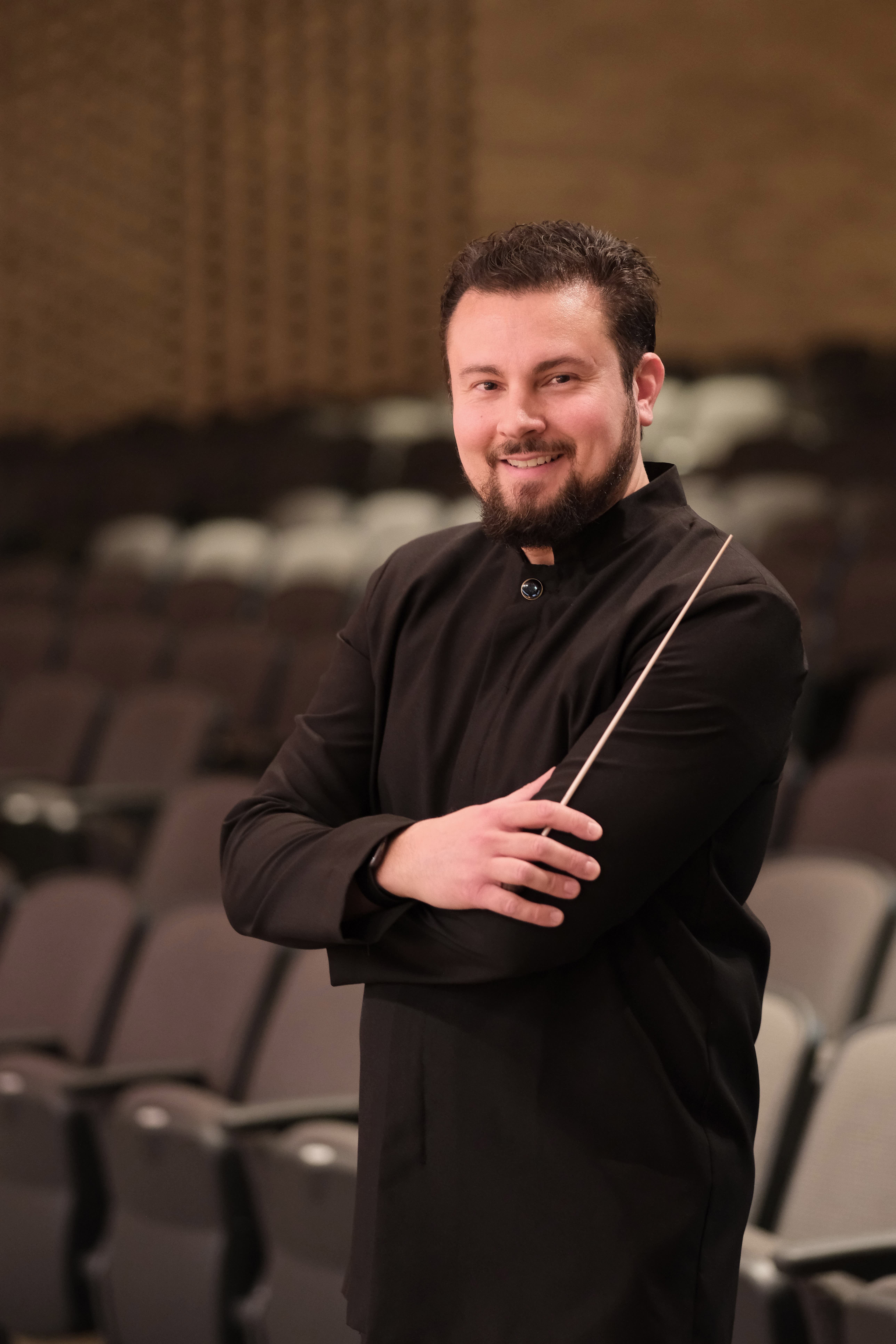
"Celebrating American Music" Travis Jürgens, Music Director Soloists: Emily Cornelius, violin, Ross Karre, percussion Music Director Travis Jürgens serves as Director of Music Ministry at Saint Ambrose Catholic Parish and as Music Director of the fully professional Perrysburg Symphony Orchestra. He won 2nd Prize and the President of the Jury Award at the 2019 Bucharest Music Institute International Conducting Competition. He has collaborated with esteemed conductors, including Michael Tilson Thomas and Marin Alsop. He has been praised as “a superior conductor” and “well on his way to becoming a major conductor in the world of symphony orchestras” (Opus Colorado). Amy Marcy Cheney Beach – Summer Dreams, Op. 47 Amy Marcy Cheney Beach was an American composer and pianist. She was the first successful American female composer of large-scale art music.She was one of the first American composers of her era to succeed without the benefit of European training and was known as one of the most respected American composers. Summer Dreams, Op. 47 is a suite of six evocative miniatures that capture a New England summer evening: mischievous sprites, birdsong, twilight hush, chirping katydids, fairy dances, and a tender goodnight. The work reveals Beach’s gift for vivid, atmospheric character pieces—music that is lyrical, playful, delicate, and richly colored. Arvo Pärt – Frates One of the first works to come out of Arvo Pärt's now-famous “creative silence” of the mid-1970s was Fratres. Composed in 1977 it was first performed by the Estonian early music ensemble Hortus Musicus.Its melodic structure is developed by gradually adding on new extensions.From this work, originally scored for string quintet and wind quintet, have come further expressions of the material for various performing forces. The first of these offspring was a set of variations for violin and piano. Other versions have been scored for strings and percussion. for wind octet and percussion, for string quartet, and for eight cellos. The six-bar theme is repeated—with a characteristic minimalist emphasis on patterning—and moved to new tonal levels, mostly by thirds. Its melodic structure is developed by gradually adding on new extensions. Margaret Brouwer – Century’s Song Century’s Song was commissioned by the Ohio Bicentennial Commission for the ProMusica Chamber Orchestra of Columbus, Ohio to commemorate the Ohio Bicentennial. The ProMusica Chamber Orchestra of Columbus first performed it on February 23, 2003 with Timothy Russell, Music Director, conducting. A signature bicentennial event was the casting of a handmade bicentennial bell in each of Ohio’s 88 counties. The ringing of bells therefore became a prominent feature in the energetic fanfare, Centennial Bells. The second movement is a song that the composer set to a poem titled With the Lark by the African American poet from Dayton Ohio, Paul Laurence Dunbar. As requested by the Bicentennial Committee, this movement was composed for choir as well as for orchestra and can be performed by choir and orchestra together or for a cappella choir, or orchestra alone. The last movement is a lively march with occasional quotes from the Red Hill Special, a fiddle tune that can be heard on the recording, Folk Music of Ohio, 1938 through 1940. Franz Joseph Haydn – Symphony No. 99 in E-flat Major By the time Haydn wrote his Symphony No. 99, he was the most famous composer in Europe, a stature he had attained somewhat to his own surprise.In 1793, when he wrote his Symphony No. 99 in E-flat, Joseph Haydn was sixty-one and at the summit of his powers and his fame, regarded by most as the preeminent composer of his time. Haydn had not only befriended and mentored Mozart, but he also learned from him, one of the things he absorbed being an interest in the clarinet. He began with No. 99, in which for the first time he included clarinets in the winds. The reason Haydn elevated the symphony to its modern position had only partly to do with his creative ambitions. It had also to do with the setting. In the “London” symphonies we feel how close we are to Beethoven. And in that, why in his time and well into Beethoven’s time, Haydn was called “father of the symphony.” |