Politics & Government
'Tripledemic' Hammers PA Emergency Rooms, COVID Death Rate Spikes
No single virus has presented Pennsylvania with overwhelming cases this fall, but hospitals are clogged and severe cases persist.


PENNSYLVANIA — While Pennsylvania has bucked the trend of the past two years and continues to resist a fall coronavirus surge, the state's healthcare systems remain extremely stressed, according to numerous officials and medical professionals.
That's largely due to increased hospitalizations in Pennsylvania from two other viruses, in addition to COVID-19: influenza activity and respiratory syncytial virus. The "tripledemic" has led to backed up emergency rooms in Pennsylvania and around the nation.
"Boarding has become its own public health emergency," reads a letter to President Joe Biden, from more than 30 medical and public health organizations."Our nation's safety net is on the verge of breaking beyond repair; EDs (emergency departments) are gridlocked and overwhelmed with patients waiting — waiting to be seen; waiting for admission to an inpatient bed in the hospital; waiting to be transferred to psychiatric, skilled nursing, or other specialized facilities; or, waiting simply to return to their nursing home."
Find out what's happening in Across Pennsylvaniafor free with the latest updates from Patch.
The letter, dated Monday, asks the White House for a summit to coordinate immediate and longterm solutions.
Pennsylvania has just four counties in the CDC's "high" level of transmission, in which masks are recommended in indoor, public places. While there are consistent weekly fluctuations (last week, there were four), that number was as high was 14 in September. Mercer, Bradford, Sullivan, and Susquehanna are the "high" counties this week.
Find out what's happening in Across Pennsylvaniafor free with the latest updates from Patch.
The agency adopted the community-level metric — a metric based on hospitalizations and case rates — in late February. The agency updates its color-coded COVID maps each Thursday, recommending masks in counties with "high" community levels.
.png)
Mixed COVID-19 statistics
The good news, as seen plainly in the map above, is that many overall coronavirus metrics continue to trend in the right direction. Here's a look at where things stand, according to the Department of Health's Early Warning Monitoring System:
- 9,030 total new cases, a decrease from 9,576
- An incidence rate of 70.5, a decrease from 74.8
- A positivity rate of 10.4 percent, a decrease from 11.5 percent
- 1,260 average daily hospitalizations, an increase from 1,223
- 63.4 average patients on ventilators per day, an increase over 64.7
- 2.5 percent of all emergency room visits are due to COVID-19, up from 2.1 last week
Further, the New York Times coronavirus tracker notes that the state has seen a 25 percent increase in deaths from coronavirus over the past two weeks.
So while cases overall are low, severe cases requiring hospitalization and sometimes leading to death remain high, and hospitalizations and related emergency room visits have increased.
Rounding out the tripledemic: flu and RSV
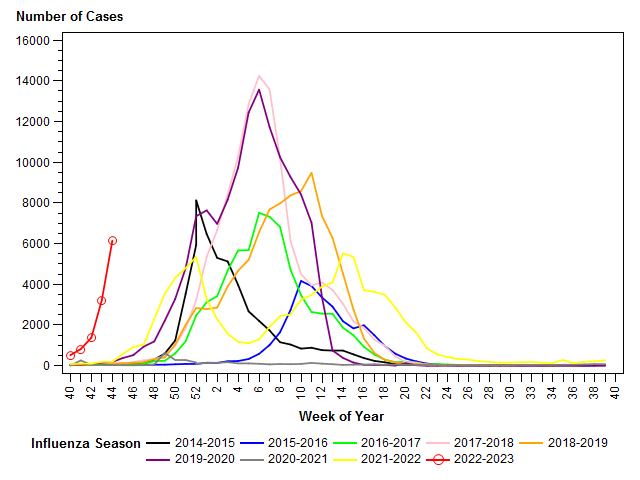
Compounding the issue, flu activity is now considered high in Pennsylvania, officials say, and much higher than normal around the country. There have been 12,065 laboratory-confirmed cases in Pennsylvania thus far this season, a number that leapt from just 1,149 on Oct. 15.
Two people have died.
While the "percent of emergency department visits associated with influenza-like illness is low," the Department of Health says, healthcare systems and officials are expressing concerns in part due to the case numbers relative to the time of year. Pennsylvania has seen exponentially more cases at this point in time as compared with any past year:
RSV, which has similar symptoms to the flu and coronavirus, can cause breathing difficulties in young children. The five week average of RSV cases in Pennsylvania have shot up from August's historically high rate of 248.333 to 403.333, according to CDC data.
While state authorities have not issued a separate warning on RSV this year, they have noted that the potential mix of multiple viruses this winter could be "severe."
At Children's Hospital of Philadelphia, beds have been near or at capacity for weeks due to the virus, the Inquirer reports.
How Pennsylvania hospitals are handling surge
Pennsylvania hospitals are faring even worse than the rest of the nation, data from Johns Hopkins University shows.
Some 79 percent of beds are taken, including 76 percent of ICU beds. Nationally, 74.4 percent of ICU beds in the U.S. have been filled, according to federal data. That includes some hospitals and healthcare systems that have been beyond capacity for months.
Overcrowding in hospitals, particularly when it leads to long waits in understaffed emergency rooms, can have devastating ripple effects throughout the system. A recent Penn State University study showed that crowded emergency departments cause "higher rates of death throughout the hospital." Any patient in a hospital on a day when the emergency room is crowded is 5.4 percent more likely to die of any cause, the study found.
“One thing is clear: emergency department crowding is a whole-hospital problem,” lead author of the study and Penn State professor of health policy and administration Charlee Hsuan said. “When policymakers and hospital administrators think about this problem, they need to consider the impacts on all patients and not just those in the emergency department. Policymakers may need to take a systems perspective on improving the quality of care in hospitals.”
With reporting from Patch correspondent Josh Bakan
Get more local news delivered straight to your inbox. Sign up for free Patch newsletters and alerts.