Politics & Government
'Use Water Wisely': Drought Watch Continues In PA
Recent rain has helped, but nearly half of Pennsylvania remains under an official drought watch. Here's what to know.


PENNSYLVANIA — Despite recent rain improving Pennsylvania's overall outlook, more than half the state continues to be under an official drought watch. Residents in the 36 counties still under the watch are asked to reduce their water use by around 5 to 10 percent, or 3 to 6 gallons a day.
The drought conditions, which have persisted for much of the summer across north central, central, and eastern Pennsylvania, are about more than just rainfall, though. The state takes stream and river flow, groundwater level, and soil moisture into account when issuing declarations, and each must maintain a delicate balance to provide both a healthy and functioning ecosystem and sustainable drinking water levels.
"We need to see continued meaningful precipitation over several months and have public water suppliers in affected counties returning to normal operations before the drought watch can be lifted,” Pennsylvania Department of Environmental Protection Acting Secretary Ramez Ziadeh said in a statement. “We ask Pennsylvanians in these counties to continue to use water wisely and follow simple water conservation tips to ease the demand for water.”
Find out what's happening in Across Pennsylvaniafor free with the latest updates from Patch.
The drought conditions are the most severe in Union, Snyder, Lycoming, and Clinton counties in central Pennsylvania, according to the U.S. Drought Monitor, which classifies parts of those counties as under "moderate drought."
However, the total portion of the state that is considered "abnormally dry" has decreased from 55.6 percent to 36.4 percent, the Monitor notes.
Find out what's happening in Across Pennsylvaniafor free with the latest updates from Patch.
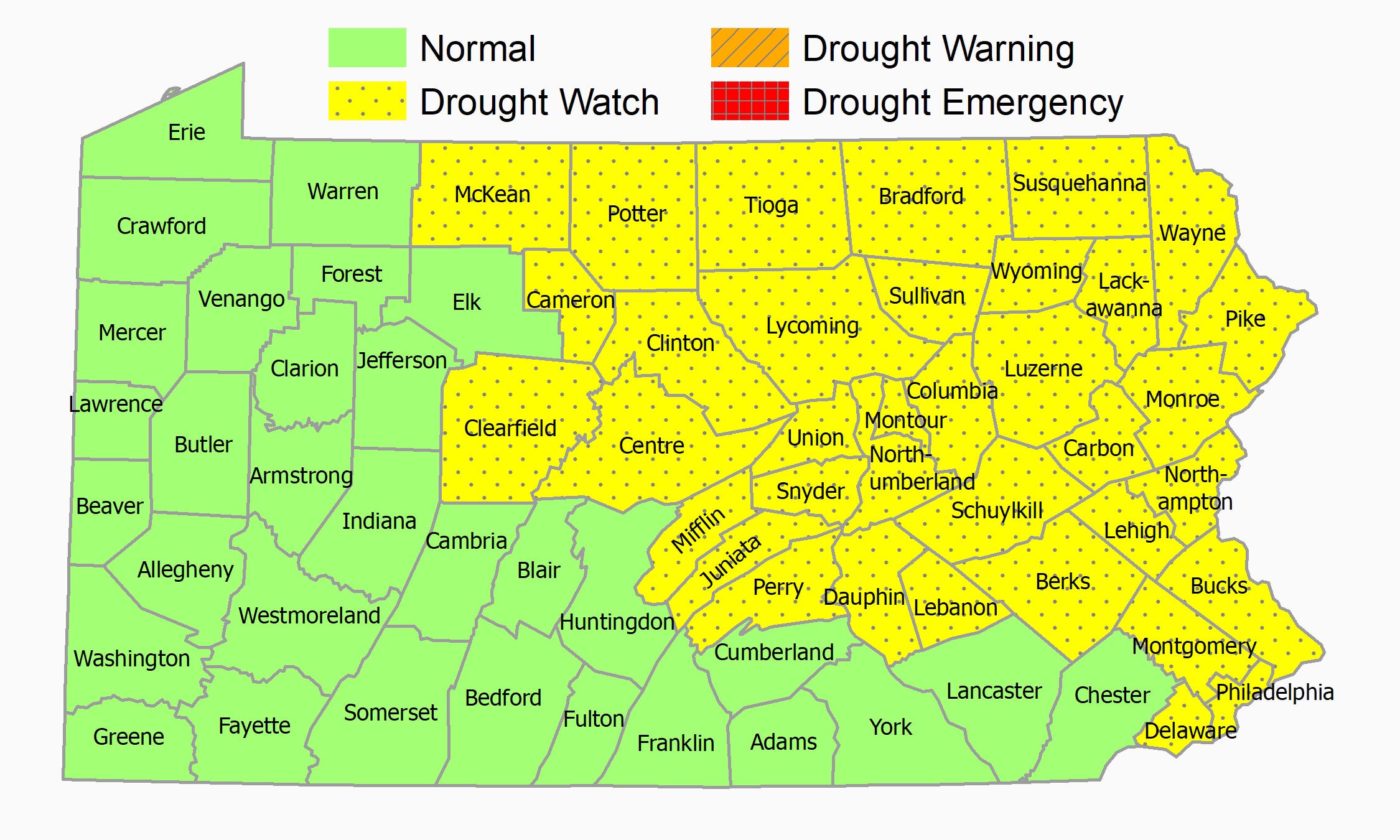
The following counties remain under a drought watch: Berks, Bucks, Bradford, Cameron, Carbon, Centre, Clearfield, Clinton, Columbia, Dauphin, Delaware, Juniata, Lackawanna, Lebanon, Lehigh, Luzerne, Lycoming, McKean, Mifflin, Monroe, Montgomery, Montour, Northampton, Northumberland, Perry, Philadelphia, Pike, Potter, Schuylkill, Snyder, Sullivan, Susquehanna, Tioga, Union, Wayne, and Wyoming.
Two of the state's water suppliers have already implemented state-mandated water restrictions. Eleven others are employing voluntary restrictions.
Climate change creates conditions that exacerbate both severe weather and drought: when things are dry, lingering heat and increased evaporation rates are likely to make them even drier. And when storms hit, they draw more moisture from a warmer ocean.
For droughts specifically, water evaporates more quickly when it's warmer. Hotter soils are drier. Drought conditions mean less greenery is growing, which means that plants are absorbing less CO2, creating a feedback loop that contributes to warming.
Get more local news delivered straight to your inbox. Sign up for free Patch newsletters and alerts.