Schools
Baldwin Hosts Science Research Symposium
Four Baldwin seniors completed graduate-level projects with their mentors.


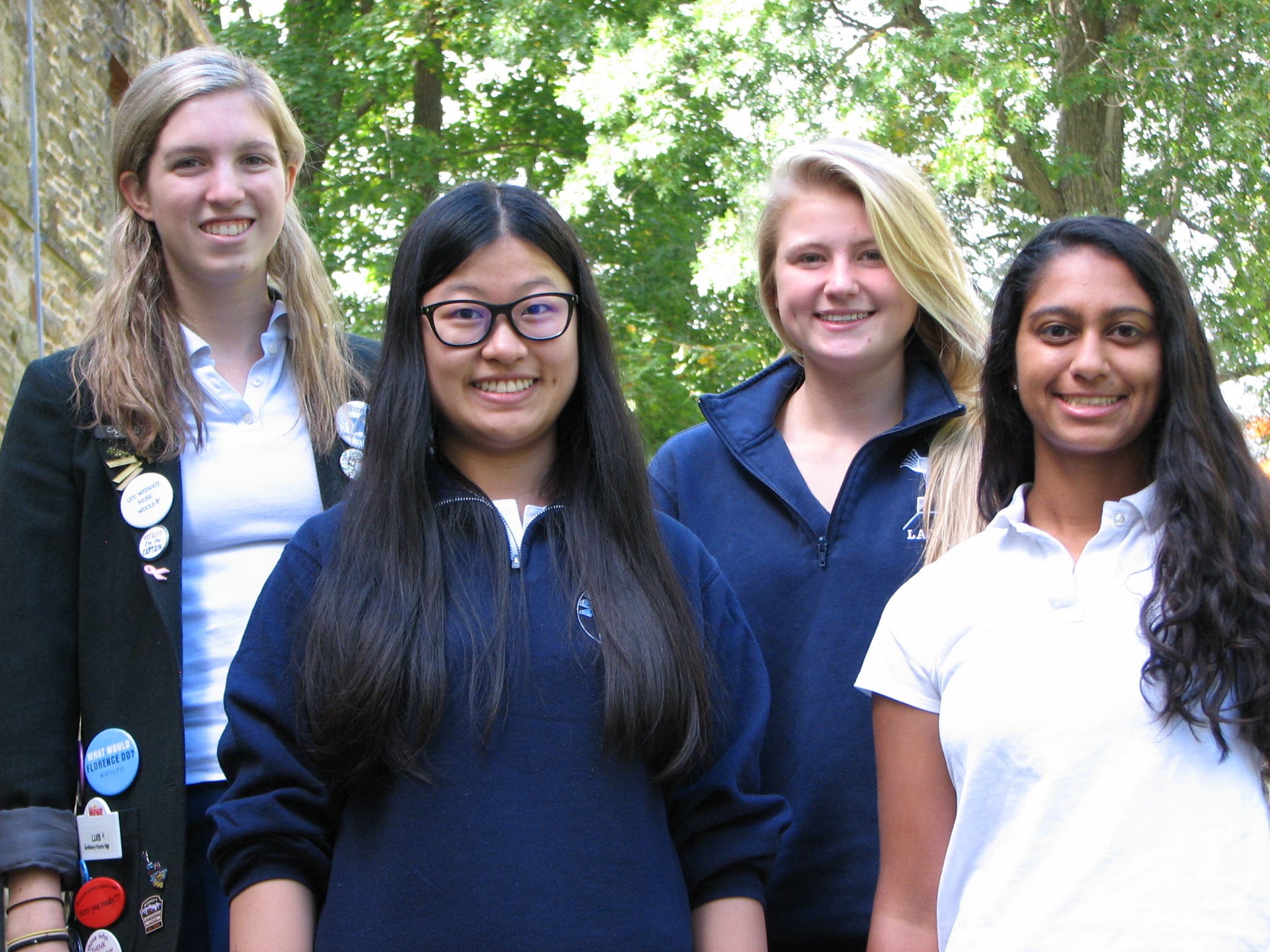
From left: Laura Noteware, Taylor Chen, Abby Andrews and Jasmine Syed. (Photo courtesy of The Baldwin School)
_____________
The following was provided to Patch by The Baldwin School:
Find out what's happening in Bryn Mawr-Gladwynefor free with the latest updates from Patch.
The Baldwin School Science Department hosted its third annual Science Student Research Symposium on Tuesday, Oct. 28. Four amazing senior scientists from the Class of 2015, Taylor Chen, Abigail Andrews, Laura Noteware, and Jasmine Syed, spent their summers in research labs at Children’s Hospital of Philadelphia (CHOP) Abramson Research Center, the University of Pennsylvania, and the Thomas Jefferson University College of Medicine.
The students put their investigative and critical thinking minds to work completing graduate-level projects with their mentors. These students have demonstrated an insatiable curiosity, an independence in completing their laboratory work, and a love of scientific learning. “It is always amazing to see the level of work and the understanding of these young scientists as they tackle potentially life-changing problems,” said Science Department Chair Christie Reed.
Find out what's happening in Bryn Mawr-Gladwynefor free with the latest updates from Patch.
The students presented their experiences and research, followed by their poster presentations.
Taylor Chen
Determining the Mechanism of Neutralization of AAV9 by Studying Anti-AAV9 Antibodies
This past summer, Taylor interned at the Gene Therapy Program of the Wilson Laboratory of The University of Pennsylvania. One big issue in gene therapy is the neutralizing antibodies generated by the immune system after the first exposure to a viral vector, which can block transgene transduction. TRIM21, an antibody receptor in humans, was found to be the potential mediator of intracellular neutralization of AAV. Taylor worked on determining the effect of TRIM21 in AAV neutralization by transfecting TRIM21 knockdown cells with AAV and anti-AAV antibodies. The goal of her research was to develop a safe and effective way to reduce the immune response towards AAV9, possibly through TRIM21 knockdown. In addition, Taylor assisted in a study validating the neutralizing effects of PAV antibodies against AAV in mice.
Abigail Andrews
Prenatal Gene Therapy
This past summer, Abigail interned at CHOP’s Center for Fetal Research under Dr. Marcus Davey. Abigail’s work focused on the concept of prenatal genetic therapy – inducing prenatal tolerance to vectors and transgenes to allow for repeated postnatal vector administration in order to ultimately correct genetic disorders. A key issue in current genetic therapy is the body’s immune response to the viral vector and transgene. In efforts to overcome this immunological barrier, the primary project investigated the possibility of inducing prenatal tolerance to the viral capsid proteins and transgene by introducing these products to the fetus during the period of fetal thymic education. Research was performed using a preclinical fetal sheep model in which the fetal sheep were tolerized to the viral vectors and then immunologically challenged with these viruses after birth. Immune response was assayed via ELISA assays and postmortem organ analysis. Additionally, Abigail assisted in an ongoing study seeking to create an artificial placenta for premature neonates.
Laura Noteware
The Therapeutic Efficacy of the MUC1 Promoter Region in Driving DTA
This past summer, Laura interned at the Brody Lab at the Thomas Jefferson University College of Medicine. The primary focus of the lab is finding novel therapeutic strategies for pancreatic cancer patients. Laura worked on creating reagents for a DNA delivery therapy that was being developed in the lab. This involved creating two plasmids: one with a MUC1 promoter and a GFP insert and one with a CAG promoter and a DTA insert. Her reagents were then used to test the therapeutic efficacy of the MUC1 promoter region in driving the diphtheria toxin A to bring about cell apoptosis. Additionally, Laura developed and executed a trial on phenformin, a potentially therapeutic drug currently used in treating type II diabetes.
Jasmine Syed
The Effect of the ARV1 Gene on Sphingolipids
This past summer, Jasmine was a summer researcher in the Rader Lab in the Cardiovascular department of the University of Pennsylvania. Her research was focused on the study of the ARV1 gene in wildtype and knockout mice and its effect on sphingolipids. She tested mouse tissue samples from the brain, kidneys and testes, as well as mouse plasma for various sphingolipids such as sphingomyelin and gangliosides. The goal of her project was to determine if the unexpected mouse phenotype of knockout mice was due to a change in sphingolipid metabolism. The importance of this research was to further determine how the ARV1 gene functions and how its deletion is linked to heart disease.
Get more local news delivered straight to your inbox. Sign up for free Patch newsletters and alerts.