Community Corner
Historic Gladwyne Home Evokes Fond Memories, Sadness
Former residents reminisce about a Monk Road home that has been approved for demolition.
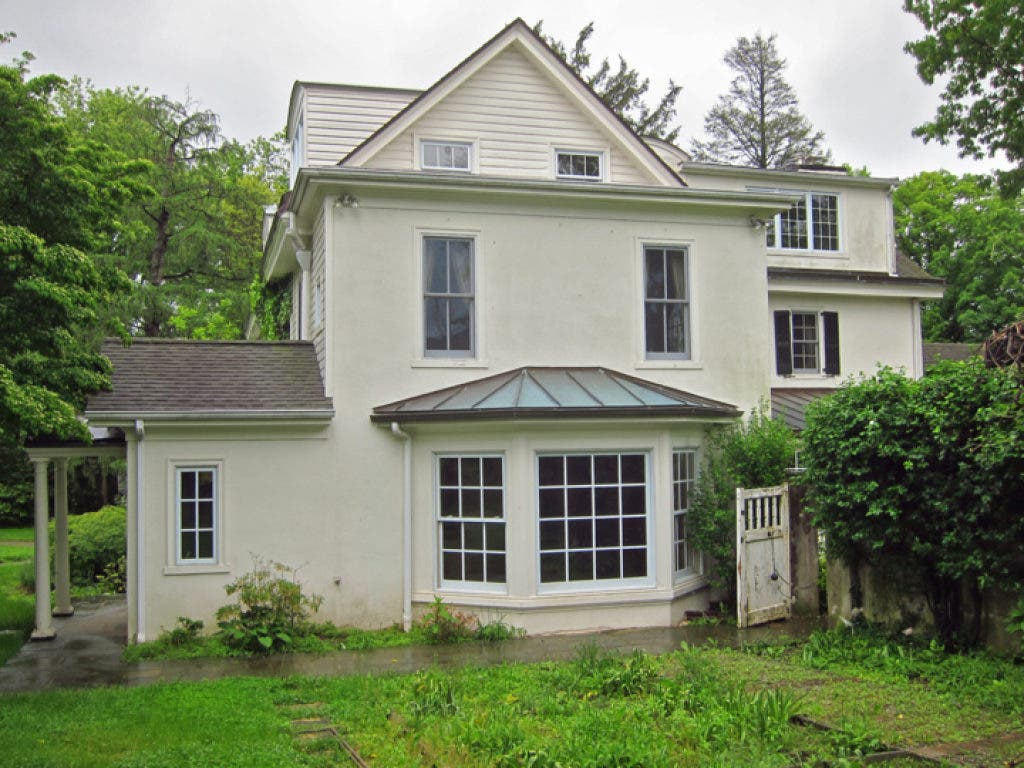


For Marty Gwinn and Nancy Huggins, their childhood home in Gladwyne evokes fond memories of farming, horse shows and family parties, as well as historic tales about the pre-revolutionary home which their parents lovingly renovated in the 1940s.
So Gwinn, 61, of Malibu, Calif., and Huggins, 69, of Concord, Mass., said they were saddened when they recently learned of the demolition of the home at 1316 Monk Road, which they grew up in along with their two older brothers.
“I felt saddened, and I felt it had just been a wonderful place to grow up,” Huggins said. “My parents were full of life and full of fun.”
Find out what's happening in Bryn Mawr-Gladwynefor free with the latest updates from Patch.
Though the Lower Merion Township Board of Commissioners expressed reservations, last month they unanimously approved James and Michele Tornetta’s request to tear down the main house, an addition to the stable and the pool house.
James Tornetta said in a phone interview with Bryn Mawr-Gladwyne Patch that he and his wife Michele purchased the property with the initial intent to restore the house.
Find out what's happening in Bryn Mawr-Gladwynefor free with the latest updates from Patch.
But after the Tornettas signed the purchase and sales agreement, they found “there’s really nothing worth saving,” in the home and renovating it would be cost prohibitive, said James Tornetta of Haverford.
Gwinn and Huggins said they both learned of the demolition plans from a .
“When I first saw it, it did make me sad,” Gwinn said. “As a historical house and keeping it, my mother predicted, before she died, it was going to be torn down.”
Gwinn thinks her mother predicted this because the home “is not an architectural gem” although, Gwinn said, it easily could be made into one.
“Frankly, anyone with a real imagination could turn it into something extraordinary,” Gwinn said. “Tearing it down sounds like a tremendous waste…”
James Tornetta—who currently resides in a Haverford home which is in a Lower Merion Township historic district and was restored by him and his wife—said the Monk Road house has renovations and additions made in the 1960s, 70s and 80s.
“Not only were they out of character with the old house…There was really no old-house charm left,” said James Tornetta, who also said he has restored an old twin house in Haverford Township which he uses as a rental property, as well as an old home in Lower Merion Township’s Rosemont neighborhood.
Tornetta said other problems with the Monk Road house include water damage to the floor joists and evidence of termite infestation.
But for Gwinn and Huggins, the home is full of history and fond memories.
The historic house at 1316 Monk Road was built in 1890, according to the Lower Merion Historical Society.
The house’s original Welsh name was “Diarffordd,” meaning off the beaten track, Huggins said.
Among the historic tales about the home, Gwinn said she has been told that there is a cannonball lodged in a wall.
“I never saw it, but there was a cannonball stuck in the wall of the kitchen,” Gwinn said.
The l in Bryn Mawr once divided the house into a two-family house and used it as a caretakers’ house,” where two caretakers and their families lived, Gwinn said.
At that time, the land was known as the Shipley farm, where the Shipley School grew all the food that was served to the students at the school in Bryn Mawr, Huggins said.
Gwinn and Huggins’ parents, the late David and Betty Gwinn, bought the house at 1316 Monk Road in 1942, Huggins said.
The couple paid some $12,000 to $13,000 for the house, the barn and nearly 13 acres of land, Marty Gwinn said.
At the time of the sale, it was a “derelict house,” in poor condition, Marty Gwinn said.
“My grandparents were appalled,” Marty Gwinn said. “They didn’t want my parents to buy the thing.”
Nonetheless, David and Betty Gwinn bought the house and set about renovating it.
Huggins said her parents moved into the house shortly after she was born.
“My dad built the carriage house and added stalls onto the original barn,” Marty Gwinn said.
The home was converted back into a warm, one-family home; Betty Gwinn planted what Huggins described as “incredible gardens,” which were featured on many garden tours, and David Gwinn established a horse farm and a working farm on the land, Marty Gwinn and Huggins said.
“They proceeded to make it absolutely beautiful,” Marty Gwinn said. “They worked very hard on the inside and the outside.”
Befitting the home’s name, the property was off the beaten track at the time, because, Huggins said, it was surrounded by fields and open land.
Since Gladwyne does not have a train station like many other communities along the Main Line, “it made it even more remote in those days,” Huggins said.
An avid horseman, David Gwinn kept work horses, pleasure horses and hunting horses on the land, Marty Gwinn said.
“The passion of his life was his horses,” Marty Gwinn said.
“A really big event every year was the Bridlewild (Trails) Horse Show,” which the Gwinns hosted on their land, drawing people from all over, Marty Gwinn said.
The founder of the Bridlewild Trails Association, David Gwinn “went on a trail ride, if he could, every day before work,” Marty Gwinn said.
David Gwinn made his livelihood as the founder and owner of the now-defunct Pennbrook Milk Company, a bottling and distribution company, which distributed milk, cottage cheese, buttermilk and iced tea throughout Philadelphia and the Main Line, Marty Gwinn said.
Marty Gwinn said her father’s clients included the Annenbergs and TV Guide, universities, large supermarkets and small convenience stores.
The Monk Road property also had a working farm, Marty Gwinn said.
Marty Gwinn said her sister has a photograph of her dad and brothers plowing a field outside their home with two work horses.
Marty Gwinn and Huggins recalled that as children they had chickens, dogs and cats, and the house was often filled with friends.
“It was just a wonderful, lively household,” Huggins said.
Their parents also enjoyed hosting parties, the sisters said.
Marty Gwinn said her mother would host sit-down dinners for 50 to 60 people outdoors in the garden, with linens on tables and candelabras.
Marty Gwinn said another old photograph of 1316 Monk Road shows someone bringing a pony inside the house for a party.
“There was a kind of creative wildness at times, and I really appreciated that,” Marty Gwinn said. “That kind of spirit lives on in a house like that, I think, but probably not at the moment.”
At age 23, Huggins married at her childhood home.
A dance floor for the wedding was built outside, devised so that the garden surrounded the dance floor, Huggins said.
Huggins and her husband John departed the wedding in an old horse-drawn carriage that had belonged to her grandfather, Huggins said.
“It was a wonderful wedding at home,” Huggins said.
Huggins said after she married, she returned home frequently to visit her parents.
“We had lots and lots of happy times there,” Huggins said.
Huggins could not remember the exact date her father sold the home, but she said it was a year or two after her mother died in 1991, at the age of 78.
James Tornetta said there is no date set for the demolition, but he does intend to either hold a pre-demolition sale or sell off items from the house to individuals.
Tornetta said he intends to sell old parts of the house such as a cast-iron coal-burning fire place located in the second floor, as well as newer kitchen appliances and cabinets, granite countertops and windows.
After the demolition, the Tornettas plan to build a new, one-family house for their family, James Tornetta said.
“The good news is that I’m preserving what’s left of that little farm,” James Tornetta said. “I’m not going for a subdivision. We’re not going to build a big McMansion.”