Community Corner
Fanny Says: Martin Luther King, Jr. Deserves National Memorial
The civil rights leader inspired the downfall of racial segregation.
Dear Fanny:
President Obama had been scheduled to dedicate the Martin Luther King, Jr National Memorial this Sunday, before Hurricane Irene forced it to be rescheduled. This is the 48th anniversary of the march on the nation's capital organized by the civil rights leader, who delivered his famous "I Have a Dream" speech there.
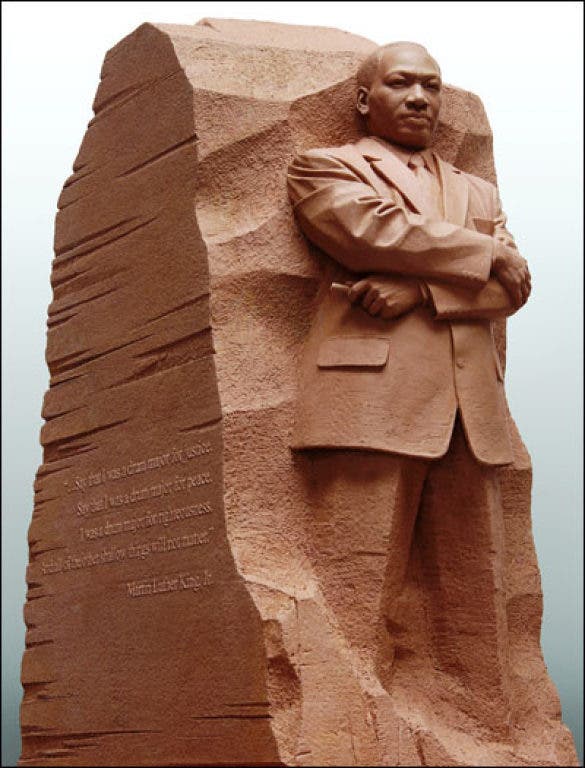
The $120 million memorial, located on the Tidal Basin between the Jefferson and Lincoln memorials, features a 30-foot-high statue of King emerging from a massive block of granite called the "Stone of Hope." To reach it, visitors walk between the two halves of the "Mountain of Despair," representing the struggles of the civil rights movement. There also is a 450-foot-long granite wall inscribed with 14 quotations from King's speeches and writings.
Find out what's happening in Doylestownfor free with the latest updates from Patch.
The sculpture has been controversial since 2007, when the memorial foundation selected a design by Chinese sculptor Lei Yixin. Critics complained about the choice of sculptor from a Communist country whose other works include monuments to China's dictator Mao Zedong, one of history's worst mass murderers.
Furthermore, critics said the sculptor made King appear angry and confrontational by depicting him standing with a stern look and his arms crossed. While two of King's three living children say they approve of their father's statue, the third was not consulted.
Find out what's happening in Doylestownfor free with the latest updates from Patch.
Besides the aesthetic objections, I question whether King deserves an individual memorial on the Mall along with presidents Washington, Jefferson, Lincoln and Franklin Roosevelt. These presidents had the ultimate responsibility for decisions that guided our nation through difficult challenges.
King certainly was the most prominent civil rights leader, but other individuals and groups played an equally important role in bringing about the demise of racial segregation. King's birthday already is a national holiday. I believe the memorial in Washington should have been designed to honor the entire civil rights movement, not just one person. What do you think?
Historically,
Sharing the Spotlight
Dear Sharing:
Adopted after the Civil War, the Fourteenth Amendment to the Constitution guaranteed equal rights to all citizens and the Fifteenth Amendment prohibited denying the right to vote on the basis of race. But these remained empty words because the federal government did nothing to stop the Southern states from blatantly depriving Negroes of equal rights and denying them the vote.
The U.S. Supreme Court's 1896 decision in favor of the "separate but equal" doctrine gave the official seal of approval to racial segregation. As history showed, separate was anything but equal.
Negroes couldn't vote, serve on juries or run for public office in the South. They were relegated to the worst jobs, the worst schools and the worst housing. Throughout the South (and some of the North), Negroes couldn't attend "white" colleges, eat in "white" restaurants, stay in "white" hotels or swim in "white" pools.
The National Association for the Advancement of Colored People was formed in 1909 to help the race cope with the onerous effects of segregation. It was the NAACP that brought the lawsuit that resulted in the U.S. Supreme Court's 1954 decision outlawing segregation in public schools.
But the Southern states weren't about to willingly dismantle segregation in schools or anywhere else. This is where King emerged as a leader who changed the course of history. His leadership of the 1955-56 boycott of the segregated buses in Montgomery, Ala., which resulted in integration of the system, brought him to national prominence.
When white racists in the South responded to Negro protests with bombings, shootings, beatings and harassment, King preached the philosophy of nonviolent resistance. If King had just given speeches, he wouldn't have had that much impact. But he literally put his life on the line.
When Time magazine named King "Man of the Year" for 1963, it called him "America's Gandhi" and noted that since 1955 he had been physically assaulted three times, his home had been bombed three times and he had been jailed 14 times.
"It is with this inner strength, tenaciously rooted in Christian concepts, that King has made himself the unchallenged voice of the Negro people--and the disquieting conscience of the whites. That voice in turn has infused the Negroes themselves with the fiber that gives their revolution its true stature," the magazine wrote.
King's tragic assassination in 1968 did not end the civil rights movement, which was not dependent on just one man. Certainly, many men and women other than King played key roles in fighting racial segregation and seeking equality.
King remains the foremost symbol of the struggle for civil rights and deserves a memorial in his name. Perhaps his greatest legacy is that the monument will be dedicated by the nation's first black president, an achievement that would have been inconceivable during King's lifetime.
Righteously,
Fanny