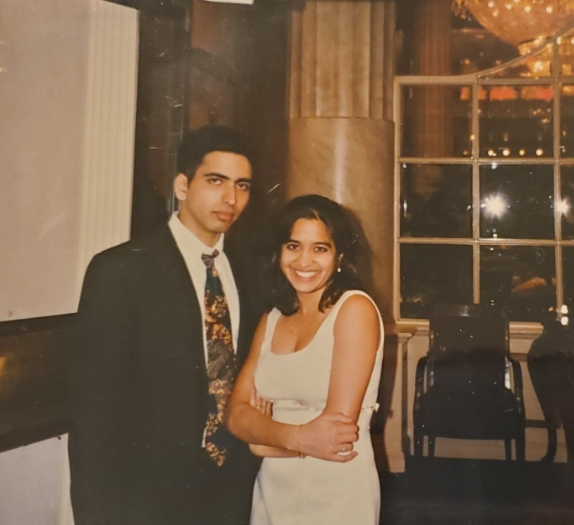
Hey yall! As you know I had a town hall last September with my friend Sal Khan who created KhanAcademy.com. You can watch a clip here: >> https://www.youtube.com/watch?v=52Qilbay5Hw << but below is my summary.
The first and most popular question of our Town Hall was: "how can parents reverse learning loss?" We gleaned numerous insights from this clip. Did you know when they matriculate, 60-70% of college bound students know math only at a 7th grade level? And btw, this predates the pandemic. Turns out, the average American kid learns 0.7 grade levels/year.
Why is this? There's a concept called mastery learning where a student is not allowed to continue to the next level of a subject until they completely understand the current level. The opposite of that is how I did it growing up which was: you take a test, and maybe you get a 70% on it. So there are clear gaps in your knowledge. Do you go back and work on the 30% you get wrong? No, you just go on to the next topic.
Find out what's happening in Doylestownfor free with the latest updates from Patch.
Guess what, there are holes in your knowledge, like holes in swiss cheese. And then you compound the issue by trying to build higher level concepts based on this swiss cheese foundation. At some point you just can't build on top anymore, there are just too many holes. (This is also why you shouldn't build things out of swiss cheese!)
Khan Academy's exercises do not let you proceed to the next chapter until you have mastered the ones before. They've done a ton of efficacy studies, which show that if kids put 30-60 minutes/week it accelerates them 30-50%. Parents don't have to wait, anyone can use Khan Academy. In fact when you use his free services, Sal has to go and raise more money to support it.
Find out what's happening in Doylestownfor free with the latest updates from Patch.
Sal recommends new students always start at the very beginning (1+1=2) and progress, to make sure all gaps are filled in to avoid this swiss cheese situation.
Something interesting -- Sal's been collaborating with Steven Levitt (the Freakonomics guy) on a new "Khan World School" at Arizona State University. Their preliminary data shows kids learning 2-3 grade levels/year in that model!
So practice makes perfect, but only at your learning edge. What is a learning edge? It is right at that boundary, where you are on the cusp of understanding something new. It's not something you already know, because that would be easy and boring. And not too hard that it is impossible to understand. Just right at the learning boundary.
So hopefully these tips help you and your children. I am putting more clips up at /https://www.letsgocbsd.com/kha... as I edit the videos. Good luck! :)