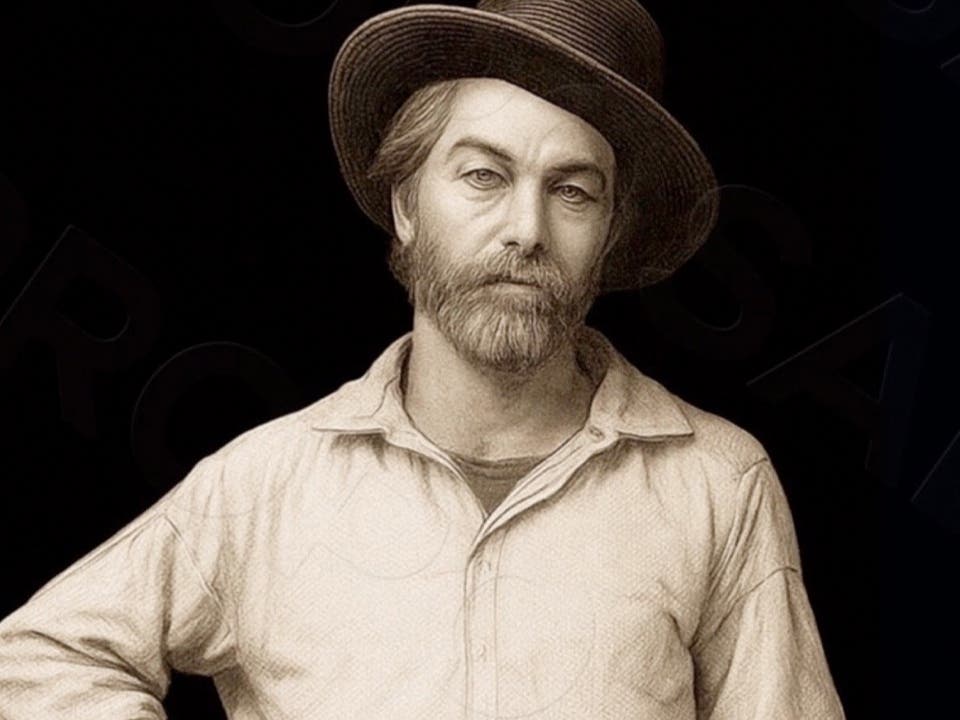

Only in recent years have biographers acknowledged that revered American poet Walt Whitman (1819-1892) lived a hidden life as a gay man. This conundrum is explored in a new novel, Whitman Days, Opium Nights: Walt Whitman’s New York, by Don Swaim, founder of the Bucks County Writers Workshop. Swaim says it wasn’t until 1997 that biographer Gary Schmidgall in Walt Whitman: A Gay Life explicitly dealt with Whitman’s homosexuality, which the poet himself never directly admitted. However, evidence of Whitman’s sexuality clearly exists in his poetry, Swaim says, which often focuses on his relationships with a circle of young men.
“American society just wasn’t ready to admit Whitman’s sexual orientation, which in retrospect now seems cowardly,” says Swaim, who several years ago covered this same theme in a Whitman-inspired short story, “Dearest Friend, Annie,” which won first-prize in the Pearl S. Buck International fiction competition.
Swaim says, “Like many admirers, I discovered Whitman during my high school years, mistakenly thinking that with its frankness and unrhymed verse it was ‘modern’ poetry. In fact, Whitman’s work has stood the test of time, and was—and is—often the model and inspiration for many of America’s finest poets.”
Find out what's happening in Doylestownfor free with the latest updates from Patch.
In Swaim’s novel, a murderous blackmailer threatens to divulge Whitman’s sexuality, which would destroy his growing career as a poet. A young department heir, who is not gay, tries to come to Whitman’s rescue, but is compromised by his own self-destructive behavior, including an addiction to opium.
The book is not exclusively about the poet. It covers a single year in New York, 1857, perhaps the most disruptive in the city’s history, as Civil War clouds grow. It is the day of Boss Tweed and his corrupt Tammany Democrats, a bloody confrontation between two competing city police departments, a deadly riot by the Dead Rabbits and the Bowery Boys street gangs, and a repressive Victorian sexuality that gives rise to the era’s most notorious real-life abortionist, Madam Restell.
Find out what's happening in Doylestownfor free with the latest updates from Patch.
Whitman Days, Opium Nights is not Swaim’s first book to deal with historical themes and figures.
“Even before I began the Bucks County Writers Workshop in 1998,” he says, “my first novel, set in 1948, addressed the acerbic author H.L. Mencken. Similar books followed, focusing on Ambrose Bierce, the Jazz Age and the Great Depression.”
Swaim says he enjoys the challenge of historical research and the effort to breathe new life to figures who have played roles, large or small, in America’s past.
“When you think about it,” Swaim says, “outside of fantasy and science fiction, all novels, by their very nature, are set in the past. The hundreds of both struggling and accomplished writers who have passed through the Bucks County Writers Workshop have explored virtually every possible theme.”
Swaim is also the co-founder of Neshaminy: The Bucks County Literary Journal.
Whitman Days, Opium Nights: Walt Whitman’s New York is published in both print and ebook by Penmore Press, and can be obtained through Amazon.com, Barnes and Noble, and other venues.