


Did you know there are 77,000 people in Homewood Cemetery? And that’s not counting the live ones who work there.
For people who grew up in these parts, Homewood Cemetery is a magical place of “firsts.” Aside from its proper utilization as a memorial park, Homewood Cemetery is a serene, sheltered tract where East Enders have gone for 133 years to do things they mightn’t have been able to do elsewhere -- first driving lesson, first nookie, first beer.
For more mature tastes, there are a great many things to do there other than being buried. Walkers, runners and cyclists eager for workouts flock to the manicured 200-acre space along Dallas and Forbes avenues on the Squirrel Hill-Point Breeze boundary.
Find out what's happening in Forest Hills-Regent Squarefor free with the latest updates from Patch.
Genealogists and historians scour the grounds, noting names and dates on tombstones and mausoleums. Researchers pore over burial records in the cemetery office, seeking clues to public health trends that reach deep into the 19th century when people tended to die of different causes than they do today.
Urban gardeners tend their squashes and legumes in a charming enclave of vegetable patches. School and social groups enjoy guided tours to learn about the history, architecture and inhabitants of the venerable burial ground.
Find out what's happening in Forest Hills-Regent Squarefor free with the latest updates from Patch.
But for most visitors it’s just a gorgeous place to visit departed loved ones and to stroll and contemplate in any weather, sheltered from the urban bustle that’s never actually more than a few hundred feet away. Here, “rest in peace” is more than a cleric’s aphorism.
Founded in 1878, the cemetery is made out of the same stuff as Frick Park, which is adjacent, just across Forbes Avenue. Its ravines, plateaus, hills, ridges and gigantic and venerable deciduous trees testify to the founders’ love of nature and conscious decision to work with her rather than bulldoze the land.
The cemetery’s archivist will show you the gorgeous old leather journals where interments have been recorded in immaculate cursive entries since the earliest days. In most instances the name, places of birth and residence, and dates of birth and death of the deceased are recorded along with their burial location within the cemetery’s dozens of distinct sections. Also recorded is place and cause of death, though many of those medical terms of mortality (grippe, consumption) now are archaic.
These records are of great interest to genealogists and scientists studying soft science like family histories and hard science like epidemiologic trends and causes of mortality in earlier times, when the city was an environmental nightmare.
The social and economic classes of those buried in Homewood are clearly demarcated. Elaborate, immense and sometimes-garish crypts dominate the landscape, but the humble burial plots of wretched orphans and forgotten war dead never are far away.
Here are Mellon, Frick, Rockwell, Hillman, Benedum, Heinz -- solid old family names of Pittsburgh. If you scout the names of streets throughout the East End, you’re likely to find a corresponding family plot at Homewood: Baum, Braddock, Solway, Negley, Welfer, Bartlett, Wilkins.
The observant stroller will find oddities like “John H. Quick, 1855-1963.” The ironically named Mr. Quick lived slowly, however, and reached 108 years of age. His wife made it to 95.
More pathetic is poor little “Ida E. Spittle, July 31 1989, December 16 1989.” Ida missed her first Fourth of July and didn’t live to see her first Christmas. She lies all alone near a wall beside Kirtland Street. It’s pretty obvious that her tombstone has slipped down the hillside over the years and that the little girl’s actual remains likely are up the hill in a group of other low-cost plots.
There’s an old guy who hobbles up there from time to time. He talks to Ida and places flags and scrounged plastic flowers on her grave beside the tiny weathered headstone. He once invested a week of his life in an internet search for Spittle family members to try to encourage them to fix up the grave. Spittles he found a’plenty and all over the U.S., but none who knew who Ida might have been and how she came to be buried in such humble circumstances.
Near the Dallas Avenue main entrance is a startling original 7-foot sculpture installed as a memorial that eerily depicts several ghostly, unsmiling heads and faces peering out of a cloud, or is it a tree or a storm?
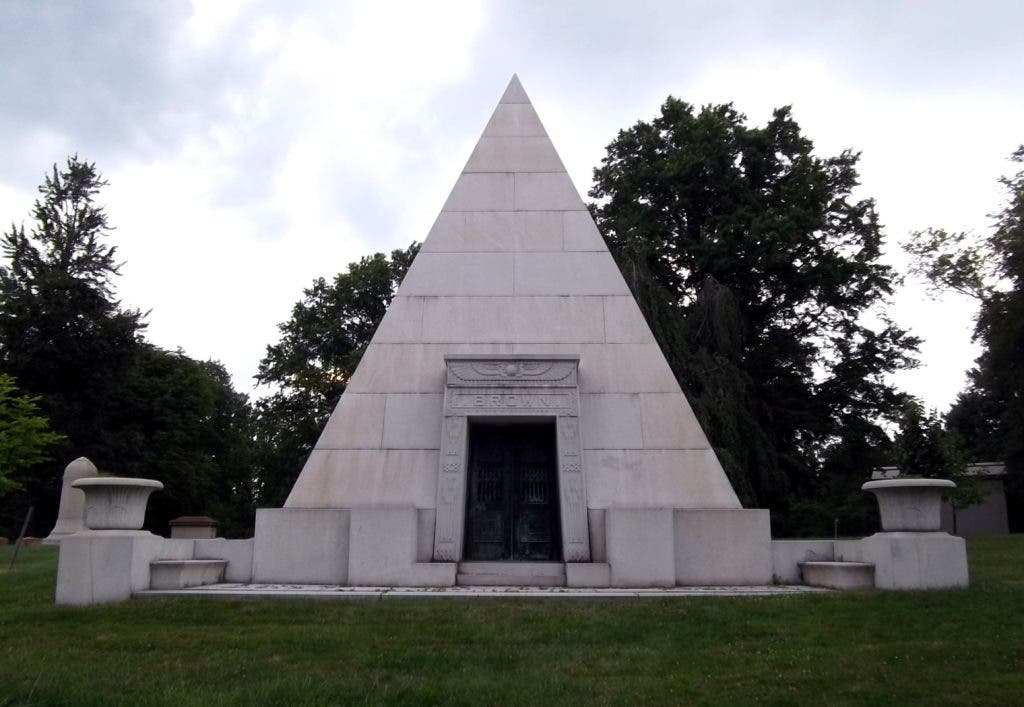
One of the most pretentious memorials is a massive replica of an Egyptian pyramid dominating the cemetery’s high-rent Section 14, just a few paces from the family crypt of H.J. Heinz. But few know the identity of “Brown,” the man who so ostentatiously memorialized himself like a pharaoh.
Research shows that he made a fortune mining coal in Fayette County and building and leasing the barges that carried coal on Pittsburgh’s rivers to be burned in the steel mills owned by the families of his cemetery-mates there in Section 14. Were these boys all members of the Duquesne Club, established in 1873?
Maybe Brown had a reincarnation plan, like the ancient Egyptians. If anybody could pull off a return to life, William Harry Brown was the guy.
Born in 1856 and interred in 1921, Harry and his brothers organized the firm of Wm. H. Brown & Sons here in 1876. In their day, they were the largest shippers of coal on the Ohio and Mississippi Rivers.
Although he died in 1921, Harry (with a businessman’s sensibility) had the pyramid erected in 1899. In life -- his first one, at least -- he spent part of his fortune touring Egypt and collecting antique treasures.
He closeted those ancient goodies in the Brown Mansion on the north bank of the Monongahela River under what is now the Homestead Grays Bridge. Eventually the great house stood in the way of what were to be the oncoming B&O Railroad tracks. So in 1903, Brown had the structure raised 160 feet up the sheer cliff and then 500 feet back from the cliff's edge. That’s where we got the names Brown’s Hill and Browns Hill Road.
In an unprecedented accomplishment, Pittsburgh’s Eichleay Engineers, Inc. moved the house intact, preserving irreplaceable murals on the interior walls. The feat attracted attention throughout the world.
Eichleay archives report: “The house was three stories high, of brick, and 44 by 85 feet in size. It sat at the base of a steep, almost precipitous incline ... Probably it had stood there for 75 years ... the house had to be torn down, or moved.
"The owner was a wealthy coal operator to whom the old residence had a great sentimental value. It had been built by his father, and [Brown] had been born and reared in it. In addition to all this, it was a fine old place. Artists had come from Europe to embellish its walls, work which of course would be destroyed forever if the old house had to come down.
"Thirty-five men worked three months in the accomplishment of that operation. The [riverbank] was somewhat irregular, receding upward in a series of roughly outlined rock ledges. We worked from ledge to ledge, first raising the house by jacks, then cribbing it up, raising and cribbing again, until, at the level of the ledge above, we were able to slip the house onto it.
"By many, this is regarded as the greatest feat of building-moving ever accomplished."
And all this in the days of ropes, pulleys and draft horses. How can Pittsburghers not know this story?
Brown and his sun-god pretension is a grand tale, but in human terms it’s no more poignant than John Quick’s or Ida Spittle’s or those of the other legions of souls interred there.
As you would expect of a place that’s been settled for more than 300 years, there are cemeteries and church yards all over the Pittsburgh region that are older and have much older burials. In Churchill and West Mifflin, for example, are graveyards holding the remains of Colonial Americans and veterans of the Revolutionary War. In Homewood Cemetery, the earliest-born appear to date from the 1790s. The first individual buried was John Marchand, age 63, interred September 19, 1878.
Homewood Community Garden, a separate organization, is located on the cemetery grounds along Forbes Avenue and has the mission of providing people with a little bit of land to grow food, flowers, and the sense of well-being that comes from nurturing growing things. The program offers 20-foot-square plots for a fee of $30 per year. Availability is limited and plots are allocated on a first-come basis.
You might puzzle about the green-ness of driving a car to plant some carrots and sunflowers, but the gardeners’ autos tend to be subcompact hatchbacks, to haul the tools.
Me, I have a personal stake in all this manicured greenery and chiseled marble. There are 10 people named McCloskey (none of them kin) buried in Homewood Cemetery, dating way back to Jennie, interred in 1902. There’s even a guy with the exact same named as me, buried in 1977 in Section 17 -- a low-cost zone in the flats above Tranquil Trail.
Unless my body is lost at sea or vaporized by war, I hope to be buried there, too, because I love the place. Some of the best parts of my life haunt the grounds.
When he was wee-little, I took my boy to play there in the evenings in the northwest corner near St. Bede’s. We would sneak through the fence and catch frisbee and football. In season, we had mock battles throwing the big green grenade-size “monkey balls” that grew on the Osage Orange trees.
The little one took a child’s impish delight in chucking the frisbee in the wrong direction then running off and hiding, giggling, behind the Katsafanas family memorial. He chose that one because, he said, he liked to say the name -- no small feat for a five-year-old with a slight lisp.
A little later, he learned to perfect his bicycle riding skills on a single-speed 16-inch Sears Free Spirit along the gently sloping and well-paved roads there in Section 27 -- safe from gravel, dogs and cars. And he never once needed the training wheels.
Eventually, Homewood Cemetery became our backyard. For a while, we owned a lovely century-old wooden home on adjacent Willard Street. Where our meager yard ended behind the house, the cemetery began. That marriage -- and our occupancy -- expired from spouse-induced sudden cardiac arrest just a few weeks after we celebrated his ninth birthday there. Second wives, I learned, can be difficult and expensive.
It took nearly five years for him and me to be able to afford move back to the neighborhood. But, ever graceful and welcoming, the cemetery was waiting. We sat on a wall in Section 18 the night he told me about his first girlfriend at Taylor Allderdice.
Those precious moments of grace are just a tiny little part of all that dwells in Homewood Cemetery -- not now present in this world, but certainly not dead.