Community Corner
Iconography for the 21st Century
Local artist Zachary Brown's first solo exhibition draws inspiration from religious icons.


Iconography is not dead.
While Christian icons have been around since the earliest days of the church, preceding the split between East and West by centuries, iconography continues to intigue contemporary artists—and not just those whose work is found in churches.
Case in point is Zach Brown's exhibit, "Home Coming," on display at Elan Gallery in Sewickley through Oct. 23.
Find out what's happening in Forest Hills-Regent Squarefor free with the latest updates from Patch.
Inspired by the religious images that surrounded him as a Catholic growing up in western Pennsylvania, Brown has blended sacred and secular, orthodox and unorthodox, Old World and New World. "I address the traditions of religious art but also push and break boundaries," he said.
"Annunciation," for example, breaks form by depicting the angel Gabriel (not Christ) offering a blessing with his left hand formed into the Greek characters iota and sigma—the first and last letters of Christ's name. Moreover, Gabriel is situated behind Mary, whereas typical icons of the Annunciation show Mary looking directly at Gabriel.
Find out what's happening in Forest Hills-Regent Squarefor free with the latest updates from Patch.
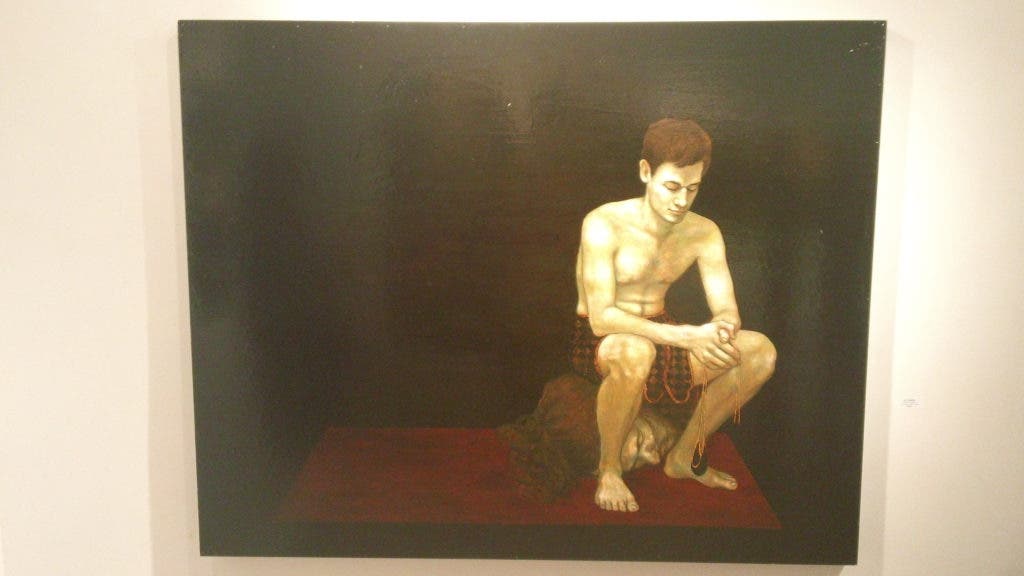
In "David and Goliath," we encounter not the triumphant David carrying the giant's head by its hair, but rather a contamplative David sitting on Goliath's head and pondering what it means to have killed a man.
Far from adhering to the two-dimensionality of Christian icons, Brown pairs in his figures flat patterns of geometric shapes with fully fleshed-out faces to create an intriguing effect not unlike pouring new wine into old wineskins.
"We as humans have a bitter struggle with duality; we are beasts of this world but our thoughts exist on a different plane apart from this world," Brown says.
Commenting on "Lucy," Brown points out that the pattern of the woman's clothing blends in with the pattern of the background, making it seem as if she has no body. For him, the painting is a meditation on human physicality: "If her body isn't there, then where is it?"
Among Brown's various depictions of female saints is a rendering of the obscure St. Casilda, who was raised as a Muslim in Toledo in the 10th and 11th centuries and now serves as an example of interfaith tolerance.
Indeed, places such as Spain and Italy (where Brown recently visited) figure prominently in some of his pieces. As he jokes, he stands in line with Spanish artists who used their girlfriends as models for St. Mary.
Brown's exhibit is clearly a visual working-out of the ancient faith of someone living in the 21st century. One piece may use metallic leaf that would seem at home in any Greek Orthodox sanctuary, while the next piece contains a shellacked helicopter seed pod or the lid of a storage trunk.
"Home Coming" is like a cross between The Mattress Factory and St. Peter's Cathedral. While a viewing of Brown's work is hardly what might be called a religious experience, one gets the sense that it either was never intended to be or, more, that it challenges the very idea of what should or should not rightly be called religious.