Community Corner
Memorial Day in the Church
Reflections on war veterans, civil religion and pastoral care.
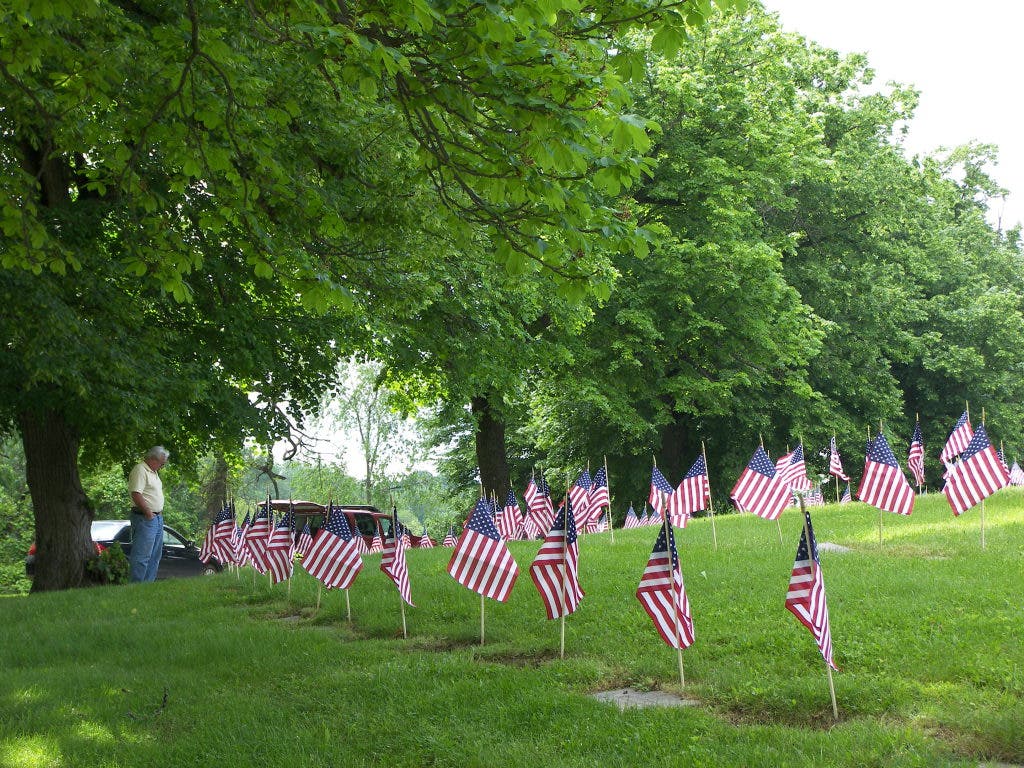


Growing up, I spent a lot of time with my grandmother in the large cemetery just up the hill from her house.
The routine never changed as she drove the circuit: visit her husband's grave, feed the geese, look for deer, tell stories about people who were buried there, and swing past the circle at the top of the hill where the war veterans monument stands, circled by hundreds of little American flags poking up from the ground.
"How many wars are represented?," she asks herself every time, but can never remember. As far back as the Revolutionary War, probably.
Find out what's happening in Forest Hills-Regent Squarefor free with the latest updates from Patch.
My grandfather, who served in World War II, is not buried on the top of the hill. But every Memorial Day, his grave has a little American flag on it, too.
If the flag of his or any of the graves has fallen down, I've been taught to pick it up so it's not touching the ground. It's about more than just respect. It's sacrosanct, like handling a religious object.
Find out what's happening in Forest Hills-Regent Squarefor free with the latest updates from Patch.
"Old glory, salute!" she says to the Stars and Stripes at the top of the pole. There's a pride and patriotism in her voice that my generation in the United States has never known. Echoes of victory gardens, food rationing, V-J Day.
As a pastor, every Memorial Day I ponder the same set of questions. Does acknowledgment of Memorial Day during a worship service move us too close to civil religion? Certainly the mission of the United States military is not the same as the mission of the church. If the reign of God encompasses all nations, should there be an American flag in our worship space? In light of the pacifist tradition in the church, should our veterans be seeking repentance instead of receiving honor for their participation in war? Is the church doing a good job of honoring peacemakers who are not involved in the military? How do I address the pastoral needs of my congregation on this civil holiday while not blurring the lines between church and state or compromising the teachings of the church?
Whatever a person's stance on war, it is obvious that wars shape people. One need only listen to a firsthand account of someone who lived through World War II, a war that touched the life of every American on the battlefield and on the home front. Wars unite or divide public opinion; they create profound bonds of friendship as well as divisions among neighbors; they lodge themselves in the minds of every soldier.
I view Memorial Day as a time to acknowledge the changes that war has brought to veterans and their loved ones. Memorial Day often evokes strong emotions of grief and loss. In the church, hawks and doves alike can come together during this time to tend to the needs of those who are grieving in our midst. Christians may disagree on the ethics of war, but the fact that we all gather under a symbol of suffering, the cross, speaks volumes about that symbol's capacity for unity.
What is the church's role on Memorial Day? I don't have all the answers, but I suspect it's the same role that the Church has always had: to affirm a God who deplores war and wages peace, to participate in each other's experiences of life and death, to bear with one another in love.
I may never feel the same way about an American flag as my grandmother does. Perhaps she and I have different reasons for making sure the flag on my grandfather's grave stands up straight. But as long as she lives, I will continue to accompany her to that sacred spot, listen to her stories, and, together with her, remember.
In the tradition of Memorial Day observances being held in civic spaces, today at 2 p.m. Homewood Cemetery will be hosting an event to honor war veterans.