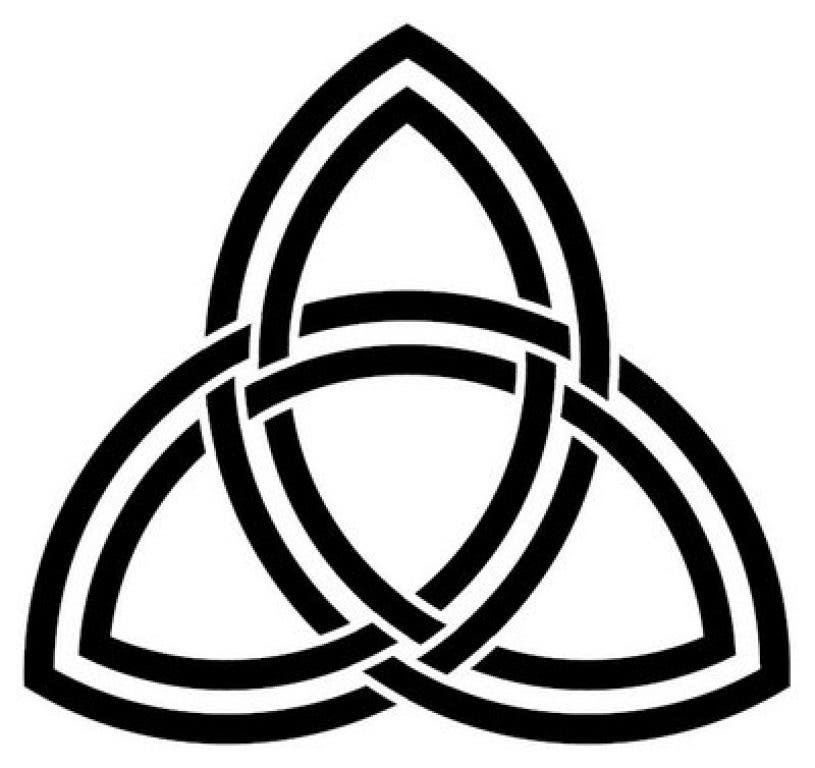
According to the church's calendar, today is Trinity Sunday. It also is Father's Day.
So, I thought it would be appropriate to consider today the church's claim that God is a father. In one of the scripture readings for Trinity Sunday, Jesus sends his disciples out into the world to baptize people, "in the name of the Father and of the Son and of the Holy Spirit."
While there are scriptural passages that are often interpreted through a trinitarian lens, including the creation story, the giving of the law at Mt. Sinai and the baptism and transfiguration of Jesus, this scene where Jesus commissions his disciples contains the most explicit reference in all of scripture to what would later develop into a doctrine of the trinity.
Find out what's happening in Forest Hills-Regent Squarefor free with the latest updates from Patch.
For many Christians, this trinitarian understanding of God is the starting point of all theological reflection, confirming the claim of the fourth century theologian Gregory Nazianzus, "When I say 'God,' I mean Father, Son and Holy Spirit." So, in trinitarian terms, "father" refers to the first person of the trinity.
But feminist theological critiques of the personhood of God have drawn attention to the deficiency of referring to God along these lines. For example, is it appropriate to refer to God with masculine pronouns when God transcends gender? Is it not more accurate to refer to God in both masculine and feminine terms, or to avoid gender restrictions by simply replacing "him" and "himself" with "God" and "Godself"?
Find out what's happening in Forest Hills-Regent Squarefor free with the latest updates from Patch.
Certainly, the imagery of God's fatherhood far outweighs the imagery of God's motherhood in scripture, although the latter is by no means absent. And Jesus himself refers repeatedly to his "Abba" or "Father," which, at the time, was an uncommon way to address God. But is this not due to the patriarchal context within which Jesus lived and the scriptures were written? While it is only hypothetical, in a different time and place Jesus may just as readily have referred to God as his mother.
I know clergy who offer blessings "in the name of God the Father, Son and Holy Spirit, Mother of us all," taking the approach that it's better to alter the traditional trinitarian formula by adding the term "Mother" than by removing anything.
Other worship leaders resolve the issue by referring to God as "creator, redeemer and sustainer." This is fine, as long as we acknowledge that these terms refer to God's work rather than God's personhood. But often this new threefold phrase becomes a replacement for "Father, Son and Holy Spirit," with the Father being the creator, the Son being the redeemer and the Holy Spirit being the sustainer.
Unfortunately, this is an inaccurate depiction of God, since all three persons of God have, in unity, been involved in every aspect of God's work. That is, the Son and the Holy Spirit are active in creation, and so forth.
Another resolution has been modeled by the 14th century mystic Julian of Norwich, who, instead of replacing "Father" with "Mother" for the first person of the trinity, uses maternal language generously when referring to God. So, for Julian, "Mother" is not a name for God but motherhood is an attribute of God. "Father," on the other hand, is a name for God, and fatherhood is also an attribute of God.
Although there are excellent reasons why Christians will not be jettisoning the term "Father" from their theological language any time soon, there are equally excellent reasons why the title "Father" and the attrubute of God's fatherhood are being tempered by newer and, I believe, more accurate renderings of God's person.
Whether we refer to God as "mother," "father," "God," or something else, one thing is for certain: the form we use to address God both reflects and shapes our understanding of God. Ultimately, we will reach the limits of human language when referring to the divine. But let this not be a cop-out for rigorous theological thought, nor an excuse to maintain the status quo. Language matters.