Community Corner
What We Believe
A conversation with Jonathan Robison, president of the Allegheny County Transit Council, about war, peace, and being a Jew-Bu-Hu.
We all believe something. Though they may not match up perfectly with any single religious tradition or worldview, we all hold personal beliefs about the big questions in life. "What We Believe" is an occasional column where I record conversations with ordinary individuals in the neighborhood about their beliefs.
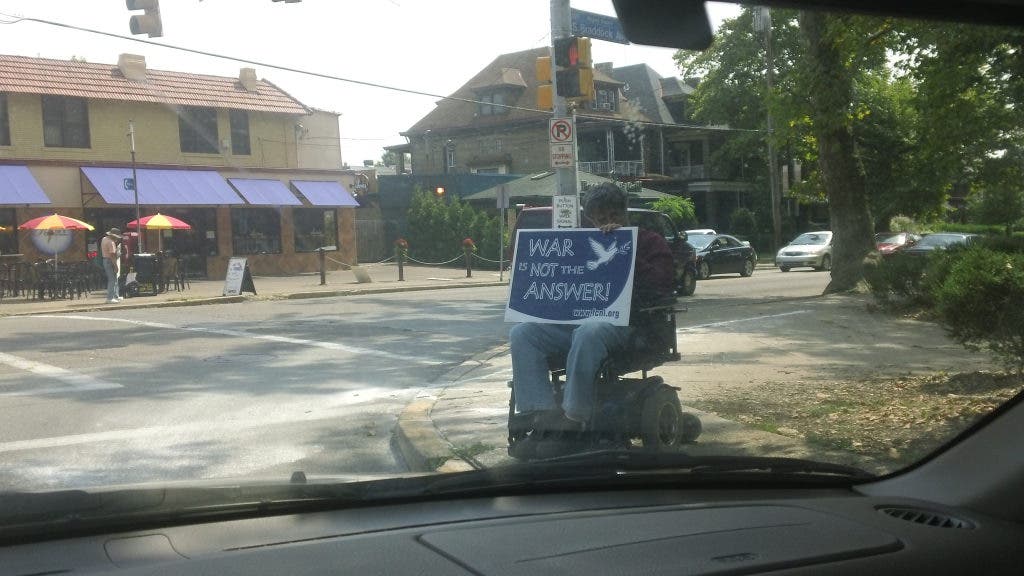
If you've traveled past the intersection of Forbes and Braddock avenues on a Saturday afternoon, chances are you've seen someone holding an anti-war placard and flashing the peace sign to passersby. I met up with Jon Robison next to the Forbes and Braddock playground to find out why he is dedicated to doing this.
I drive past this intersection every day and I've seen you guys out here many times. Are you with an organization?
Find out what's happening in Forest Hills-Regent Squarefor free with the latest updates from Patch.
This vigil is not really sponsored by an organization. We're out here from 12 p.m. to 1 p.m. There's another group that's out from 1 p.m. to 2 p.m. at Penn and Highland, and that is sponsored by Black Voices for Peace.
Five of us are regulars here, but anyone else is welcome to join us. Just come any Saturday and hold signs with us. I've been vigiling for peace since we invaded Iraq.
Find out what's happening in Forest Hills-Regent Squarefor free with the latest updates from Patch.
Since 2003?
Yeah, but at first I was vigiling downtown. I'm not sure how long we've been here, our group. A good while.
So, it's a peace vigil. How would you define peace?
People not shooting at each other.
Is it more than that? Is it only that?
That's basically what the vigil's about. I would like to do more. Besides finishing the job of getting out of Iraq and Afghanistan, we ought to have major cuts in the military budget. We have enough nuclear weapons to kill off the whole population of the planet 10 times over. Don't you think that's overkill? We should cut the military budget drastically and use the money for domestic purposes.
Any in particular?
Transportation infrastructure—supporting public transportation, fixing the roads and bridges. The feds should provide operating funds and they don't. There's education. There's health care. And general support for the bottom.
When I hear the word "vigil," that's something I usually associate with the church. Do you do this because of your political convictions or religious convictions, or both?
I'd say probably mostly my political, but also spiritual. I believe in peace. I believe in people. Nobody said it any better than my distant cousin, "Do unto others as you would have others do unto you." And he was a distant cousin—at least on his mother's side.
Spiritually, I'm a Jew-Bu-Hu.
What's that?
Jewish, Buddhist and humanist.
So what's your view on war from a spiritual perspective?
Well, it's bad. We ought to move toward world disarmament, starting by cutting our military budget about in half, and move to a world authority to keep the peace and human rights globally. That should be the direction we go in.
Something like the United Nations?
Yeah, exactly. Do you know who wrote the Universal Declaration of Human Rights? Eleanor Roosevelt. She was hated in her time, and she got it through the United Nations right after World War II, but they didn't get serious about implementing it. We're making progress. Slowly, but we're making progress. The Universal Declaration of Human Rights should be exactly that—for everybody, all censured beings.
Your poster says "War is not the answer." What is the answer?
I think it was the peace activist A.J. Muste who said, "There is no way to peace; peace is the way." And we should do that. We should move away from war and reliance on weapons.
Would you say that you're a pacifist?
Pretty darn close. I would not have been a pacifist during World War II. In fact, if I had been around at the time and if I had had the guts, I would've done what my Uncle Jesse did—volunteer in Spain. Jesse fought in Spain with the loyalists against the fascists, and then in the Pacific against the Japanese.
What makes World War II an exception for you?
Fascism, and the fact that they were making war on people in general. They were killing their own. Hitler wanted to rule the world, and he was trying. We could've prevented World War II back in 1920, if we'd backed the League of Nations and backed disarmament then, but we didn't. We didn't do it when we had a chance, and war came.
I wasn't a pacifist during Vietnam. In those days, you practically had to be a member of a religious group—a Quaker or a Mennonite—to be a pacifist. I should've applied, in retrospect. But I didn't. I chickened out and joined the National Guard, which was very safe at the time. I didn't go anywhere. I went to New Jersey.
So do you get a lot of comments at this intersection?
We get beeps from passersby, I would say three or four every minute. The beeps are definitely positive. Occasionally, we get negative responses, but not often enough to remember.
How long do you think you'll hold these vigils?
As long as it takes.