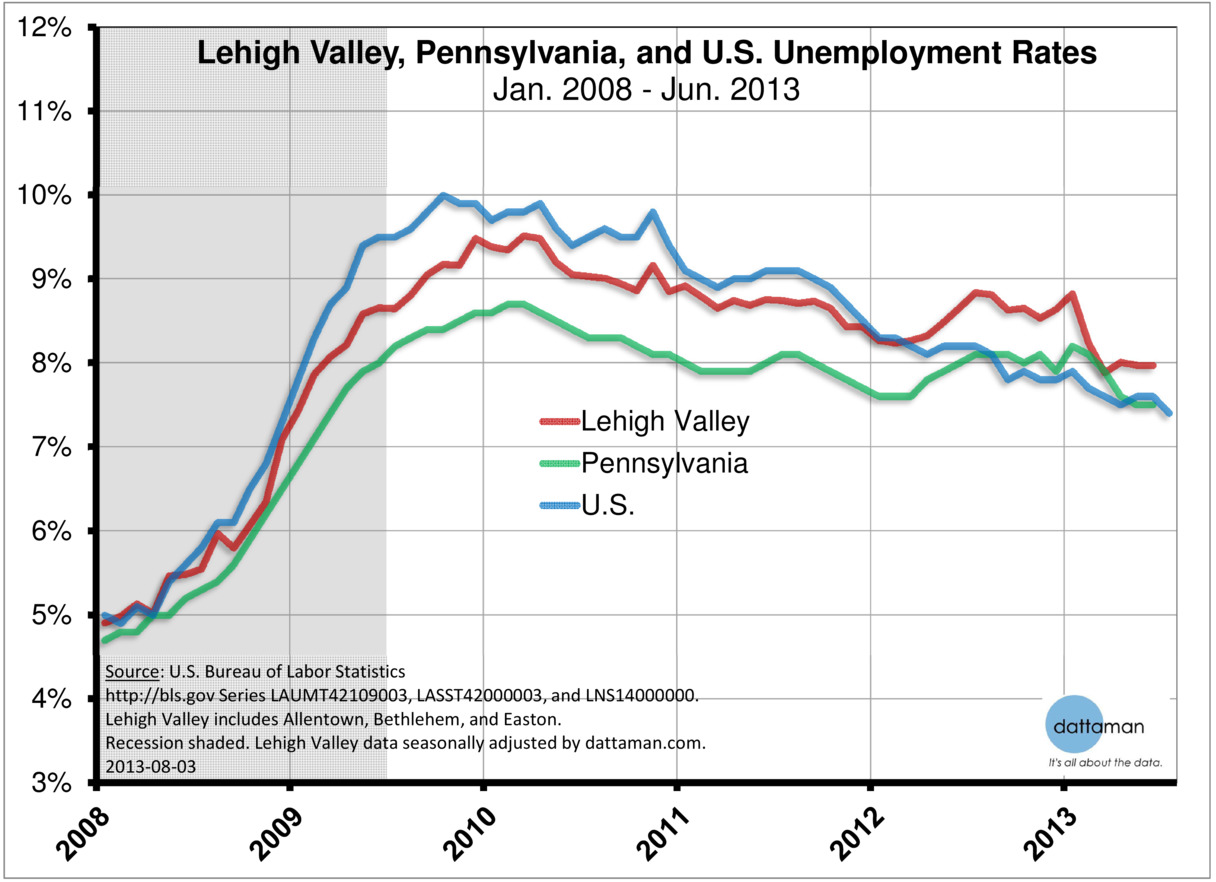


The seasonally-adjusted unemployment rate for the Lehigh Valley was unchanged at 8 percent in June, based on data from the Bureau of Labor Statistics (BLS). The rate hasn't change in the past three months.
On an unadjusted basis, the Lehigh Valley unemployment rate increased from 7.8 percent in May to 8.1 percent in June, but an increase in the unemployment rate is normal this time of year, as students finish the school year and start looking for work. Once this normal seasonal variation is taken into account, there was no real change in the local unemployment rate.
On a seasonally-adjusted basis, the Lehigh Valley unemployment rate remains above both the U.S. and the Pennsylvania unemployment rates. The June rate for Pennsylvania was 7.5 percent, and the BLS just reported that the national unemployment rate dropped to 7.4 percent in July.
Find out what's happening in Hellertown-Lower Sauconfor free with the latest updates from Patch.
The Lehigh Valley metropolitan area includes Allentown, Bethlehem, Easton, and surrounding areas.
The number of people employed in the Lehigh Valley hit a pre-recession peak of 402,000 in January 2008, right after the Great Recession began. Local employment plunged throughout 2008 and 2009 to a low of 381,000 in December 2009, six months after the recession officially ended. In total, nearly 21,000 local jobs were lost, a decrease of more than 5 percent.
Find out what's happening in Hellertown-Lower Sauconfor free with the latest updates from Patch.
Since 2009, the number employed has increased solidly. As of June, it now stands at 410,000, 2 percent above pre-recession levels, and more than 7 percent above the lows of 2009.
The number of people unemployed locally was less than 20,000 in 2007, but it increased steadily throughout the 19 months of the Great Recession and beyond, hitting 41,000 in December 2009. Since the recession ended, the number of people unemployed in the local area has trended downward somewhat, but with lots of stops and starts. By January 2012, the number had fallen below 35,000, but local unemployment jumped back up to 39,000 by the end of last year. Unemployment again dropped sharply in the first three months of 2013, but has leveled off since April, remaining at around 35,000.
The good news is that nationally, economic fundamentals are gradually improving. Consumers are feeling more confident, housing is showing signs of life, manufacturing is improving, and the national unemployment rate fell in July, and for the right reasons.
If Congress can avoid doing any more economic harm, there's every reason to believe that labor markets should continue to improve (slowly) for the next few years at least. With the usual caveats about financial problems in China, possible Eurozone crises, Mideast violence, and mentally unstable North Korean dictators.
Yes, the Fed's Quantitative Easing program will eventually end, and that will cause turbulence in stock and bond markets. But investors have known for years that the Fed's stimulus wouldn't last forever, and that should have been factored into asset prices long ago. In the end, easing up on the easing should turn out to be a non-issue.
Net, the local labor market is improving, albeit much more slowly than any of us would like. Of course, lines on a graph are of little comfort if you're one of the 35,000 Lehigh Valleyans who still can't find a job.