Politics & Government
Monroe County Key to Redrawing PA Senate Districts
Monroe County residents want changes to districts in the county, which is currently divided six ways.
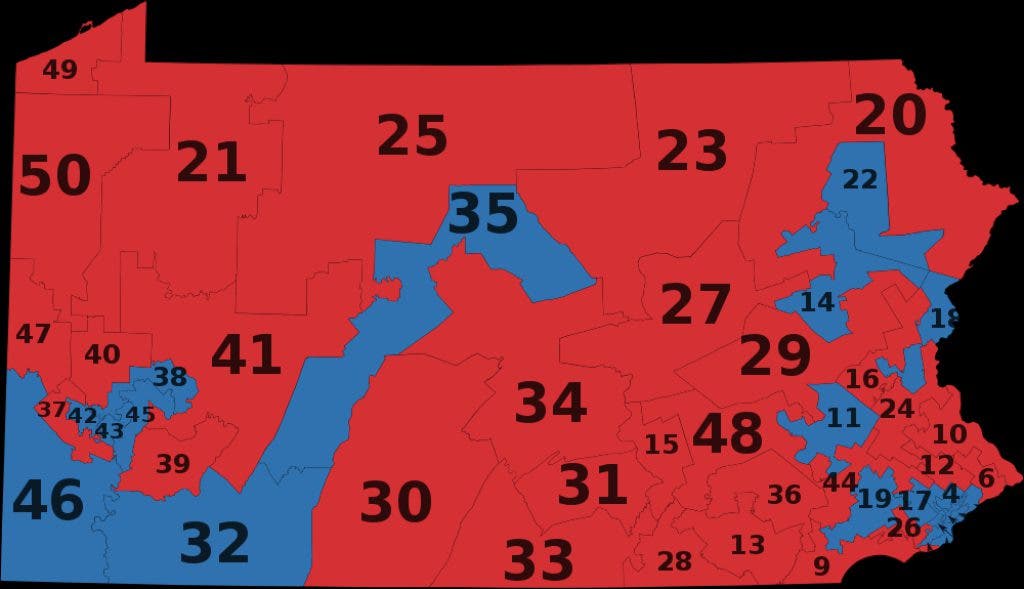
It’s not quite "taxation without representation," but it might be the next worst thing.
Thanks to some interesting political mapping, the residents of Monroe County for the past 10 years have been part of a half dozen state Senate districts. Those six districts extend beyond the county borders, and all the senators who hold the seats live outside Monroe County.
The divides have left some county residents feeling conquered by political interests.
Find out what's happening in Hellertown-Lower Sauconfor free with the latest updates from Patch.
Monroe County resident John Moyer said the situation equates to about 170,000 Pennsylvanians who do not have a voice in Harrisburg.
“In 2011, I believe Monroe County’s war cry should be: taxation with too much representation,” Moyer said.
Find out what's happening in Hellertown-Lower Sauconfor free with the latest updates from Patch.
Moyer was one of several Monroe County residents who spoke to the Legislative Reapportionment Commission at its Sept. 7 meeting in Allentown. The commission is charged with redrawing the state House and state Senate districts once per decade. Congressional redistricting is tackled by the state House and state Senate.
Members of the redistricting commission include Senate Majority Leader Dominic Pileggi, R-Delaware; Senate Minority Leader Jay Costa, D-Allegheny; House Majority Leader Mike Turzai, R-Allegheny; House Minority Leader Frank Dermody, D-Allegheny; and former Superior Court Justice Stephen McEwan, who was appointed by the state Supreme Court to be chairman of the commission.
Too many representatives have watered down Monroe County’s influence. Moyer said none of the six senators who represent Monroe County have more than 20 percent of their total constituency in its borders.
In other words, “these six senators can be assured of re-election without a single vote from Monroe County,” Moyer said.
Monroe County has been one of the fastest growing counties in the state in recent years, nearly doubling in population since 1990. In the past 10 years, the county’s population jumped by 22 percent to about 170,000. Only two other counties in the state, including neighboring Pike County, have grown faster, according to census data.
When the new political map is drawn for the next decade, each state Senate district must include about 254,000 residents. Monroe’s population doesn’t allow it to have a district unto itself. But opponents of the current setup say even dividing the county between two senators would be far superior to the current arrangement. One school district, for example, is divided among three Senate districts.
“Monroe County’s districts have been drawn in direct violation of our state’s constitution,” said Judy Fiske, vice president of the Monroe County League of Women Voters, a civic group that encourages open and transparent government.
Article 2, Section 16 of the Pennsylvania Constitution requires that legislative districts are equal in population, compact and contiguous--though courts traditionally have allowed a degree of gerrymandering--and prohibits the division of political subdivisions like counties and townships, except when necessary. Gerrymandering results in maps where certain parties have a political advantage.
Robert Phillips, president of the Greater Pocono Chamber of Commerce, which represents business interests in the region, said building political consensus is “a serious challenge” in the politically divided county.
Monroe County Commissioner Suzanne McCool said the current arrangement harms residents, school districts, businesses and politicians alike.
If the redistricting commission addresses the grievances presented Sept. 7, it has two options.
It could eliminate a district from the western part of the state--which has lost population in the past 10 years--and create a new one in Monroe and Pike counties, giving them a Senate seat and the chance to pick a new member to fill it.
Or, the commission could rearrange the existing districts so one or two districts can cover the majority of Monroe County, but likely with pieces of neighboring counties, and the incumbents remaining in the picture.
Both scenarios would have a statewide impact. Eliminating a district--likely from the Pittsburgh area or the Altoona-Johnstown-State College corridor--would require that other district lines be redrawn to absorb the extra space created by the removed seat and force the existing districts in Monroe to make room for the new district.
On the other hand, rearranging the six districts that share Monroe County would require redrawing the entire northeastern portion of the state Senate map, with any changes also forcing changes to districts that border on them. The members of the commission Wednesday avoided showing their hands.
“Clearly, the testimony was compelling,” Costa said. “I think it’s going to go a long way in helping us determine what we have to do with the northeastern part of the Commonwealth.”
“I thought there were important points made, and they have to be taken into account,” Turzai said.
Political concerns also must be balanced. The six Senate seats are split between three Democrats and three Republicans. With both parties represented on the commission by two members, an agreement will have to be reached on whether the demographics in the new Monroe district or districts will favor the GOP or the Democrats.
Costa and Turzai declined to discuss the political ramifications of the redistricting process.