Community Corner
Historical Fall Festival Attracts a Crowd
Artisans and crafters demonstrate a simpler time.
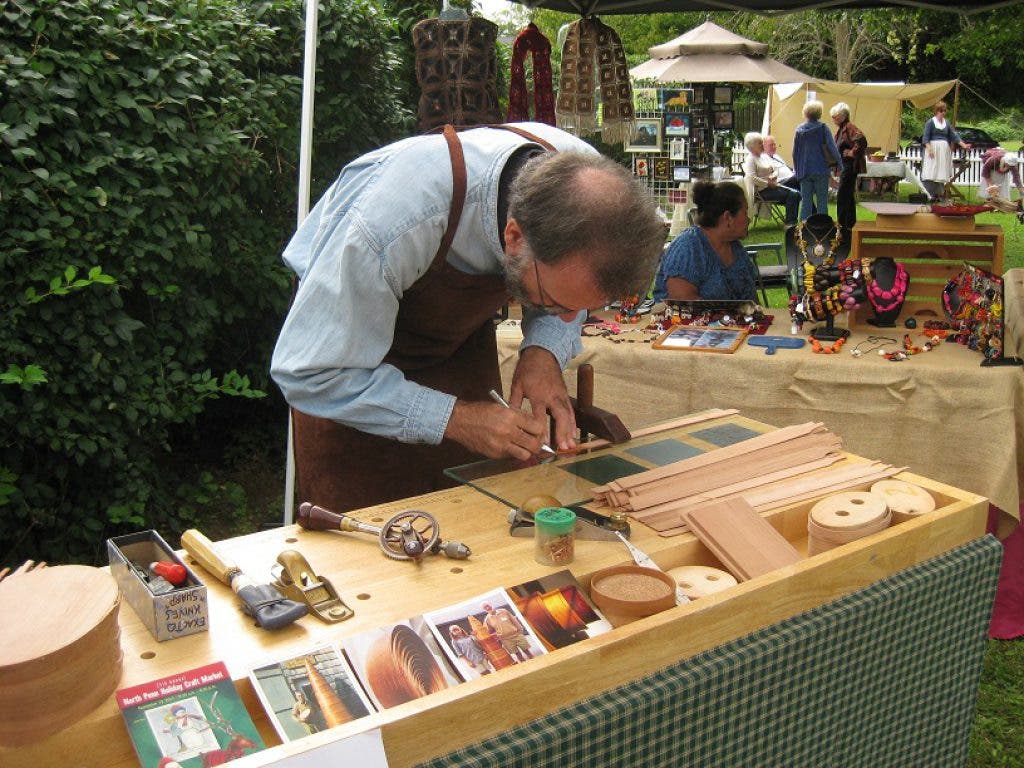


A crisp, sunny fall morning heralded in the fourth annual Historical Fall Festival and Hartzel-Strassburger Open House which took place on Saturday and was sponsored by the Historical Society of Hilltown.
The event showcased the historical societies Hartzel-Strassburger house and featured over 25 local artisans, crafters, exhibits, and live historical demonstrations including open-pit cooking.
Beverly Slifer, of the Hilltown Historical Society, who lives in a historic house adjacent to the imposing brick Hartzel-Strassburger house, noted that records indicate the existence of a log building on the site as early as 1772. The present structure was built in 1834, and the dual name which the house bears, were those of the father and daughter.
Find out what's happening in Montgomeryville-Lansdalefor free with the latest updates from Patch.
The historic structure is being restored by the society, and the open house gave the public a chance to see the inside and the work that has been accomplished to date. Evidence exists of an underground tunnel, thought to have harbored slaves as part of their escape to freedom, as well as numerous fireplaces and a summer kitchen replete with all the necessary accouterments needed to cook a meal and run a kitchen in the 1800s.
A large barn occupies a portion of the remaining farmstead, and many artifacts of the period were discovered inside including numerous shoe forms and shoe making tools—indicative of the likelihood that a cobbler plied his trade here. Attached to one side of the house is a room that is thought to have been the workroom and shop of the cobbler, with worn floorboards as witness to the pounding of his hammer while he toiled at his trade.
Find out what's happening in Montgomeryville-Lansdalefor free with the latest updates from Patch.
Artisans and crafters occupied the Hartzel-Strassburger house as well as the outside lawn area, and they were anxious to educate visitors about their trade or handwork.
Rick Gehlhaus was demonstrating cigar making and tobacco culture under a tent.
“Tobacco was a very big crop back in the 1820s. There were three parts to making a cigar: the filler, then it was rolled in a binder, and then wrapped with the best part of the leaf,” he said.
He then demonstrated how the finished cigar was placed into a press for 30 minutes on one side, then flipped and pressed for another 30 minutes. Gehlhaus went on to explain his collection of pipes commonly used at the time, including the traditional clay pipe which was often used in taverns.
The long, thin pipe grew shorter with age and use due to each new smoker breaking off an end piece of the pipe—not for sanitary reasons, but for a new start and a better smoke.
A store was set up under another tent that displayed all the necessities needed for running a household in the 1800s. Items ranged from gloves and buttons to bowls, ladles, irons, bee skeps, and spectacles.
Nancy Berger had a display of early lighting which included more than the common candle. She noted that one early lamp, a Phoebe lamp, was so named because it resembled the shape of the Phobe bird and was not named after a person.
Berger held up a camp lamp, which consisted of a tin box with a candle inside. When it was lit and opened, the tin magnified the light emitting power of the simple candle — providing much needed light when soldiers were out in the field. One lamp used oil from Sperm whales, and it originally was designed to contain just one wick. On a long transatlantic ocean voyage, Ben Franklin came up with the idea of making the lamp with two wicks, thus doubling the light of the simple lamp.
Wilz Pottery displayed their folk art-inspired sgraffito ware which included plates, mugs, bowls, and ornaments. For sgraffito, the potter uses a sharp tool to cut through a layer of contrasting colored slip to the clay below; thus, creating a design. Sgraffito is a Latin word that means "to scratch and is also the root for the word graffiti meaning as to write."
Denise Wilz is self-taught, and her inspiration comes from Pennsylvania German folk art, including pottery, fraktur, and painted furniture. She uses traditional methods and tools, while each piece that she creates is handmade and unique.
Handcrafted American broom construction is John Paul Warren’s specialty. Functionality as well as beauty and originality are the hallmarks of Warren’s unique and useful brooms.
He explained that his brooms are reproductions of original designs from long ago, but some of his designs come with a twist. One unusual broom had a tennis racket for a handle, but most of the brooms have a tradition handle made from native American woods that are indigenous to the area.
“I call this my sweep and serve broom,” he said, referring to the tennis racket. “All my brooms are made from broomcorn, and nothing sweeps better.”
Carol and Bob Fegley shared one area to demonstrate their hobbies— Carol does loom weaving and tape loom weaving, and Bob showed his skill at band box construction.
“The Shakers sold thousands of these boxes, and they invented the 'fingers' on the boxes that were designed to relieve the stress on the box,” Fegley said.
Fegley uses cherry wood for the box sides since it is yields more favorably to bending, while the bottoms are constructed of white pine. The simple, exquisite boxes are held together by putting the wet wood into a shaper, and then it is tacked with wooden bands — with absolutely no glue being used in their construction.
Other crafts present included candles, handmade soaps, chair caning and rushing, as well as a blacksmith, spinning, hand engraving, felt design, and rug hooking.
Open-pit cooking was a favorite stop for visitors as Carol Oughton was preparing a whole, stuffed chicken along with pear stew — cooking in a hollowed out pumpkin — sour dough bread and an apple pie that was baking in a Dutch oven. Curious children eagerly volunteered to keep the string wound and the chicken turning on the circa 1820 rotisserie chicken—a simple, yet efficient way to insure that the bird cooked evenly.
Ron Walters announced that he and his wife are KOOKS — Kollectors of Old Kitchen Stuff. Their display area was full of enough old kitchen oddities to prove it.
Visitors were kept amused by guessing each implements purpose and function in years gone by. Items ranged from early can openers to corn shellers, old mixers, butter molds, a foot toaster, and a metal baby feeder that the baby sucked from—maybe the first bottle. Ron also has a collection of woven coverlets, local textiles, feed sacks, and clothing from local millers in addition to wooden stamps used to affix markings on grain sacks.
Most of those in attendance agreed that it was fun to visit the 1800s for a few hours and experience what life was like, but it sure was a relief to be able to get into their cars and return to the present and all the necessities that simplify our daily lives.