Business & Tech
Local Experts Weigh in on Stock Market Drop, Talk What's Next
What happened yesterday, why, and what to expect next? Level-headed experts offer level-headed analysis.

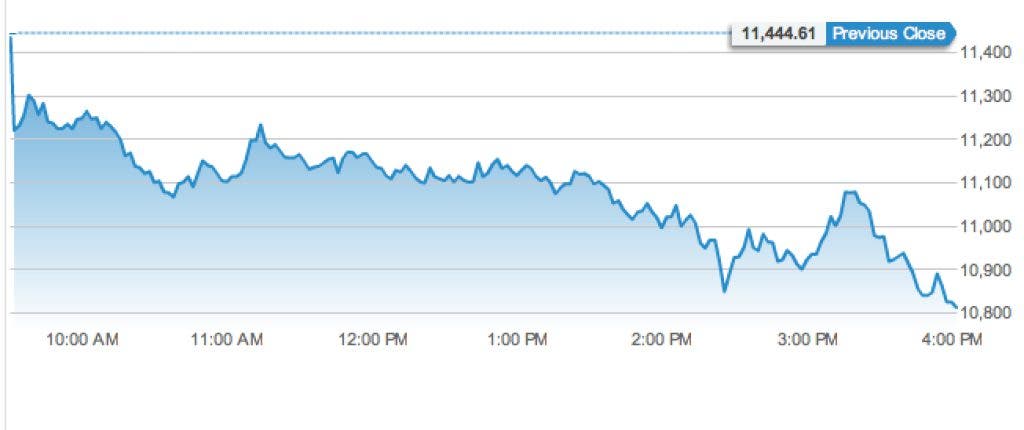
It's all over the news. It's the big headline. The Dow Jones Industrial Average fell 643 points, or 5.55 percent, Monday, following Standard & Poor's downgrade of its United States credit rating from "AAA" to "AA+."
The Nasdaq and S&P 500 indexes? No better, at -6.9 percent and -6.66 percent, respectively.
However, in a system as complex and unpredictable as the stock market and global economy, a lot of answers can get lost in the fray. Was today as bad as it could have been, or did we luck out? What happens next—should an investor sell or buy? And for those unfamiliar with the stock market: Just what the heck is a credit rating downgrade anyway?
Find out what's happening in Montgomeryville-Lansdalefor free with the latest updates from Patch.
To get the answer to these questions, Patch talked to a number of finance and accounting professionals, who have more to say than “the sky is falling."
Was today as bad as it could have been?
Find out what's happening in Montgomeryville-Lansdalefor free with the latest updates from Patch.
In short, no. Answers from our experts ranged, but each said there were at least a few positive indications from today's session.
"The extent of the downturn and its persistence throughout the trading day were both a bit greater than I expected," said John Myers, president of in Dresher. "But at the end of the day, we settled almost exactly on another key level of technical support. This leads me to believe that today's drop is more the result of short term trading activity, and not based on fundamentals."
Myers also points out that today's new low is hardly the stock market's worst low. Not even on the year.
"While a nearly 6.6 percent tumble in the S&P 500 index is indeed dramatic, it is important to remember that we were nearly 2 percent below this level just 11 months ago," Myers said. "Many people would be only too happy to earn 2 percent on a bank CD these days."
Douglas Kaufman, of Kaufman Financial Services, also says that today wasn't as bad as some predicted.
"Today's drop in the stock market was as expected, after the Standard & Poor's downgrade of U.S. debt," said Kaufman. "Judging solely on the country's emotions to the downgrade, the Dow could have dropped as much as 7 to 10 percent in one day. It is clear that emotions are running high in the market."
But what caused the drop?
Many are painting last Friday's S&P downgrade of the U.S. credit rating as the main culprit in the market's woes. However, the three major U.S. indexes all saw significant losses last week, before the announcement of the downgrade, suggesting there's more to it than that.
"More than anything else, earnings are what drive the market," said Myers. "While the recent crop of second quarter corporate earnings were strong, most CEOs cautioned about an expected reduction in sales and earnings for the third and fourth quarters."
Myers said that the recent downturn reflects this concern over low earnings.
"The market tends to reflect expectations six months out, and the pullback that started last week was a result of those reduced expectations," Myers said. "The timing of the correction was caused by [a number of] factors, including second quarter earnings reports, a rise in concern about Italy's debt load … and the debt limit drama and concerns about potential downgrades."
But what exactly was the downgrade?
Most of the talking heads on TV state over and over again that the United States credit rating was downgraded from the highest possible rating, AAA, to one notch below, AA+. But what exactly does that mean?
"A credit rating is assigned to individuals, corporations and governments to allow lenders to compare lending opportunities in an apples to apples fashion," says Ross Reiter, a tax senior associate at the accounting firm KPMG in Philadelphia. "S&P is a rating agency which uses complex modeling tools to assign corporations, governments, and others a credit rating."
According to Reiter, S&P, like the two other major rating agencies, Moody's Investor Service and Fitch Rating, uses a formula to determine government ratings.
"For governments, the rating is determined using a number of factors and variables, including economic status of the government, investment in public and private sectors and political stability," said Reiter.
The main justification for the S&P downgrade came under the political stability category.
"Most of those variables are driven by speculation, and when the government appears to be in crisis mode, constituents lose faith in their elected officials, and when those officials appear not to be compromising, speculation goes into overdrive," Reiter said.
But was the downgrade warranted?
Officials across Washington fired back at S&P over the weekend, including Treasury Secretary Timothy Geithner, who accused S&P of making a $2 trillion error in its calculations, according to the Huffington Post.
"They've handled themselves very poorly. And they've shown a stunning lack of knowledge about the basic U.S. fiscal budget math," said Geithner, according to the article.
However, Kaufman says that the downgrade was not uncalled for.
"The U.S. government, state governments, local governments and U.S. citizens have extended themselves quite far," said Kaufman. "Our country loves debt, and maybe we have all binged a little too much."
Kaufman says that this overextension causes worry in a globalized economy, especially when other markets are volatile.
"With the United States extending its wealth and power to countries and causes around the world, it is a scary thought of what could happen if we can’t pay our debt," said Kaufman. "Also, keep in mind that there is extreme volatility and uncertainty in Europe, as well. There is a so-called “Sovereign Crisis” around the world, where sovereign solvency is in question in a number of nations."
Myers agrees that S&P is not to blame here.
"Criticizing S&P is like shooting the messenger. S&P's comments are not surprising,” said Myers.
However, Myers also takes the conversation one step forward, and believes that S&P even acted with bravery, as he explains that the rating agency could take a financial hit from the downgrade.
"S&P, like other ratings services, is paid to develop ratings analyses and they are one of a handful of ratings agencies on the government's approved list," Myers explained. "Municipalities, corporations, financial institutions and other government bodies are virtually required to use only the companies on this list. Thus, potentially angering the government that holds sways over your own revenues must not have been an easy call to make."
So what now?
There was no question that the stock market took a major hit today, regardless if it could have been worse. So what do the professionals suggest?
"Be patient," said Kaufman. "Reacting to the news right after may lead to unsatisfactory results, and always remember that the stock market and economy move in a cyclical manner."
Myers agrees.
"We had expected a pullback this fall as a prelude to a period of little or slow growth. I believe this period has started and will continue for the balance of this year," said Myers. "What happens beyond the end of this year depends on the economy's performance in the next few months. If we enter 2012 with at least minimally encouraging economic news, that could be a springboard for a new rally."
And Myers' specific advice for investors:
"Be careful about bond funds—rates are more likely to rise than fall … and make sure your portfolio is broadly diversified; there are examples of people who loaded up on their own company's stocks in their 401k, only to see their retirement pushed because of a one-company meltdown," said Myers.
A final piece of advice: Carefully choose which boat you'll use to weather the storm.
"Think of company stocks as if they were ships," Myers said. "A large ocean liner can ride out the storm better than a small motor boat. But once the storm subsides, the runabout can react more quickly."
Get more local news delivered straight to your inbox. Sign up for free Patch newsletters and alerts.