Community Corner
Planetarium Brings Out Stars During Day at Library
Merck's portable StarLab planetarium taught families about constellations, stars in Lansdale Library's Lynn Janoff Community Room Wednesday




It was the only time to see constellations and stars during the day - and indoors nonetheless.
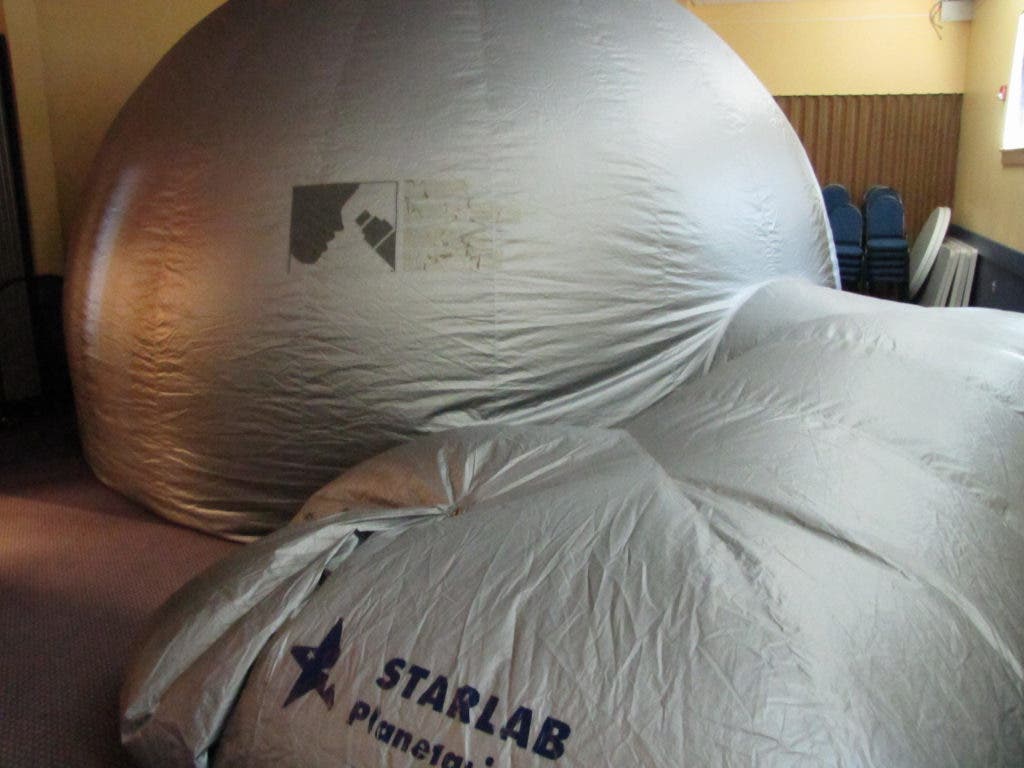
, as part of its "Dream Big: Read" theme, turned its Lynn Janoff Community Room into a planetarium Wednesday morning thanks to Merck's portable StarLab Planetarium.
With shoes off, parents and children crawled through a tunnel and into a large, dark sphere. There, they sat and looked up as library director Tom Meyer told of the mythologies behind and astronomy of various constellations seen in our night sky.
Find out what's happening in Montgomeryville-Lansdalefor free with the latest updates from Patch.
The Big Dipper (Ursa Major), Cassiopeia, Pegasus and Orion were just some of the constellations pointed out in the StarLab.
"Cassiopiea was a beautiful woman, and she was fond of boasting about her beauty," said Meyer during the presentation inside the StarLab. "The maidens who tended to King Neptune in his underwater kingdom learned about her boasting and they were upset and demanded Neptune punish her. So Neptune sent a sea monster to the town on the coast that was ruled by King Cepheus and Queen Cassiopeia. The king went and asked the oracle how he could get rid of the sea monster, and the oracle said he would have to sacrifice his daughter, Andromeda."
Find out what's happening in Montgomeryville-Lansdalefor free with the latest updates from Patch.
This would appease the natives and avenge the way Cassiopeia had insulted them, Meyer said. Cassiopeia was placed in the heavens to be punished rather than honored, he said.
"Every night, she sits halfway around that North Star, upside down, hanging on for dear life, in a position humiliating for such a beautiful queen," he said. "That's her punishment."
Ursa Major and Ursa Minor, known as the Great Bear/Big Dipper and the Little Bear/Little Dipper, are in the sky because of Zeus, Meyer said.
"Zeus fell in love with Callisto, a beautiful huntress. Zeus' wife Hera was so jealous, she turned Callisto into a bear," Meyer said. "One day, when Callisto was still a bear, she saw her son Arcas and came up to greet him. Arcas was so frightened, he raised up his bow and arrow. At the last second, Zeus saved Callisto by turning Arcas into a little bear. Zeus swung those two up into the heavens."
Hera was so mad that Zeus cared for Callisto that she put both Callisto and Arcas near the North Pole, Meyer said.
Orion, Meyer said, has three stars that make up his "belt." The middle star is not a star, but a nebulus, which is a cloud dust in space.
"Some of the brightest stars in the sky are part of Orion's constellation," Meyer said. "The right shoulder is Betelgeuse, the red giant. The bottom foot is called Rigel. The belt itself points down to Sirius, the dog star, which is the brightest star in our sky."
Meyer said the Iroquois used to tell a story about Orion where he was an old man who carried the Sun to the sky on his back.
"When winter came, his bones began to ache. So he gave that job of carrying the Sun to his son, who, like most young people, tried to do the chore in the most easiest way possible," Meyer said. "The young man carried the Sun across the sky on a much lower path during the winter. That is why in the winter there is not much Sun."
When spring comes, the old man takes the Sun back on his back, and takes the higher mountain path.
Pegasus, Meyer said, is the winged horse that was ridden by Perseus. The rectangle inside the constellation of Pegasus is called The Great Square, he said.
"If you look at the rectangle, it looks like the same shape as The Big Dipper. When you look at the rectangle, you are looking out of a window that looks beyond our Milky Way," Meyer said.
Children also learned about an asterism, which is a group of stars that is not a constellation.
"The kids had an interest in stars already," said Kelly McClennen of Hatfield, who attended the StarLab with her husband, Jamie, and children Kaitlyn and Tyler. "We thought we would add to it."
She said her children had seen a planetarium once before at The Franklin Institute.
"This was very interesting," she said. "They loved it."
Kaitlyn said her favorite part was looking at the constellations.
"And going through the tunnel," she said.
Kelly and Jamie learned some things themselves, such as the names of some constellations and that a nebula is in the middle of Orion's belt.
"We loved it," Kelly said. "We feel bad that their friends missed it."
Meyer said this was the StarLab's first appearance at the library. It was made possible through The Merck Institute for Science Education.
"Merck is very strong in promoting science," Meyer said. "They ask their employees to get trained to do all kinds of science stuff."
Other MISE events include making ice cream through the use of dry ice and teaching about static electricity.
"The reaction has been excellent," he said. "Everyone says how cool it is."
The StarLab isn't limited to constellations. Meyer said there is a biology presentation and a Civil War presentation that can be used with the huge sphere.
"We could borrow it again for the 150th anniversary of the Civil War and do a program with it," Meyer said.
The StarLab was manned by retired Merck employees, now volunteers, Adel and Dee Riad of Towamencin.
"Merck does so many different things to help the community and children in schools," said Dee Riad.
Adel Riad said Merck communicates with volunteers to take science items and display them in schools.
The StarLab, Dee Riad emphasized, makes seeing the night sky possible anytime, anywhere.
"With Scout groups, they plan a stargaze night and it always rains and they never see the stars," she said. "This is a guaranteed stargazing night."
Get more local news delivered straight to your inbox. Sign up for free Patch newsletters and alerts.