Community Corner
An Afternoon with the Premier Historian of Royersford/Spring City, William C. Brunner
Kelly Thunstrom, local arts reviewer, spent an afternoon with the premier historian of Royersford/Spring City, William C. Brunner, at the Spring-Ford Historical Society.
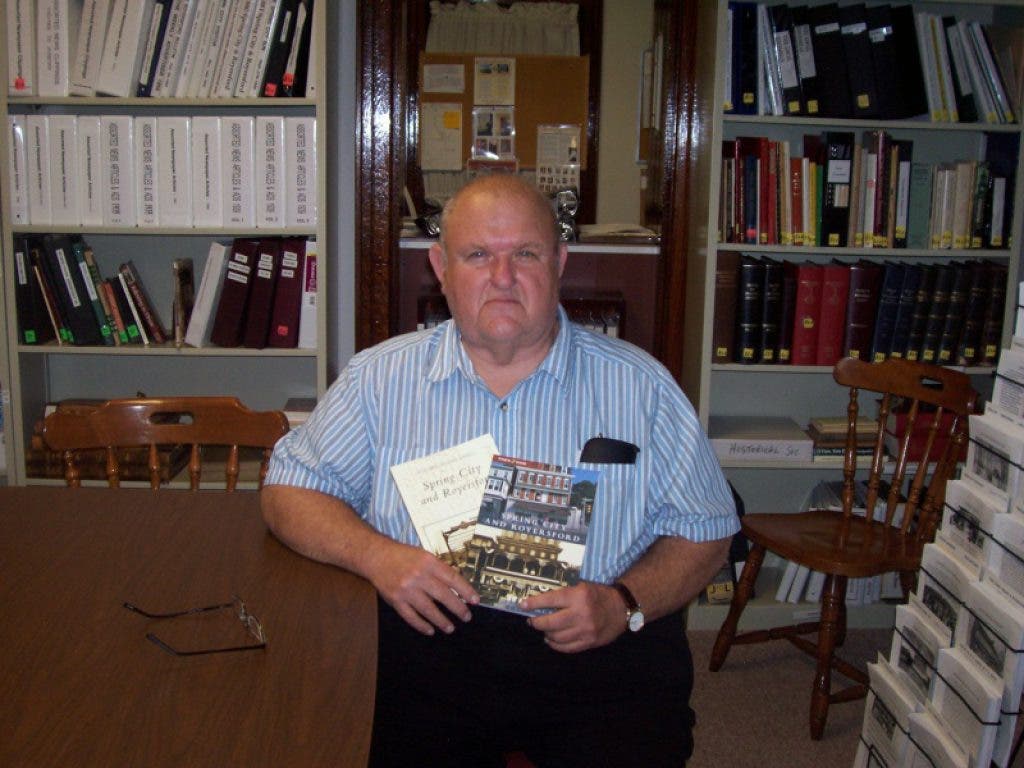
I had the pleasure of meeting with William C. Brunner at the Spring-Ford Historical Society, located on 526 Main St. in Royersford. Brunner is not only the President of the Historical Society, but arguably the premier historian of Spring City, where he has lived since 1958, as well as Royersford.
Brunner is the author of two books, Spring City and Royersford (Postcard History Series, Arcadia, 2003) and Spring City and Royersford: Then and Now (Arcadia, 2007). He also to give me a personal tour of the museum and its grounds. If you have never been there, you are missing an absolutely fascinating place.
The Historical Society is located in the fourth oldest house in Royersford (1861) and has been operating in this location since 2000. The house was built by Rebecca Custer and William Lewin when they married. Custer was the daughter of Samuel Custer, who owned the oldest house in Royersford (1817), located at 224-226 Second Ave. Custer's farm covered over 200 acres.
Find out what's happening in Limerick-Royersford-Spring Cityfor free with the latest updates from Patch.
The grounds not only house the museum, but also a library and cobbler shop, which upon entering, is like stepping back in time. The museum visitor is treated to informative exhibits, such as the collection of stoves and high school yearbooks from every year. Upon entering the building, there is a shocking exhibit of items relating to the Ku Klux Klan. Brunner informed me that there used to be an amusement park in Spring City called the Bonnie Brae. When it closed, the Ku Klux Klan bought the park to use as their Southeastern Pennsylvania headquarters.
Brunner is most proud of his first book, Spring City and Royersford. He has always had a big interest in photography, beginning with photographing trains, then moving to locations for postcards. He continues to be an avid collector of area postcards, buying them online. His first book is a collection of his old postcards from the area. The postcard on the cover is extremely important and symbolic to him, as it is the first one he ever bought. Both towns can be seen, as well as the . The iron for the bridge was made in Phoenixville, where he was born and raised before moving to Spring City.
Find out what's happening in Limerick-Royersford-Spring Cityfor free with the latest updates from Patch.
For Spring City and Royersford: Then and Now, Brunner was able to use negatives that were dropped off at the Society by an anonymous donor, as well as pictures from the Heeston Collection. The cover of this book, to me, is like looking at ghosts from the early 1900s. Everyone's favorite breakfast spot, , is pictured on the top. This used to be the site of the White Star Market, which can be seen on the bottom. The grocers dressed in white aprons look like old-time ghosts. This is the essence of this book. The buildings in Royersford and Spring City have so much history.
There are many photographs of World War I homecoming parades, as there were roughly 100 men involved in the war. Brunner told me about floods in the late 1800s, 1901, 1942 and Hurricane Agnes in 1972. The area across the bridge, into Spring City, was called the "lowlands," as it was six feet lower then. There used to be an Acme Market here.
A picture in Then and Now, taken by Brunner, shows this area completely underwater. If you were standing near the glass doors of the Acme, the water would have been up to your neck, about five feet deep.
There is so much history in these two books: buying Ford cars in 1914 at the Spring City Garage; the Royersford Opera House, built in 1897 at 368 Main St. (this building is no longer there), and the Gem Theatre, built in 1908, on Main Street in Spring City (now Chaplin's Music Cafe).
The Gem Theatre had vaudeville acts and silent movies into the 1920s. Buster Keaton and other stars visited it. It is interesting to see that where the Golden Age Manor is located now once stood the Joseph Addison Buckwalter mansion. He was president of the Buckwalter Stove Company, of which a few are in the museum. On the grounds of the Lakeview Shopping Center (where , , and are now) stood an actual lake, which was used for swimming in the 1920s, but developed into an amusement park. All that remains of the lake is a pond in the back.
Both of Brunner's books can be purchased at the Historical Society. I would strongly recommend both of them.