Neighbor News
Special Kids, Special Moms
As Mother's Day approaches, two moms of daughters with multiple disabilities describe the challenges, triumphs, and joy.
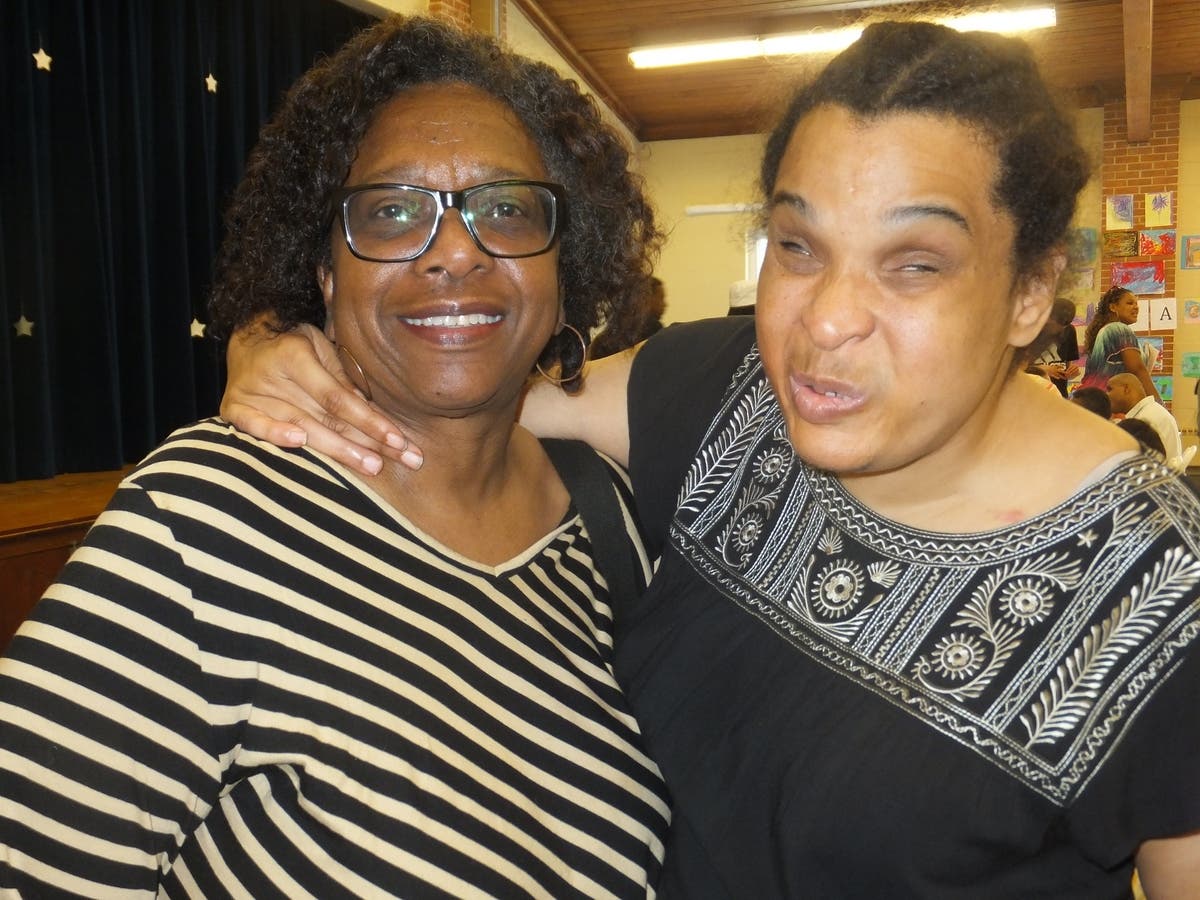

Paoli, PA...The beginning was the hardest part, agree Royer-Greaves School for Blind moms Sandra Smith and Jatae Winkey-Posey. It was then, in the first few months after the birth of their children, that they had to let go of some of the dreams they had for their daughters.
Smith’s daughter, Sonia, is an adult client in Royer-Greaves’ adult training program. Winkey-Posey’s daughter, Jala, is a student in the day school program. Both are blind and have significant social and communication difficulties that mean they rarely speak. They also have physical disabilities.
In addition to all that came with being a first-time mother, Smith and Winkey-Posey soon learned to be researchers, nurses, advocates, and cheerleaders. As they learned about their daughters’ needs and abilities, they learned about their own strength and determination. One of the hardest lessons: Learning not to help too much.
Find out what's happening in Malvernfor free with the latest updates from Patch.
Jatae Winkey-Posey and Jala Winkey: A Mom Learns How Much Her Daughter CAN Do
At her four-month checkup, Jala’s doctor noticed her eyes weren’t following a pen light, but moving as randomly as a newborn’s. An ophthalmologist confirmed her blindness.
Find out what's happening in Malvernfor free with the latest updates from Patch.
“It was very scary, because the most I’d ever done with a blind person at that point was walk past one. And now I had a blind child,” remembers her mom, Jatae Winkey-Posey. “The fear lasted only a very short time, because I immediately went into mommy mode. No, I didn’t know how to do any of the things she needed, but it was something I had to do, and so I would do it.”
By her one-year checkup, Jatae Winkey-Posey realized that Jala, who is now 11, faced other challenges. “She wasn’t crawling, she wasn’t walking. She could stand a little, but she was missing some milestones.”
Winkey-Posey sums up her feelings at the time in two sentences:
“My baby can’t see, and I love her. My baby needs her mommy to do everything, and I want to do everything for my child.”
Winkey-Posey did just about everything for Jala, until Jala was about six, and an occupational mobility therapist and a teacher separately pulled her aside. “Her teacher said to me, ‘Don’t underestimate a child with special needs.’ She said I was limiting Jala.”
She forced herself to let go. One day, Jala’s occupational therapist said she had something to show Winkey-Posey. “She said, ‘Jala, put your shirt on.’ And my child did it! Jala can’t dress herself, but she can help with dressing herself,” Winkey-Posey said. “I wasn’t giving her the opportunity to become as independent as she can be within her circumstances.”
Jala’s independence has increased considerably during her three years at Royer-Greaves School for Blind, said Winkey-Posey, 33, a bus driver for ROVER Community Transportation. Rather than saying what she wants, Jala has a tendency to push or pull at someone to get his or her attention. Royer-Greaves has made her an electronic device fitted with buttons. Each button is topped with a tiny object that Jala can identify by touch with her fingers. Her teachers have taught her that each object stands for something she might want. Pushing the button with a miniature cup and straw means she wants a drink. The one with feathers means she wants someone to tickle her arm. A bell means she wants music.
Her teachers and aides are also working to get her to verbalize her requests, Winkey-Posey said. “When Jala wants music, she will be stubborn a couple of minutes, but they keep at it with her, and eventually, she’ll say it,” Winkey-Posey said. “She is verbalizing more.”
Jala also brings a lot of joy to her Coatesville household, which now includes stepdad Dameyon Posey and brother Naadir.
“Even though she does not talk, she sings a lot,” Winkey-Posey said. “She also loves to make beats on the wall – I bought her a drum set and she was not interested in that! And she has a phone that is her own little portable music player – she loves to listen to K-Love on YouTube.”
Naadir, 9, is the little brother, but he’s more like the big brother, always helping Jala, often holding her hand.
“She softens him, just like she has softened me,” Winkey-Posey said. “She softened me up so much.”
“The best thing about being Jala’s mom is she is such a ray of sunshine,” Winkey-Posey said. “I get hugs. I get kisses. And sometimes, I don’t even have to ask.”
Sandra and Sonia Smith: Love for her daughter propels a mom through graduate school
Sonia Smith, born by C-Section after a drawn-out and difficult labor at New York Presbyterian Hospital, was born without sight and had her first surgery to try and address that at 7 months old, and the second, also unsuccessful, at 18 months.
Her hips were dislocated so she was put into a tiny cast.
“It was really tough, nerve wracking and just hard to see a baby having to have surgeries,” said Sandra Smith, who lives in East Oak Lane. “Her doctor said he didn’t think she was going to thrive, and all I could do was just love her.”
Her daughter did thrive, even if she wasn’t meeting the usual milestones of early childhood. By the time she was four, it was clear that her daughter had other issues with speech and socialization, said Sandra Smith, who is now 69. “It was scary and overwhelming. But it also taught me to be determined.”
When Sonia was 9, her birth father left. Her mom, determining that it was solely up to her to be sure every need of her daughter’s could be met, pushed herself to earn first bachelor’s degree in sports medicine, then a master’s in counseling and psychology. "I needed to get that master's degree, so that no matter where I had to take her to get the help she needed, if we had to move to Australia, I could get a job," Sandra Smith said. “I carried her picture in my bags, and when I felt tired, I looked at it."
Sandra Smith was an elementary PE teacher when she had a chance to study for 18 months at Temple’s sports medicine program. “Sonia and I have always been very close, and so I could never leave her for any extensive period of time,” Sandra Smith said. She took her daughter to St. Christopher’s Hospital for Children, and the treatment she got there led her to move to Philadelphia. “I uprooted my life, for Sonia’s sake,” she said.
After earning her master’s degree, Sandra Smith worked as an intensive case manager at COMHAR for 30 years.
When Sonia Smith was 21, her mom enrolled her in Royer-Greaves’ adult training program. “They understand that she has more than one disability,” Sandra Smith said. “I think it has made her a lot more confident, and so she socializes more.”
Sandra Smith said Royer-Greaves has also supported her, particularly after her second husband, Wesley, died unexpectedly.
Sonia Smith now lives in a KenCrest Community Home and is transported to Royer-Greaves daily. Besides time with friends, she enjoys Royer-Greaves’ music therapy classes and swimming in the indoor pool.
“Being her mom taught me to be very patient,” Sandra Smith said. “I just devoted my life to her, because I want to do everything I can possibly do to help her become the best person she can be.”
Advice for Parents of Kids with Disabilities
- Learn as much as you can about the disability or need.
- Advocate for your child. Be persistent when necessary.
- You know your child best, so if you think the “experts” are not seeing what you see, keep going until you find someone who does see it.
- Take advantage of community and other resources, and do so as early as possible. Contact your county’s department of human services to learn more.
- Ask for help.
- Accept help that is offered.
- Do things for yourself sometimes – even if it is only for an hour.
Advice for those who love a family that includes a child with a disability
- Reach out with a text, email, or phone call. Your support means everything.
- Offer help – even sitting with a child for an hour so a parent can run an errand will be so appreciated!
- Don’t overwhelm parents with too many questions about the disability, especially at first.
- Do listen when they are ready to share.
- Treat this child like anyone else; include him or her in everything.
Sources of advice: Moms Sandra Smith and Jatae Winkey-Posey, and Royer Greaves School for Blind Executive Director Vicky Mayer.