Arts & Entertainment
Visions of Cuba Through Bones' Shutter
Sarah Bones has traveled all over the world in her work as a photojournalist. Some of her photographs are on display at Malvern Library through July.
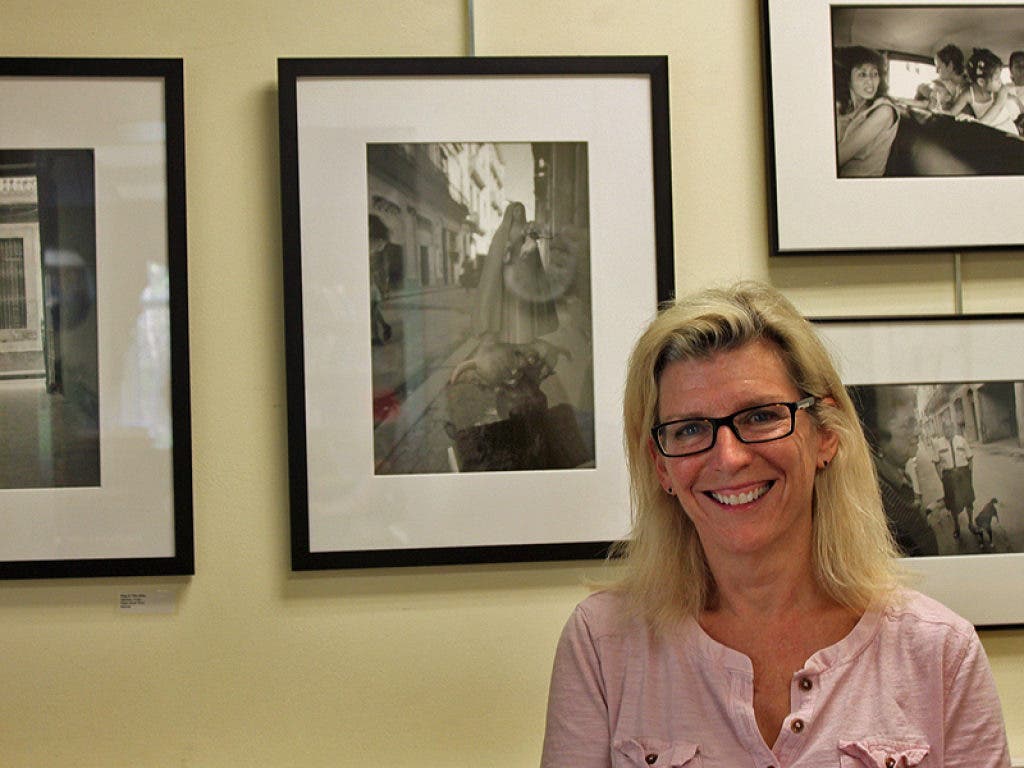
If you’ve visited the recently, you’ve probably seen the work of award-winning Malvern photographer Sarah Bones, whose prints are on display in the library through July. Bones has traveled to Cuba, Rwanda, Somalia, Sierra Leone and other locales in her work as a photojournalist.
The library exhibit features some of Bones’ new and old work, including street photography from Cuba.
“I’ve always loved photography,” Bones said. “I can remember the first time I looked into a view camera, an old Brownie—it was my grandma’s, and I was probably only seven—but from there I was hooked.”
Find out what's happening in Malvernfor free with the latest updates from Patch.
By age 14, Bones—who grew up in Wayne, and later, Paoli—was hitchhiking into the city to photograph the people and places around her, particularly the homeless. But even with such an early interest in photography, Bones did not become a professional photographer until her late 20s, at which point she began working in commercial photography.
“Until I was 45, I was satisfied using my art to make money—I was so thrilled that I could make a living as a photographer,” Bones said. “… but I always wanted to be a photojournalist. … I wanted to use my camera to make a difference—how cliché is that? To help give a voice, to tell other people’s stories.”
Find out what's happening in Malvernfor free with the latest updates from Patch.
So, 10 years ago, Bones decided it was time for a change. She flew to Cuba to take a photojournalism workshop, where she says she found her voice as a photographer. In Cuba, she produced some of the work hanging in the Malvern Library—all shots taken in one town, on a single block of a street. Some are happy, some are grave, and most have stories behind them.
(Bones shares the stories behind two of her photographs in a video attached to this article.)
“Cuba was the first time I did what I do now,” Bones said. “I discovered this gift—well, I don’t know if it’s a gift—but it’s almost like people line up to tell me their stories. I seem to be able to get people comfortable enough to open up.”
That skill has aided her well in the past 10 years, as freelance work for nongovernmental organizations (NGOs) like CARE has taken her to Rwanda, Sierra Leone, Guatemala, parts of Asia, and into prisons and homeless shelters here in the United States.
“The more I travel and the more I do this, the more I realize people are all pretty much the same. Everyone wants the same things, and when they don’t have access to them, it’s pretty much the same situation. It’s all part of the same human experience, and it’s not like anyone is different in Somalia or India or Philadelphia,” Bones said.
When on an assignment, Bones usually arrives at a site with a ground support team and a translator. She goes out with as little gear as possible—only one camera, wrapped around her wrist—and she walks around. She listens and learns, and tries to capture stories with her lens.
“I like to go somewhere and be totally immersed,” Bones said. “I just show up and learn as I go. … Sometimes I think if you do too much [research] it just gets in the way. People are very grateful just to see that someone cares enough to go over and listen to them tell their story. Sometimes just showing up is really all it’s about.”
Telling peoples’ stories, especially stories that others have overlooked, is something Bones passionately pursues here at home, too.
Sometimes, getting a story involves hard work and a little strategy. Bones recalled the story of a man she profiled in 2003: an ex-convict who had spent the last 50 years behind bars, with nowhere to go upon his release.
After running into a few dead ends once she decided to take the assignment on, Bones decided to contact then-Corrections Secretary Jeffrey Beard directly for permission, but she encountered plenty of red tape. Her solution? Sneak into a conference he was speaking at and approach a top employee directly.
“If you have a camera on you, people generally assume you’re there for a reason,” Bones laughed.
She got Beard’s ear and the OK, and from then began photographing the subject, Earl Reinhardt. Once Reinhardt was released, she enlisted the help of a fellow photographer—and ex-private investigator—to track him down.
(View the photographs and story here).
One of Bones’ recent endeavors is a multimedia project, “Housing as the Road to Healthcare,” playing on MindTV throughout May and June. Bones interviewed chronically homeless mentally ill people in Philadelphia who have recently been housed, visiting them in their homes and interviewing them at places they used to sleep when they were homeless.
“There’s a million stories right here in Philadelphia,” Bones said.
And like she said before, sometimes, showing up is really all it's about.
To see more of Sarah Bones' work, visit her website, www.sarahbones.com.