Health & Fitness
“A Most Thought Provoking Call”
"I'm afraid that Sam isn't reading on grade level, should I get him a tutor?", "Should I make a teacher request for next year?". Read for a unique take on these and other parent questions!
“A Most Thought Provoking Call”
Carly Tolson
As the parent of three young children and a career educator, I often get calls from friends with questions relating to school. “I’m afraid that Sam isn’t reading on grade level, should I get him a tutor?”, “ Homework time is a nightmare in our house, how long should it take?” and the perennial favorite, “Is the principal going to think I’m a difficult parent if I make a teacher request for next year?”. If you have kids in school, chances are you’ve lost sleep ruminating over one of these issues and educator experience aside, I’m right there with you.
While I carefully consider my thoughts before responding to the myriad questions I receive, none have left me more contemplative than the call I received last week. “Carly, we’re thinking of applying to a Montessori school. Why do you send your children to Montessori?”
Good question. Why do I send my kids to a Montessori school?
If you live in the greater Media area, chances are you live in a competitive school district funded by a hefty tax bill. I have spent most of my professional career working in fantastic public school districts and I believe in them. So no one was more surprised than me when it came time to choose a school for my own children and the biggest deciding factor was an Italian physician born in 1870 named Maria Montessori.
Sure you’ve heard of Montessori and perhaps you even have a neighbor or colleague who sends their child to a Montessori school. Maybe you’ve even gone so far as to Google it or check out a school for yourself. But what does it really mean and in this day and age of failing schools, why does it work?
Before I go any further, I need to insert a professional disclaimer. I am not Montessori educated myself; I am speaking as a parent. Although I have been a teacher for fifteen years and served as Principal of an award winning public school of 350 children, I relinquish any notion of real expertise on this topic to the highly trained Montessorians who live in the classroom and inspire me daily. They are the experts; I am merely Montessori by osmosis.
At the risk of oversimplifying one of life’s more complex choices, I am going to do just that. There are so many magnificent, scholarly Montessori articles and research studies out there I could draw on, but I prefer to draw from the heart of my own experience. So back to the matter at hand, why do I send my kids to a Montessori school?
Reason #1: “Education should no longer be mostly imparting of knowledge, but must take a new path, seeking the release of human potentialities.”- M. Montessori
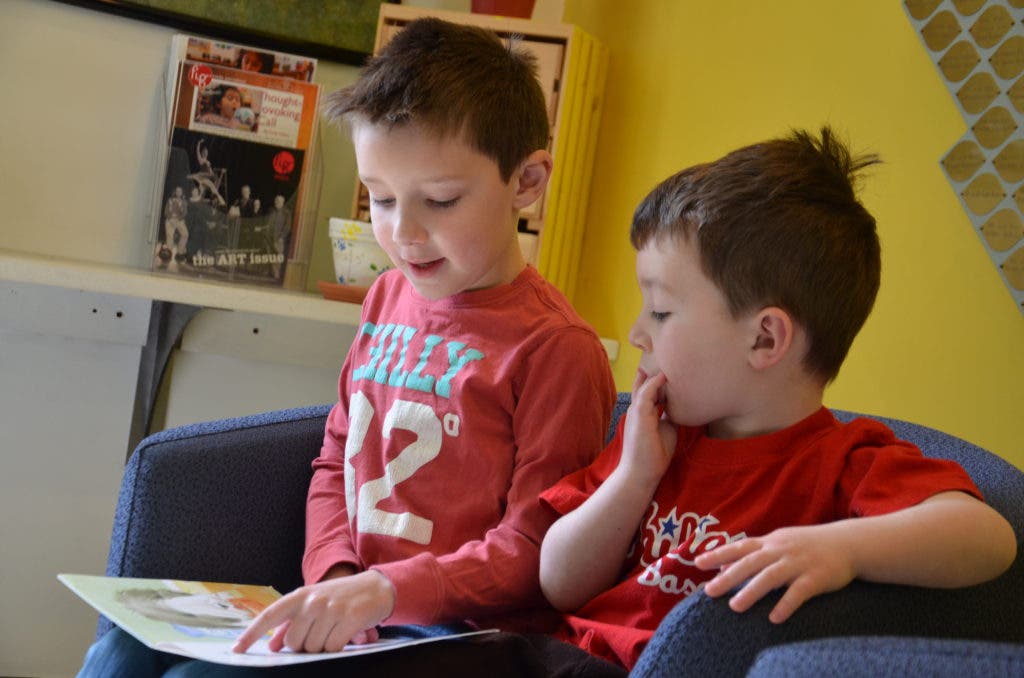
Montessori believed that children are intrinsically motivated doers, not “something empty to be filled”. With this core value so firmly planted at the nucleus of every decision and strategy, Montessori schools create a joyful, experiential learning environment that fosters academic growth in a realm of independence, choice, and collaboration. In the impeccably and logically arranged classrooms, children are encouraged to be self-directed, make decisions, manage their time, exchange ideas and discover concepts for themselves.
I view this scenario as a recipe for 21st century success. The ocean of purposeful activity that is a Montessori classroom is exactly what I want for my children to develop not just as learners, but as happy, well- rounded human beings.
Reason #2: “The first duty of the educator, whether he is involved with the newborn infant or the older child, is to recognize the human personality of the young being and respect it.” - M. Montessori
The communication that takes place between child and teacher in a Montessori classroom is an art form that encapsulates the indelible hallmark of respect. The peaceful tone that acknowledges how a child is feeling or the gentle, often unspoken, understanding that can neutralize any upset or misunderstanding is a marvel to witness. Spending their days in an environment of reflective listening and mindfulness allows children to absorb what it means to communicate thoughtfully and to act with grace and courtesy.
Don’t get me wrong; I have three children under the age of seven and while they’re hardly a page out of Emily Post, their Montessori experience has given them the tools to communicate their needs appropriately and solve problems with empathy and understanding.
Of equal importance are the lessons I have learned by observing my children’s Montessori teachers. Though I am still not immune from reprimanding my kids at a birthday party or making the occasional bribe in the check-out line at the ACME, my approach is different, and dare I say more effective than if left to my own devices.
Reason #3: It works.
A recent neuroscience study by researchers in Milwaukee showed that “Montessori students proved to be significantly better prepared for elementary school in reading and math skills than the non-Montessori children. They also tested better on “executive function,” the ability to adapt to changing and more complex problems, an indicator of future school and life success.”
So for the people who think Montessori is embraced only by “tree-hugging hippies”, think again. Montessori success defies stereotypes, and its global success knows no ethnic or socioeconomic bounds. With education reform looming larger on the national political scene, more and more experts are preparing for the future by looking back in time to a way of learning that has proved to be internationally tried and true.
I wish every call from a friend was this simple to answer.