
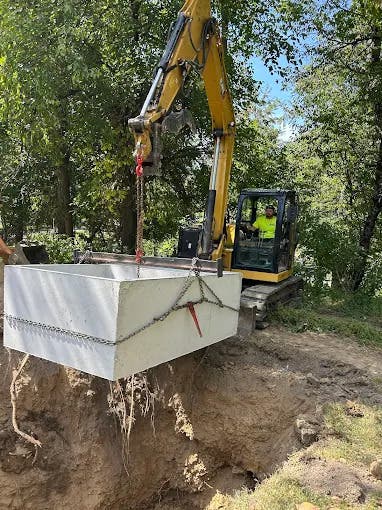
A septic system rarely announces trouble all at once. It gives small signals first: a drain that takes a little longer, a faint odor near the yard, a patch of grass that looks too green for the season. Most homeowners file those away as minor annoyances and move on.
By the time a more obvious problem shows up, the repair is usually bigger and more expensive than it needed to be. That gap between early signal and late action is where most of the damage happens.
What Pittsburgh's Soil Does That Most Guides Never Mention?
Homeowners in Allegheny County and the surrounding area deal with something that generic septic guides skip over entirely. The clay-heavy soil common throughout western Pennsylvania does not drain the way sandy soil does. When that clay becomes saturated after a heavy rain or a wet spring, the drain field loses its ability to absorb effluent, even if the system itself is in decent shape.
This means you can have a wet, spongy area over your drain field that has nothing to do with a failing tank. It can also mean the opposite: a system that is quietly overloading during dry months, with no visible sign until the soil gets one good rainstorm and cannot keep up anymore.
That distinction matters. Treating a saturated-soil problem the same way you would treat a failing tank leads to unnecessary costs.
The Warning Signs Pittsburgh Homeowners Dismiss Too Early
Slow drains inside the house are the one most people notice first. A single slow drain usually means a clog. But when sinks, showers, and toilets throughout the house all start draining sluggishly around the same time, that points to something happening deeper in the system, not just one pipe.
Gurgling sounds after flushing are easy to chalk up to old plumbing. In a house connected to a septic system, that sound often means wastewater is struggling to move through the outlet line or that the tank is approaching capacity.
A few things worth checking yourself before calling anyone:
- Unusually green or lush grass over the drain field during dry weather
- Soft or spongy ground in the drain field area after rain has passed
- Any sewage odor near drains inside or around the tank access area outside
- Water pooling in the yard that does not seem to follow the rain pattern
- Toilets that run slowly even after the fill valve has been checked
None of these alone means your system is failing. But two or more together, especially with a tank that has not been pumped in several years, is worth a call.
Why Freeze-Thaw Cycles in Western PA Create a Specific Problem?
Pittsburgh winters add a stress that homeowners in warmer states do not face. The ground freezes and thaws repeatedly through the season, and that movement works on underground pipes over time. Older concrete tanks in Beaver County and Allegheny County develop cracks not because they were installed poorly, but because decades of that freeze-thaw cycle slowly compromises the material.
Tree root intrusion follows a similar pattern. As soil shifts and contracts, small gaps open in tank walls and pipe joints. Roots find those gaps. By the time roots are causing visible backup issues, they have typically been growing in the system for a long time.
What an Experienced Crew Looks for That Homeowners Cannot See?
When we assess a system, we are not just looking at what is visible. The outlet baffle is the component inside the tank that prevents floating solids from moving into the drain field. It is one of the first things to check in an older system. When that baffle deteriorates, solids migrate out and clog the absorption area. A homeowner has no way to know the baffle condition without opening the tank.
I'm Zac Bonzo, owner of Bonzo Septic Repair and Installation in New Brighton, PA. We serve Pittsburgh and the surrounding area, and we see these kinds of problems regularly. Often in systems where the homeowner had no idea anything was wrong until a routine pump-out revealed it.
How Long Can You Wait Once You Notice Something?
This is the question most people ask when they start seeing signs. The honest answer is: it depends on which signs you are seeing.
Slow drains alone give you some time. A sewage odor outdoors near the tank, standing water over the drain field, or any backup inside the house all require attention within days, not weeks. Waiting through one more season when those signs are present is how a repair job becomes a full system replacement.
Homeowners in the Pittsburgh area who want to understand what the repair process actually involves can find out more here before making any decisions.
Zac Bonzo
Owner, Bonzo Septic Repair and Installation
945 PA-68, New Brighton, PA 15066
724-251-8513
https://bonzosepticrepairandinstallation.com/