Arts & Entertainment
Lambertville Artist Creates Works For Philly's '52 Weeks Of Firsts'
The works are part of a special outdoor exhibit highlighting the city's many firsts and celebrating the nation's 25oth birthday.


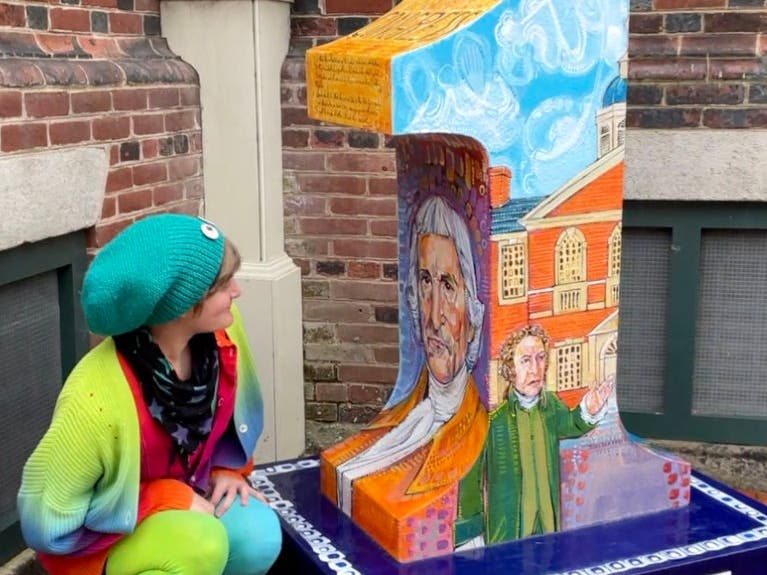
PHILADELPHIA, PA — In celebration of the nation's 250th birthday, a Lambertville, New Jersey, artist has created three unique sculptures depicting a trio of Philadelphia firsts - the Continental Congress, the Philadelphia Zoo, and John Fitch's steamboat.
The works are part of Philadelphia's "52 Weeks Of Firsts," a special outdoor exhibit highlighting the city's many firsts, from being the first capital of the United States to having the first organized volunteer fire company and manufacturing the first pencil with an eraser.
The "52 Weeks of Firsts" exhibit is a joint project of the National Constitution Center, Historic Philadelphia, and Mural Arts Philadelphia, and features a year's worth of free events and public art projects, each created in the shape of a No. 1.
Find out what's happening in New Hope-Lambertvillefor free with the latest updates from Patch.
Three of the public art projects - the First Continental Congress, John Fitch's Steamboat, and the Philadelphia Zoo - were created by the 2026 NJ Individual Artist Fellow Gwenn Seemel, a Lambertville, New Jersey, painter best known for their dynamic polka-dot Cubist style.
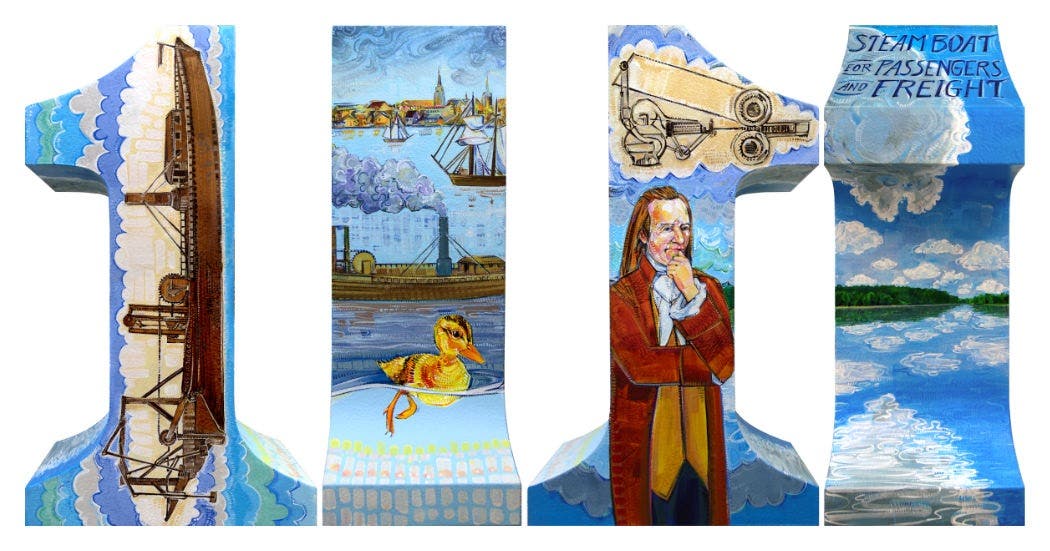
This shows the four sides of Gwenn Seemel's No. 1 John Fitch Steamboat sculpture. (David Vanadia)
Find out what's happening in New Hope-Lambertvillefor free with the latest updates from Patch.
Seemel’s artworks, like all the pieces from 52 Weeks of Firsts, are person-sized sculptures in the shape of a No. 1 that the artist hand-painted with designs inspired by Philadelphia’s historic firsts.
The Lambertville painter is one of 25 artists who spent several weeks at the end of last year creating the art landmarks, which are on display during the yearlong celebration in more than a dozen neighborhoods across the city.
“Figuring out how to portray the first steamboat, first zoo, and First Continental Congress was each a puzzle, but making custom art is something I’m used to. Fitting my designs onto a No. 1 was the real challenge, and it proved delightful,” says Seemel.
The Lambertville painter’s art will be the focus at special events from 11 a.m. to 1 p.m. on May 30 at the Independence Seaport Museum, on August 8 at the Zoo, and on September 12 at Carpenters’ Hall, but the public can visit Seemel’s artworks anytime during the year.
Use this interactive map to plan your art tour and celebrate the city on any given Saturday this year at special firstivals.
About The First Steamboat
John Fitch’s steamboat carried both passengers and freight over 1,000 miles back and forth between Philadelphia and Burlington, New Jersey for several months in the summer of 1790. The side of Seemel's sculpture depicts the steamboat on the river with other ships of the day in the background and a duckling in the foreground, emphasizing the unusual duck-paddling design of Fitch’s 1790 steamboat. On the back of the sculpture, the artwork depicts Fitch thinking about his engine, and, on the final side, there’s a beautiful river view of the Delaware.
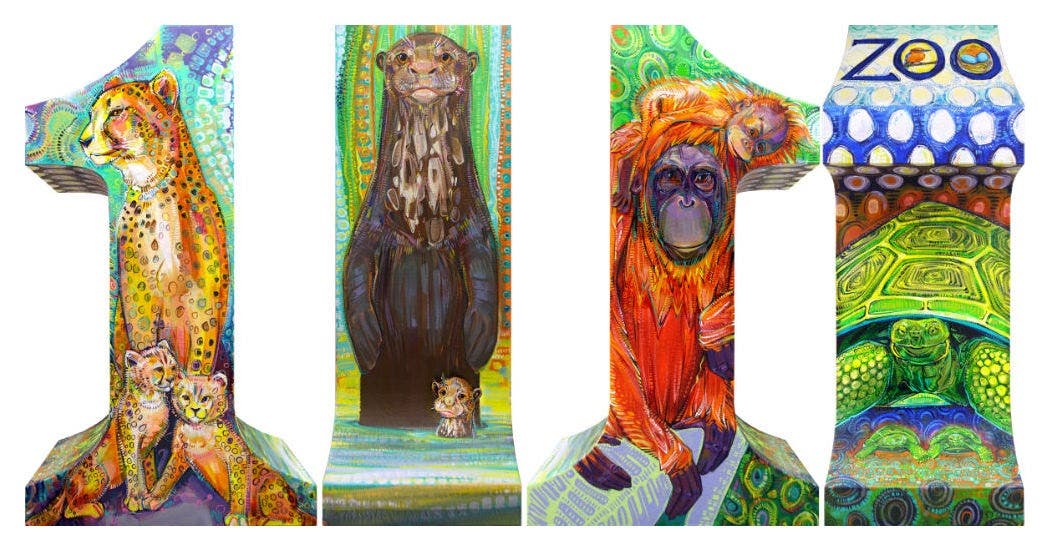
This shows the four sides of Gwenn Seemel's No. 1 Philadelphia Zoo sculpture. (David Vanadia)
About The First Zoo
The first zoo in the United States is an institution full of big milestones: the first birth of a cheetah in a zoo in 1956, the first birth of a giant river otter in North America in 2004, the first birth of an orangutan in a U.S. zoo in 1928, and the first recorded parent-reared sihek in 1985 as part of the captive breeding program that the institution undertook to help save the species. In 2025, the Philadelphia Zoo added yet another big moment to its annals when Mommy the Western Santa Cruz Galápagos tortoise became a mother for the first time at 97 years old.
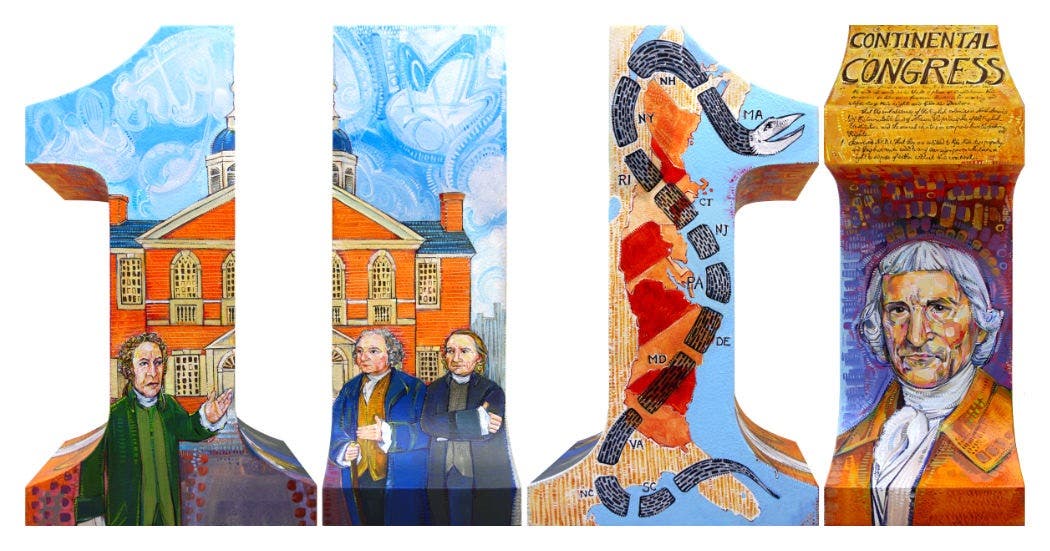
This shows the four sides of Gwenn Seemel's No. 1 First Continental Congress sculpture. (David Vanadia)
About The First Continental Congress
The sculpture depicts Patrick Henry speaking to John Adams and John Morton, the representative from Pennsylvania who would later provide the swing vote that allowed the state to vote in favor of the Declaration of Independence. The back of the sculpture shows a map of the 13 colonies along with a reworking of Ben Franklin’s “Join, or Die” snake that was published in The Pennsylvania Journal after the First Continental Congress. The final figure is Charles Thomson, a Philadelphian who was secretary of the Continental Congress as well as being a defender of the rights of indigenous people and one of the designers of the Great Seal of the United States.
Since 2003, Seemel has been painting in a playful polka-dot Cubist style that lends a playful intensity to their figurative art. Seemel’s work has been featured everywhere from Newsweek and Hyperallergic to the cover of an Oxford University Press book, and the artist has worked with Princeton University, Garden State Equality, and Jobs With Justice, among many other institutions.
Seemel speaks regularly about creativity, notably giving a TEDx talk in Switzerland. The artist is French-American, and they live in Lambertville, New Jersey. Seemel received a 2026 Fellowship from the New Jersey State Council on the Arts.
Get more local news delivered straight to your inbox. Sign up for free Patch newsletters and alerts.