Traffic & Transit
Open House Event To Preview New Hope-Lambertville Bridge Project
Programmable architectural lighting system to be major project element.


NEW HOPE, PA — Proposed construction plans, travel restrictions, and other aspects of a 2024 rehabilitation of the nearly 120-year-old New Hope-Lambertville Toll-Supported Bridge will be detailed at an open house event on June 15 from 5 to 7 p.m. at the Riverside Ballroom at the Lambertville Station Inn, 11 Bridge Street, Lambertville, N.J.
The open house will include viewing stations where the public can speak one-on-one with members of the project design and engineering team, ask questions and offer comment on the project. The session will feature visual displays of existing conditions, planned major project tasks, an updated project schedule, anticipated travel restrictions and impacts, the sequencing of work stages, and information about a programmable LED lighting system that would highlight the bridge’s architectural profile along the river.
Following the open house, the displayed materials will be added to a project-specific webpage -- http://www.drjtbc.org/project/newhopelambertville — the commission established earlier this year. Individuals unable to attend the open house sessions will have an opportunity to view the materials and relay concerns or questions during a two-week-long public comment period scheduled to end 4 p.m. on June 30. Once the open house/public comment process is completed, project planning will proceed to final design.
Find out what's happening in New Hope-Lambertvillefor free with the latest updates from Patch.
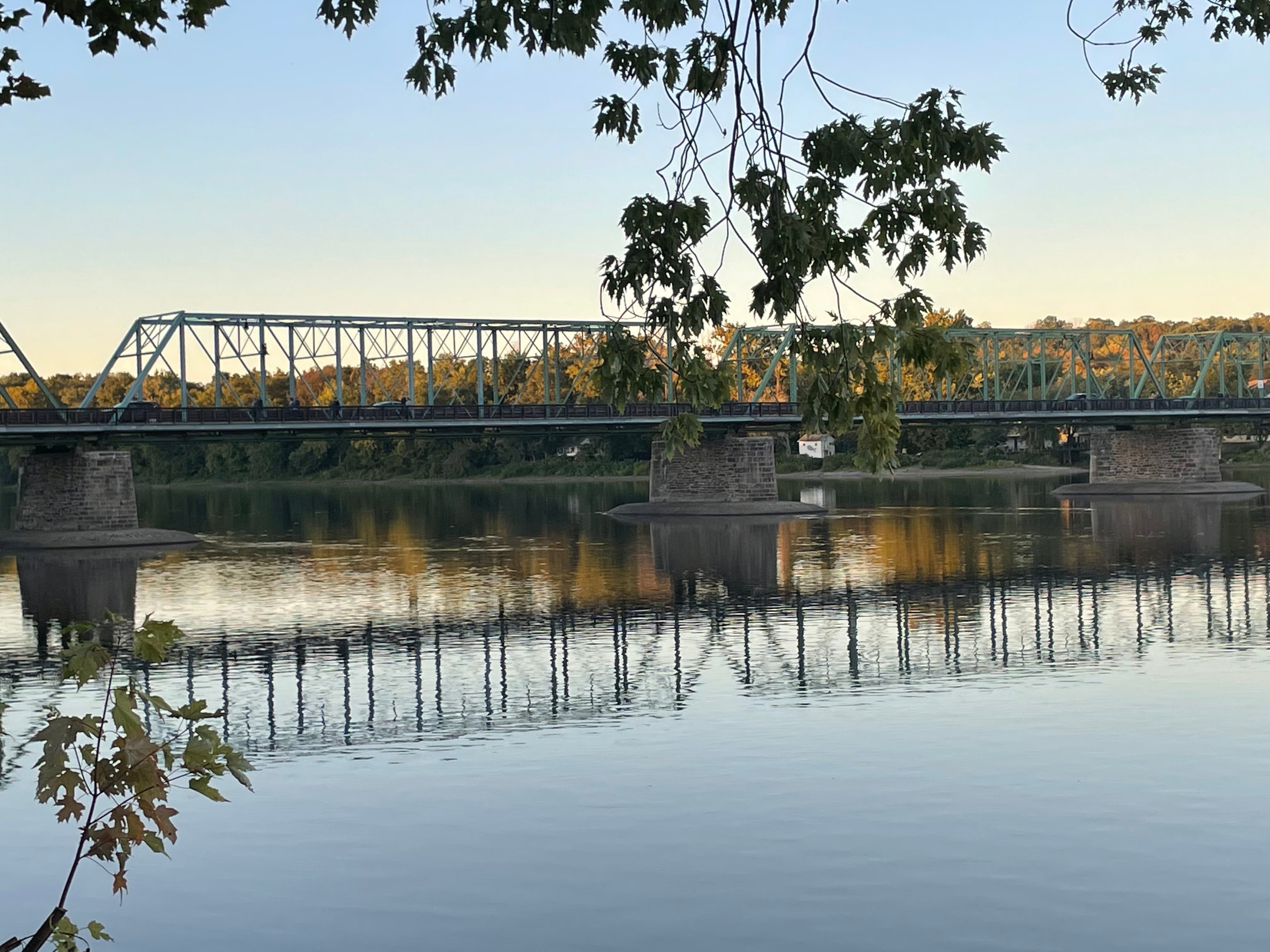
New Hope-Lambertville Free Bridge. (photo by Jeff Werner)
Besides the installation of an architectural lighting system, the bridge’s rehabilitation is expected to include the following major work:
Find out what's happening in New Hope-Lambertvillefor free with the latest updates from Patch.
- Removal of the current walkway panels and replacement with skid-resistant foam-core fiber-reinforced-polymer panels;
- Cleaning and repainting of the bridge’s steel-truss superstructure; and
- Repair or replacement of various deteriorated or compromised steel components.
According to the commission, the bridge’s walkway will need to be closed for a yet-to-be-determined period as part of the rehabilitation projec. Motorist impacts also are in the process of being determined. The extent of pedestrian and motorist impacts will be ascertained and included among the materials presented at the June open houses.
The commission said it cannot rule out that short-duration closures of the bridge’s two travel lanes might be necessary at some points during the rehabilitation.
"Ideally, the project can be staged in a manner that would impact westbound (Pennsylvania-bound) vehicular travel across the bridge only as a last resort," said the commission.
Tolls are collected in the Pennsylvania-bound direction at the next closest river crossing – the New Hope-Lambertville [Route 202] Toll Bridge – roughly one mile upstream. Class 1 passenger vehicle tolls at that bridge will be $1.50 for E-ZPass and $3 for cash transactions at that bridge in 2024. Toll rates are higher for larger vehicles.
Eastbound (New Jersey-bound) motorists affected by rehabilitation project travel restrictions would have toll-free access in that direction across the nearby toll bridge.
The aging steel-truss bridge connecting New Hope and Lambertville’s commercial centers was last rehabilitated in 2004.
In February, the commission announced the procurement of an engineering consulting firm – GPI/Greenman Pederson, Inc. of Lebanon, N.J. – to design a planned rehabilitation of the bridge in 2024.
GPI has performed a detailed inspection of the structure to identify and confirm the various structural deficiencies to be addressed under the rehabilitation project. GPI is currently in the process of mapping out a preferred course of action to address identified issues with the bridge and plan out the other major tasks that the Commission has budgeted to be conducted during the project. This preferred rehabilitation scenario is what will be presented to the public at the upcoming open houses.
The functionally obsolete bridge superstructure has a four-ton weight limit, a 10-foot height restriction, and a 15-MPH speed limit. It carried an average of 12,400 vehicles per day in 2022.
The bridge was constructed for the former New Hope Delaware Bridge Company in 1904, replacing a wooden covered bridge that was destroyed in the “Pumpkin Flood” of October 1903. The steel truss replacement bridge initially operated as a private tolled crossing 15-1/2 years. The bridge has been publicly owned and operated as a non-tolled crossing since early 1920. The Commission has owned the bridge since July 1, 1987. The commission uses a share of toll proceeds collected at its eight toll bridges to operate and maintain the bridge and 11 other “toll-supported” bridges along the river.
Get more local news delivered straight to your inbox. Sign up for free Patch newsletters and alerts.