Politics & Government
Could An EV Police Car Be In Newtown Borough's Future?
Police department test drives BMW; borough council hears cost benefit analysis as it weighs electric vs. gas-powered vehicles.


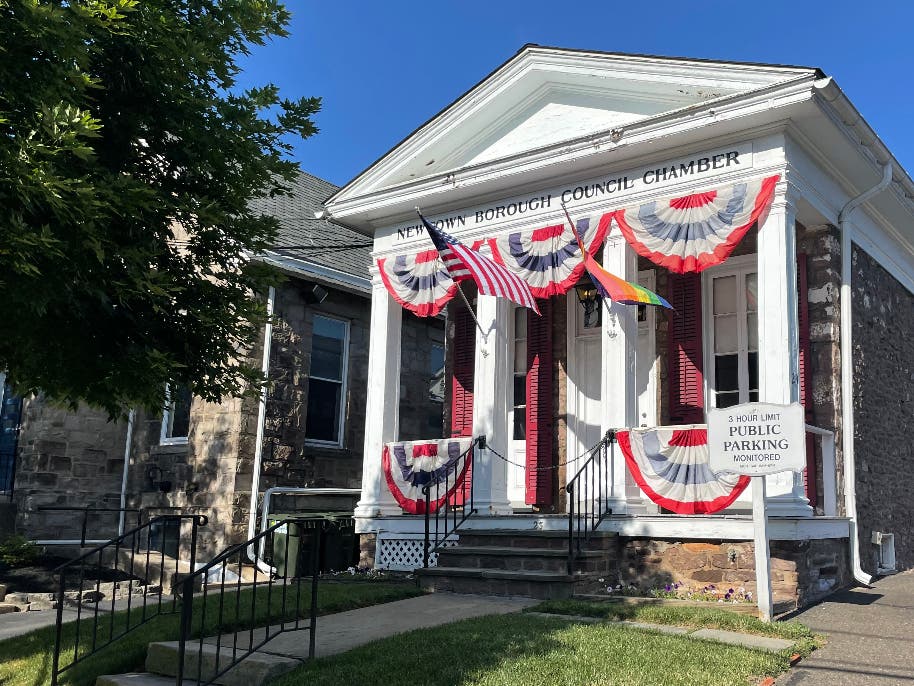
NEWTOWN BOROUGH, PA — Newtown Borough is in the early stages of an investigation that could lead to the purchase of an electric-powered police car.
At this week’s borough council meeting, Police Sergeant Sean Orr, who formerly worked as an automotive field technician, presented council with a preliminary cost benefit analysis of a gas powered vehicle versus an EV.
Since the beginning of the year, the department has been test driving a 2022 BMW IX EV through a partnership with the BMW Corporation.
Find out what's happening in Newtownfor free with the latest updates from Patch.
The partnership was arranged by borough resident Joe Lovi who suggested back in October that the council consider an EV when purchasing its next police vehicle. He offered to reach out to his connections at BMW to arrange an electric vehicle for a test drive.
The department took Lovi up on his offer and Lovi reached out to his BMW connections. Soon after that BMW delivered the electric car to the borough for what the department thought would be a week or two.
Find out what's happening in Newtownfor free with the latest updates from Patch.
“I picked it up on January 3. It’s still parked outside. I’m not complaining,” said Orr.
As part of the test drive, Orr began investigating the pros and cons of an EV purchase, developing a cost analysis and vehicle comparison which he presented to council this week.
A move to EV, said Orr, would address vehicle idling, one of the borough’s biggest challenges with its gas-powered vehicles.
“Idling is probably the biggest killer of our patrol fleet’s gas vehicles,” said Orr.
“The industry standard is one hour of idling is the equivalent to 33 to 35 miles traveled. When we’re monitoring an intersection, it’s idling. When we're sitting in front of the gas station, it’s idling. On an average 12 hour shift the car is probably idling any where from 8 to 10 hours. When you do the math, that’s over 40,000 miles of idling," said Orr.
“With that being said, our fleet lasts an average of three and half years,” continued Orr. “The idling increases maintenance costs due to the wear and tear. Besides that it’s increasing greenhouse emissions.”
An EV, on the other hand, has an eight year battery life, said Orr. “That doubles the life of my patrol vehicle,”he told council. “It eliminates the greenhouse emissions. It significantly reduces the cost of energy consumption. It significantly reduces the cost of maintenance because there are no mechanical parts and there’s no transmission.”
With that said, there’s the lack of infrastructure to accommodate charging, Orr continued, noting that the closest public charging station is at Washington Crossing Park.
Orr said some of the benefits of EVs include the availability of federal, state and local grants; an EV infrastructure that could create a new revenue stream for the borough; and the potential of putting the borough on the map for being the first department to make the transition.
Among the drawbacks, he said, is marketability. “If everyone goes at once (to EVs) it’s going to be hard to get the parts and hard to get for the cars,” said Orr.
Orr’s analysis found that the initial cost of an EV, which has a battery life of eight years, and the associated infrastructure would be about $125,000. The cost includes $85,000 for the purchase of the car, $10,000 for a charging station, $17,000 for lights and equipment and another $14,000 for radio and a camera.
In comparison, over that same eight year period Orr said the borough would have to spend $270,000 on gas-powered patrol vehicles, which equates to replacing a vehicle every 3 1/2 years due to idling hours and maintenance costs.
“Electric vehicles still cost us $125,000 because the battery is still good for eight years and the motors in the cars are rated at a million miles. When an electric car stops there’s nothing moving. It’s just running off a battery,” said Orr.
A cost analysis of energy use also shows a potential savings of $4,366 a year in favor of the EV.
According to Orr, an EV would eliminate idling hours, negating the need to purchase a new vehicle every 3 1/2 years; there would be no environmental issues; an EV would save the borough more than $4,000 a year in energy cost; and an EV would save the borough $145,000 in acquisition costs over an eight year period.
During public comment, Lovi said companies like BMW are willing to install infrastructure as long as the charger is available for public use.
“This is where the incentive is,” said Lovi. “BMW loves the fact that we’re four miles from I-295. They also see the fact that we’re a hub and the spokes to the other towns. Change is not going to happen from the larger municipalities. It’s going to happen from a small borough perspective and then it’s going to move on from there,” he said.
And Lovi added, “From a cost perspective, you’re looking at $150,000 in savings in one car. You have a fleet of four. That’s $600,000. The budget for the police department is $1.2 million. That’s half of the whole budget,” he told council.
Get more local news delivered straight to your inbox. Sign up for free Patch newsletters and alerts.