Crime & Safety
Amtrak 188 Driver: 'This Is It, I'm Going Over'
The engineer in control of Amtrak 188 when it derailed offered "dream-like" details in two interviews released Monday by the NTSB.


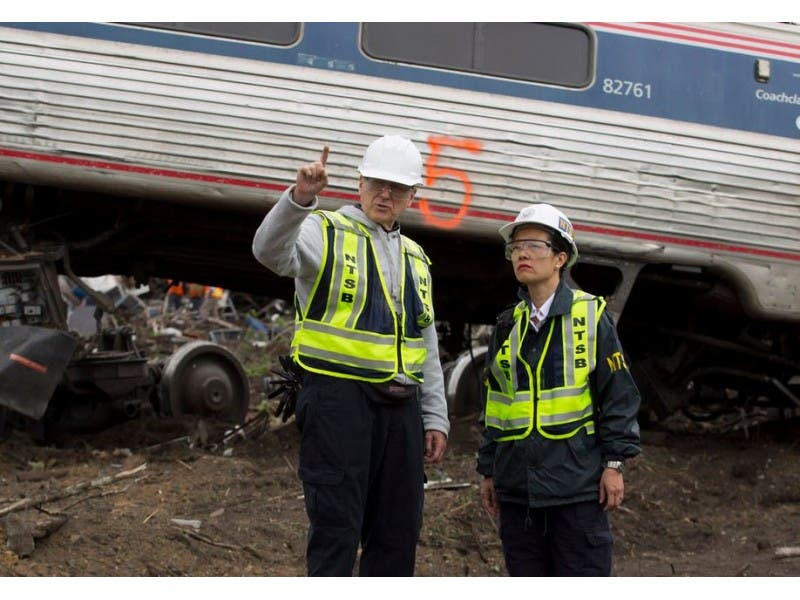
The engineer operating the Amtrak train that derailed in Philadelphia in May, killing eight people, offered investigators ”dream-like” details of the night of the crash in two interviews released Monday by the NTSB.
But more than 75 pages of interview transcripts with Amtrak engineer Brandon Bostian, who was operating the Washington, D.C.-to-New York route on the evening of May 12, 2015, offer no concrete answers behind the cause of the derailment.
In his first interview, conducted three days after the crash, Bostian, 32, told investigators with the NTSB his last memory before the train derailed at Frankford Junction was several minutes before the crash.
Find out what's happening in Newtownfor free with the latest updates from Patch.
“The last memory I have on the way back is approaching and passing the platforms in North Philadelphia. I remember turning on the bell, and the next thing that I remember is when I came to my senses I was standing up in the locomotive cab after the accident,” Bostian told investigators in his first interview after the crash.
However, in an interview six months later, Bostian recalled additional “dream-like” details of the crash but could not positively say if his recollections were in fact accurate. The interview transcripts paint a murky picture of the moments leading up to the crash.
Find out what's happening in Newtownfor free with the latest updates from Patch.
“There’s several gaps in my memory as I approached the accident curve. And I couldn’t say with certainty that my memory is accurate,” Bostian told investigators on Nov. 10.
He elaborates on speed limit changes.
“I came out of the 65 mile an hour curve. I pushed the throttle forward to accelerate my train. And as I approached 70 miles an hour, I have a memory that I backed off the throttle by mistake because I was targeting 70 miles an hour instead of 80 miles an hour.” He said he then pushed the throttle forward in order to accelerate from 70 to 80.
“I don’t remember anything from that point until after the train was already in the curve,” he said.
His memory from being in the curve seconds before the crash to the time he regained consciousness after the accident is vague, he said.
“I hesitate to use the word dream-like because it sounds like I was asleep and I don’t believe that I was asleep at all,” he said.
Bostian said he doesn’t remember sounds. His recollection of the events is “more of a feeling.” He recalled three manipulations of the train’s brake controls in the moments leading up to the crash.
“I remember feeling my body lurch to the right, towards the right side of the engine. I remember feeling as though I was going too fast around a curve. In response to that feeling, I put the train brake on, made about a ten-pound application of the brake,” he said.
That action would have been a normal response to slowing down a train, he told investigators.
But “very soon” after that, he realized from the force of his body that “this is something that’s very serious” and he needed to bring the train speed down quicker. And so, almost immediately, he said he went to “full service” on the breaks.
Soon after that, he said he “felt a sensation” that one side of the train was lifting up and the engine was tilting over.
“And that’s when I realized…the train was going significantly fast around the curve. And that’s when I put the train into emergency,” he said. Around that time, he recalled hoping the train would not completely tip over.
“Immediately after having those thoughts, I remember feeling the train tip over even further. And I remember realizing that the train was going to go off the track. I remember holding onto the controls tightly and feeling like, okay well this is it, I’m going over. And so I tried to brace myself.”
His only visual memory during the moments surrounding the crash is seeing objects fly in front of him, with “kind of a bluish tint to them,” he told investigators.
“When I try to remember what the visual of the memory is, it just looks like small objects. And that’s pretty much all I remember.”
His next memory is after the crash, when he was in the cab, “hearing screams from passengers.” Otherwise, it was ”kind of quiet,” he said.
Bostian also recalled some radio chatter leading up to the fateful curve, when an engineer in an adjacent track had placed that train into emergency.
“He had reported that rocks had hit his windshield. He had had a radio conversation with the dispatcher. The dispatcher asked him a couple of times if he needed medical attention. He didn’t answer the question directly and so, they went back and forth a few times,” Bostian recalled.
Then he radioed the SEPTA train to alert them he was passing on an adjacent track. “I blew my train’s whistle quite a bit.”
The final report on the cause of the crash could take up to a year from the derailment, authorities have said.
Get more local news delivered straight to your inbox. Sign up for free Patch newsletters and alerts.