Community Corner
Newtown and Slavery
Newtown was home to abolitionists and the Underground Railroad, as well as slaveholders.
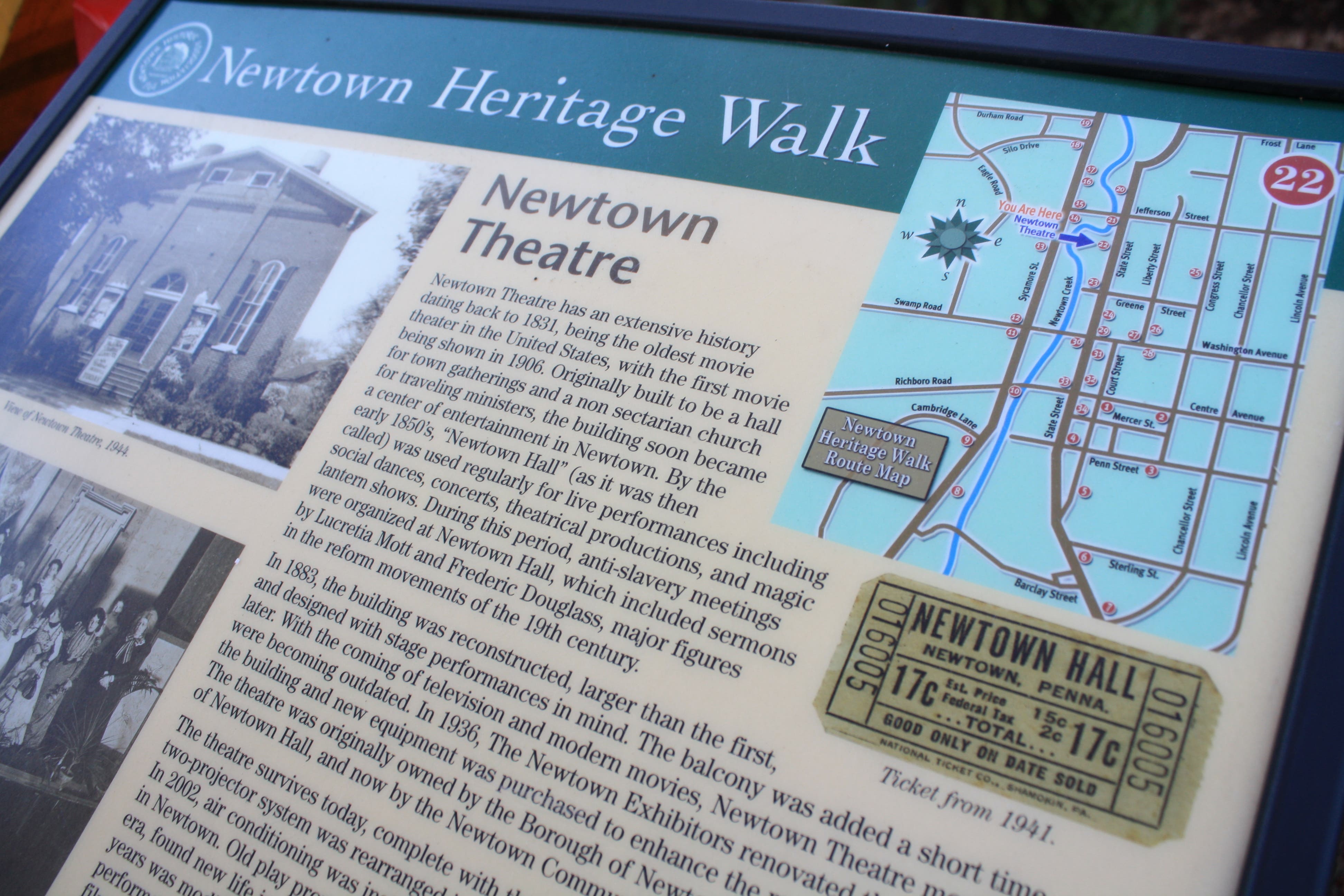
It’s well known that during the 1850s, abolitionists Lucretia Mott and Frederic Douglas engaged audiences in the anti-slavery movement at the Newtown Theatre, then known as Newtown Hall.
The activism in Newtown’s Quaker community is also known to have been instrumental in the Underground Railroad. Slave hunters found tracking runaways difficult once they crossed the Pennsylvania border and supposedly claimed that there must be an underground railroad. Hence the name.
Despite all of that, Newtown was not exempt from the evils of slavery.
Find out what's happening in Newtownfor free with the latest updates from Patch.
Slavery came to Bucks County with Dutch and English settlers, including William Penn, who brought slaves with them beginning in the 1630s.
Penn urged that slaves should be monogamous and that they should be educated, according to Charles C. Waugh’s Friend Indeed. Some historical references claim that slavery in Pennsylvania was of the mild variety. According to W. W. Davis’ History of Bucks County, “slaves were treated well as long as they behaved themselves.”
Find out what's happening in Newtownfor free with the latest updates from Patch.
Pennsylvania: A History of the Commonwealth, on the other hand, notes that Pennsylvania slaves were treated harshly. Unlike life on southern plantations, “enslaved Pennsylvanians suffered from social and familial isolation. They had less opportunity to form families or to live with family members, nor could they easily develop a semiautonomous community centered around a slave quarter.”
In 1696, the yearly Quaker meeting advised Friends not to import slaves. However, it wasn’t until 1776 that it directed a monthly meeting to disown slave holders. Pressure from the Friends is credited in the creation of the State Assembly’s Gradual Emancipation Act, initiating the gradual abolition of slavery in 1780.
As part of the act, all slaves were to be registered by November 1782. Noncompliance resulted in the forfeiture of slaves.
There were 23 slaves registered in Newtown, according to W. W. Davis. The owners included Thomas Buckman, Martha Murray and Lamb Torbert, who each held one slave in 1782. Peter Lefferts held two slaves and Margaret Strickland was registered as having three slaves. Hannah Harris held the most slaves – 11.
Martha Murray was the wife of General Francis Murray, who organizaed a company of Newtown soldiers to fight in the Revolutionary War. Margaret Strickland was the second wife of Amos Strickland, who built the Brick Hotel. She was also the daughter of Joseph and Margaret Thornton, who owned the Court Inn, which is now the headquarters for the Newtown Historic Association.
It was Hanna Harris’ house (razed in 1862) that served as General George Washington’s headquarters after the Battle of Trenton. Washington, who most likely was attended by slaves during his stay, wrote two letters from the house updating the Continental Congress on his latest success.
It was also Washington who made one of the earliest references to slaves running away and being helped to freedom.
According to William J. Switala’s Underground Railroad in Pennsylvania, Washington wrote a letter to Robert Morris, the financier of the Revolutionary War and for whom Morrisville is named. In it, he wrote that if the Quakers’ practice of helping runaways did not stop, anyone visiting Philadelphia with a slave ran the risk of losing that slave.
"I can only say that there is not a man living who wishes more sincerely than I do to see a plan adopted for the abolition of (slavery); but there is only one proper and effectual mode by which it can be accomplished, and that is by Legislative authority," Washington stated in his letter.