Politics & Government
Newtown Area Townships Racing to Regulate Data Centers Before They Arrive
5 Surprising Takeaways from the May 7, 2026 Newtown Area JZC Meeting

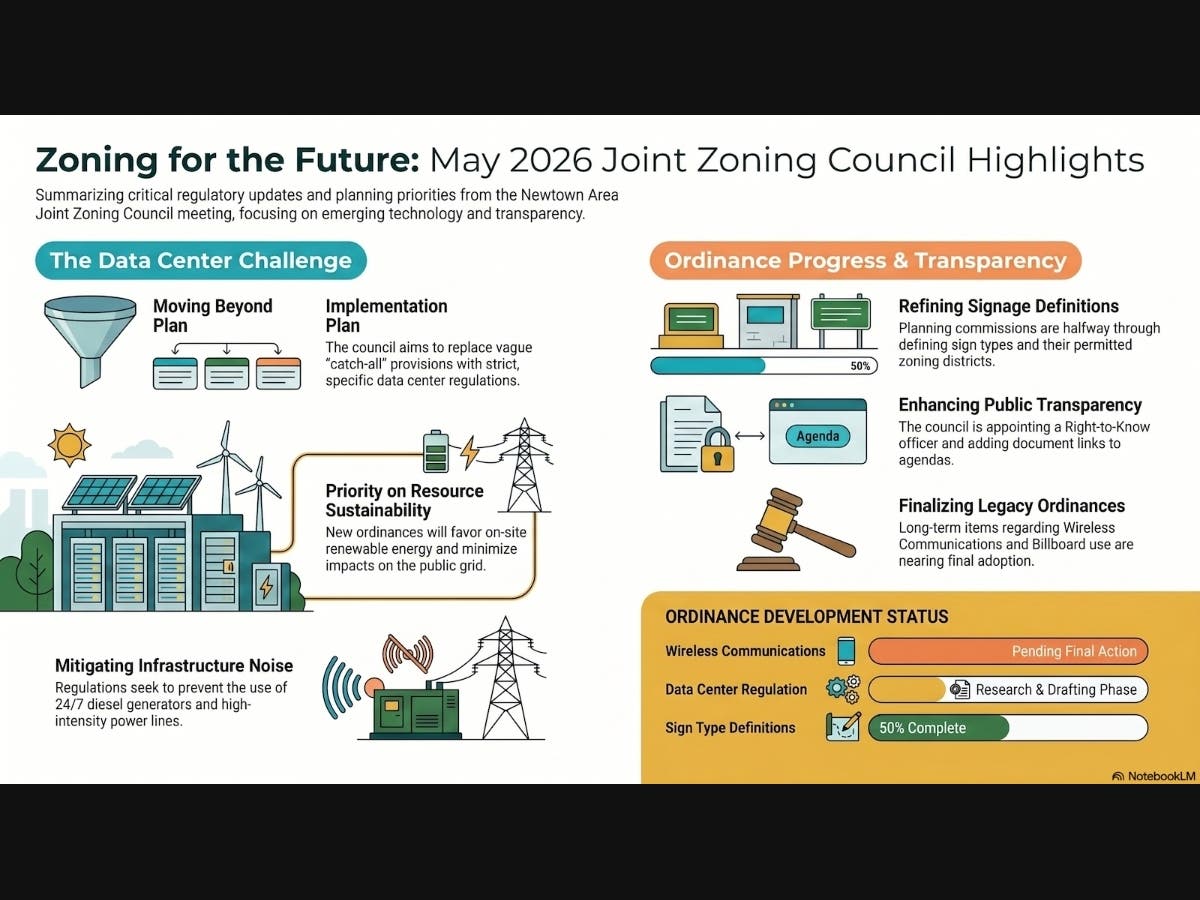
5 Surprising Takeaways from the May 7, 2026 Newtown Area JZC Meeting
The Newtown Area Joint Zoning Council is racing to regulate data centers before they arrive.
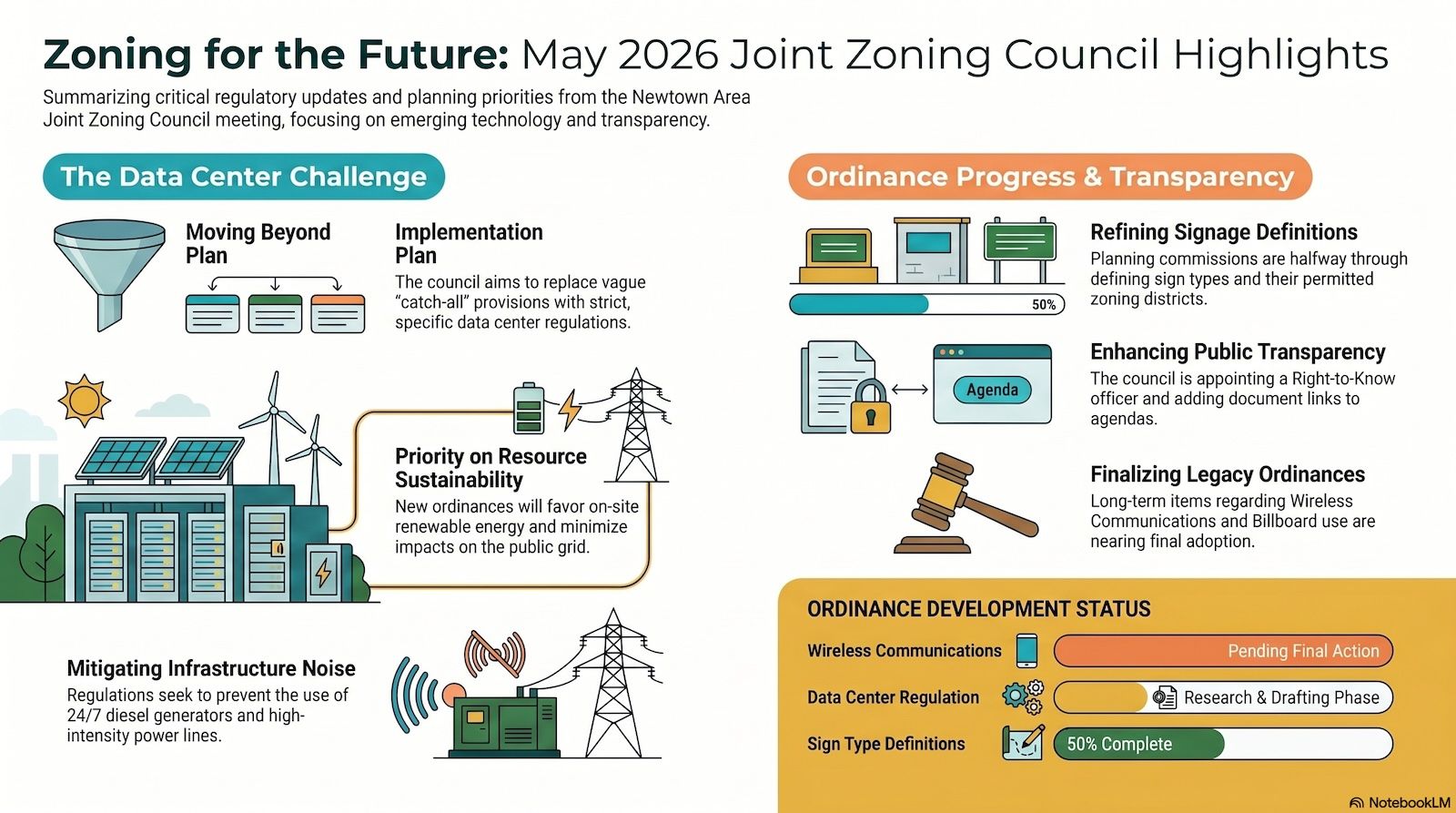
On a typical Thursday evening at the Wrightstown Township Municipal Building, the agenda of the Newtown Area Joint Zoning Council (JZC) usually reflects the slow, predictable rhythm of suburban zoning. But the May 7, 2026, meeting signaled something much bigger: a high-stakes effort to prepare the Newtown area for the possible arrival of massive data centers and the staggering energy demands of artificial intelligence.
The JZC, which represents the collective zoning interests of Newtown Township, Wrightstown, and Upper Makefield, is now working to define how these industrial-scale technology facilities fit — or do not fit — into a landscape of historic farms, quiet neighborhoods, and limited natural resources.
Find out what's happening in Newtownfor free with the latest updates from Patch.
Find out what's happening in Newtownfor free with the latest updates from Patch.
1. Local Zoning Is Playing Catch-Up
Data centers are a relatively new land-use issue in this region. As a result, the current Joint Municipal Zoning Ordinance does not specifically define or regulate them.
That creates a vulnerability. Without a dedicated ordinance, data centers may fall under a general “catch-all” provision for lawful uses not otherwise defined. Currently, undefined uses are often steered toward RI (Rural Industrial) or RIA (Rural Industrial-A) districts in Wrightstown, otherwise known as the “Quarry District.”
JZC Solicitor Oetinger compared this to past situations where new uses, such as axe throwing, emerged faster than zoning ordinances could be updated.
“That catch-all provision is a nice safety net to have, but it’s not the gold standard.”
The Problem: The "catch-all" lacks the "gold standard" protections residents might expect. It does not provide specific, high-level requirements for:
- Noise levels from industrial cooling systems.
- Energy demands and potential "behind the meter" power generation (like diesel generators).
- Water usage for cooling and its impact on the local water table.
The concern is that this catch-all provision could steer undefined uses into RI or RIA districts without the detailed protections residents might expect for noise, environmental impacts, aesthetics, water use, and energy demand.
2. Data Centers May Bring Their Own Power Problems
One of the most striking issues discussed was the possibility that data centers could operate “behind the meter,” using on-site power generation to bypass delays or limits in the electrical grid.
The meeting referenced examples of large technology operations relying on extraordinary energy sources, including mobile loud, polluting diesel generators running around the clock and renewed interest in (OMG!) nuclear power facilities.
For local communities, this raises serious questions:
- Could diesel generators run continuously near homes?
- Could local electrical infrastructure be overwhelmed?
- Should renewable energy – solar, wind – be required on-site?
- How should water-intensive cooling systems be regulated?
The JZC intends to explore ways to require stronger safeguards, including renewable energy provisions and protections against private wells that could threaten the local water table.
3. Defining a Data Center Is Harder Than It Sounds
A central challenge is how to define a data center without accidentally regulating ordinary residents or small businesses that use multiple computers or servers.
The council discussed the need to distinguish between an “accessory use” and a “principal use.” For example, a business that uses server equipment to support its normal operations may be very different from a facility whose primary purpose is data processing for commercial clients.
Key factors under consideration include:
- Scale: The size of the building, server racks, and related infrastructure.
- Profit motive: Whether the facility processes data for third parties as a commercial enterprise.
- Grid impact: The amount of electricity, cooling, and backup power required.
4. Unpreserved Farmland May Not Be Safe
During public comment, Newtown Township resident John Mack raised a question that should concern many fellow residents: could large farms in the Newtown area be sold to data center operators?
The answer was sobering. While Patterson Farm is legally preserved, not every farm or large open parcel has that protection. The Wright Farm was cited as a cautionary example of a property that was not legally preserved and is now being developed for luxury homes.
Data center developers often seek large parcels — sometimes 50 acres or more. If a farm is currently being worked but is not legally preserved, it may still be vulnerable to market pressure.
That is why the JZC’s work matters. Without a carefully written ordinance, large unpreserved parcels could become targets for high-intensity industrial development.
5. Transparency Is Getting an Upgrade
The meeting also produced a positive push for open government. The council moved toward appointing a dedicated Public Information/Open Records Coordinator (i.e., Righ-to-Know officer or Agency Open Records Officer).
This was in response to Mr. Mack’s request that the JZC make information more easily available to the public without requiring residents to file formal Right-to-Know requests.
Mack’s goal , which is inline with the goals of Neighbors for Open Government, is to provide:
- Linkable agendas with direct access to draft ordinances, memos, and supporting documents.
- More proactive disclosure so residents can see the same documents officials are reviewing.
- Better public access when high-impact issues such as data centers, billboards, or zoning changes are discussed.
The Bottom Line
Solicitor Oetinger advised the council to write the most “scripted” and restrictive ordinance possible at the outset, noting that it is easier to relax a requirement later than to add protections after a project is already proposed. The goal is to define these facilities as a "principal use" and establish clear environmental and infrastructure safeguards before a developer attempts to use the catch-all provision to bypass local oversight.
That may be the most important takeaway from the meeting.
The Newtown area is not just debating a technical zoning amendment. It is deciding how much industrial-scale technology infrastructure should be allowed in a community defined by farms, neighborhoods, and historic character.
In the race between silicon and soil, a carefully scripted ordinance may be the only thing standing between a historic farm and a diesel-powered data hub.