Business & Tech
Newtown Zoning Board Hears Arguments In Borscht Belt Sign Appeal
Decision to be announced at the board's February zoning hearing board meeting.


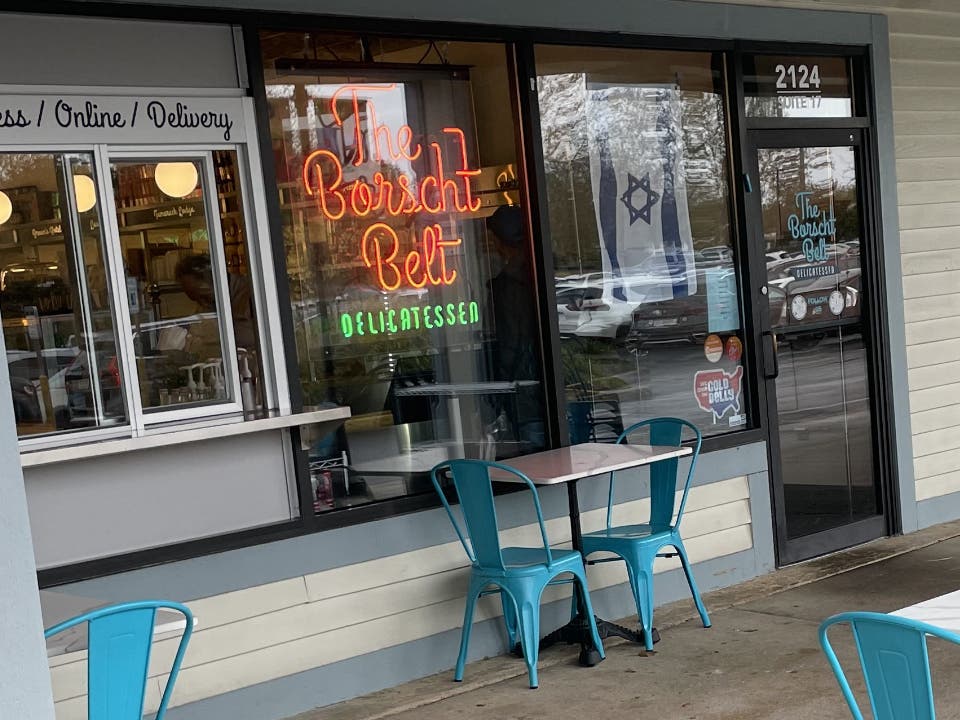
NEWTOWN TOWNSHIP, PA — The fate of a neon sign hanging in the window at the Borscht Belt Deli rests in the hands of the Newtown Township Zoning Hearing Board.
After hearing two and a half hours of sometimes emotional testimony and public comment Thursday night, the board continued the hearing until February when it will issue its decision on whether the sign can stay or or has to come down.
The owners of the popular Jewish deli, which opened last spring, are appealing a notice from the township that its red and green neon sign containing the deli's name violates the township's ordinance, which states that “any sign illuminated by inert gas or any form of exposed tubes is prohibited."
Find out what's happening in Newtownfor free with the latest updates from Patch.
The township filed the notice after receiving complaints, one of which the Borscht Belt owners contend came from a known antisemitic who has had issues with the deli.
The township’s lawyer, Dave Sander, opened the hearing by asking the board to immediately deny the appeal arguing that the eatery failed to file an appeal within 30 days of the issuance of the violation notice, which it’s required to do under the law.
Find out what's happening in Newtownfor free with the latest updates from Patch.
After adjourning into a brief executive session, the zoning board said it would take Sander's request under advisement as it considers the appeal, but decided to move forward with the hearing.
In arguing the township's case before the board, Sander asked the zoning hearing board to uphold the law and to reject the appeal.
“This is a zoning case limited to a sign that is neon that appears in the front window of a business in the township. A complaint was received by the zoning officer. She investigated it. She saw what she believed to be a violation of the sign ordinance.
“The sign is what it is,” said Sander. “It is a neon sign that’s hanging in the front window and it violates the zoning ordinance. There’s no question about that. The issue that there are other (neon) signs (at other businesses in the township) is not at issue here.
"The appellants have made this a case of disparaging treatment, of singling this business out based on content because it is a Jewish deli. It’s being made into something that’s much more suited for argument before the federal bench. This is a very simple case. This is an illegal sign. This person was cited. Others were cited and are now in compliance ... So let’s not go down the rabbit hole of selective enforcement and antisemitism and content-based enforcement.”
Sander asked the zoning board “to focus its decision and first hold that it was not timely filed based on the paperwork filed, but secondly, the sign is in violation of the zoning ordinance and the zoning officer issued a true, correct and proper enforcement notice.”
Borscht Belt owner Mike Dalewitz argued before the zoning board that the township used selective enforcement, pointing to 100 other neon signs in the township that had gone unchallenged until the Borscht Belt’s sign was singled out.
“There has been selective enforcement of this zoning code in that there are examples throughout this township that have allowed these neon signs to exist,” argued Alan Nochumson, the Borscht Belt's lawyer. “We’re asking that the board stop any kind of monetary fines because of this selective enforcement.
“It’s an either-or scenario," said Nochumson. "Either you prohibit every single neon sign or you allow every single neon sign in the township. You cannot condone this activity that has been perpetrated by this zoning officer who has turned a blind eye to other people because of the content of the speech.”
"The irony here is this," said Dalewitz. "The Borscht Belt was created by the Jewish community in a portion of New York State - the Catskills - as a resort community. Why was it created? Because there was signage there that didn't allow Jews. No Jews were allowed to inhabit resorts within the Catskills. Over 30 years, more than 500 hotels were created specifically for the Jewish community. Now we have a situation here where we have a deli that is respecting the past, of what was special there. Now we're being told to take down the sign that we're proud of."
During public comment, a handful of residents weighed into the appeal, most of whom spoke in favor of granting the appeal.
"This is a very troubling situation," Eric Pomerantz told the zoning board. "And I'm sure you, as the zoning hearing board, can feel some of what this community here today is feeling."
Pomerantz said the community is aware that an individual who had demonstrated hostility toward the Borscht Belt has made complaints to the township.
"Why wasn't there an investigation done to assess the number of other businesses in violation before issuing the violation to the Borscht Belt? Because we hear that they only respond to complaints," he said. "So you present to our community that you're doing the bidding of this person who has demonstrated hostility. It certainly feels like selective enforcement given that all the other businesses operated their signs without issue. It certainly feels like the Jewish community has been singled out for enforcement while others are not," he said.
"We're part of the community. What's happening here is not something you should be proud of. So what's your solution? If I were in your position, I would invite them (the Borscht Belt) to submit an application for a variance because legally Mr. Sander may be right, but morally he is wrong. And this will be something the community will not forget," said Pomerantz.
Rabbi Charles Briskin from Congregation Shir Ami in Newtown spoke in support of the appeal, speaking about the letter of the law and the spirit of the law.
"The spirit of the law says this is a business that has a lovely sign in the window, that does not say anything offensive. It is not blinking and it's not obnoxious," he said. "It is a sign that is simply here to announce a business, a culture, a tradition. I hope that this board could find that compromise between the letter of the law and the spirit of the law.
"Perhaps the letter of the law says there was a violation. The spirit of the law is that Mike and Dave simply want to have a lovely sign that announces this wonderful restaurant, this wonderful addition to our community."
Resident Brandon Win, the former president of Congregation Brothers of Israel in Newtown and a former member of the zoning hearing board, broke with the majority of speakers to voice support for the letter of the law and against the appeal.
"We have regulations in the township. They are there for a reason. This zoning hearing board just can't look at one moment in time. These are not decisions made in a vacuum," said Win. "It is the burden of the zoning board to not think about today, but to think about next year and the year after that about what the township wants to be. That's why certain codes are put in place.
"For those who don't know the history, the codes for the LED and the neon signs were fought over not just in Newtown, but in Upper Makefield and Wrightstown," continued Win. "It was a long process and they were put there for a reason."
Win continued, "I am repulsed by the notion that people are using the term antisemitism about a sign. What we have here is the enforcement of an ordinance that has been in place for decades," he said. "If it's a selective enforcement, it is the applicant's prerogative to take up a claim in the appropriate forum. This is not that. This is an argument about an appeal about whether or not they violated the code that is in place today and has been. It is no more. It is no less."
Get more local news delivered straight to your inbox. Sign up for free Patch newsletters and alerts.