Sports
Phillies Are Eliminated From The Playoffs: Here's What Went Wrong
With a loss Tuesday, the Phillies were officially eliminated from the playoffs. There's one key factor which separates them from MLB's best.


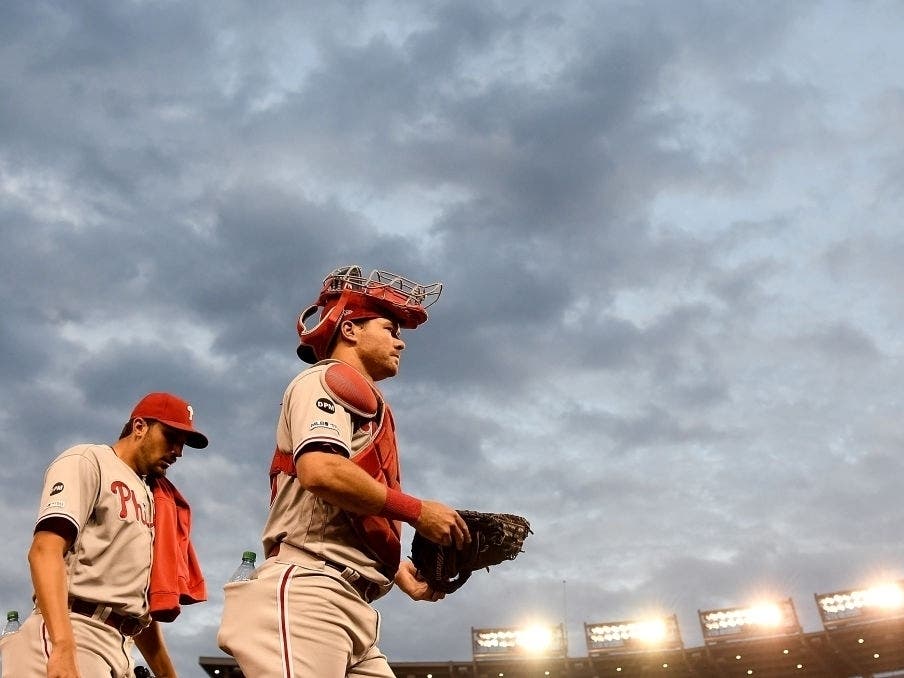
PHILADELPHIA, PA — A season of sky high hopes flickered away with a fly-out to right field Tuesday afternoon in Washington, as the Phillies were officially eliminated from the playoff race with a 4-1 loss to the Nationals.
For months now, fan and media narratives have sought explanations for the Phillies long descent from World Series contender on Opening Day to a middling club that hasn't made the postseason since 2011. The easiest thing to do is to place the blame on the public faces leading the Phillies: manager Gabe Kapler and general manger Matt Klentak.
It's also the most baseless and the most naive.
Find out what's happening in Norristownfor free with the latest updates from Patch.
No, the reason for the Phillies record this year is obvious, and it has nothing to do with Kapler or Klentak. It's nothing that could've been addressed with in-season trades or offseason signings or different bullpen management or a shifted starting lineup. The difference between the Phillies and the best teams in baseball is a bevy of young, superstar-level, homegrown talent.
The Phillies farm system has been outclassed by most of the National League for over a decade now, and it's a problem that existed long before Kapler and Klentak came to Philly. It's what's allowed teams like the Braves, Dodgers, and Nationals to take a step which the Phillies cannot, despite their deep pockets. Superstar position players like Cody Bellinger, Alex Verdugo, Gavin Lux, Ronald Acuna, Ozzie Albies, Juan Soto, and Trea Turner were all signed or drafted during the Phillies recent rebuilding phase. Those teams got those guys, and the Phillies did not.
Find out what's happening in Norristownfor free with the latest updates from Patch.
And there is no amount of managing or general managing that can bridge that gap in a year or two.
Increasingly, championships are not won and lost on the trade market or in free agency. In the frenzy of the Phillies historic offseason last winter, which added veterans like JT Realmuto and Bryce Harper (who both turned in stellar seasons), that was easy to forget. All good teams add good free agents and make shrewd trades, just like the Phillies did this offseason. But the Phillies have always been missing the most important pieces of the puzzle, the base of elite talent around which to build. Nobody, not even the Phillies, has the money or prospect capital to buy and trade for an entire championship-caliber roster, and Harper and Realmuto can't do it alone.
The Phillies do have Rhys Hoskins and Scott Kingery and Adam Haseley, who have all shown flashes of brilliance and could yet become franchise players. And of course on the mound, they have developed one true star in Aaron Nola. In the minors, pitcher Spencer Howard and third baseman Alec Bohm have everyone excited, and could contribute as early as next summer.
But the upper levels of the Phillies farm are lacking in depth. And so far, the Phillies have not developed an MVP candidate since the Howard-Utley-Rollins days, nor even an All Star-caliber hitter (outside of the first half of Domonic Brown's 2013).
Compare that to the Braves and Dodgers, who still rank among the best farms in baseball, even as they graduate talent to their major league rosters and even as they maintain strings of 100-win, playoff caliber seasons. The Nationals aren't far off, and even the Mets, for all their quixotic absurdity and self-immolation, have a pair of MVP candidate rookies on their hands in Pete Alonso and Jeff McNeill.
A common fan refrain is that Klentak trusted the Phillies rotation too much coming into 2019 and that at the very least he should've signed Dallas Keuchel, who eventually went to the Braves in a midseason deal. There is also no end to the overanalysis of Kapler's bullpen moves and his starting lineups.
Regardless of the veracity of these criticisms, the fact of the matter is that even in the best possible scenario, none of that would've come close to bridging the now massive, 16-game gap between the Phillies and the Braves. In the best case, an improved rotation and a time-traveling robot manager who can see into the future and make impeccable bullpen choices would've given the Phillies a handful more wins. They'd still be well out of the Wild Card.
And all of this is not even taking into account the crushing string of injuries that have left the Phillies without a third of their Opening Day roster, and the absolutely unpredictable regression of the starting rotation they began the year with.
With a little luck and a few offseason moves, the Phillies will almost certainly be playoff contenders into September once again in 2020. But becoming the championship contenders everyone wanted to believe they were back in March will take something else entirely. Something else, needless to say, that is out of the control of the manager and the general manager.
Get more local news delivered straight to your inbox. Sign up for free Patch newsletters and alerts.