
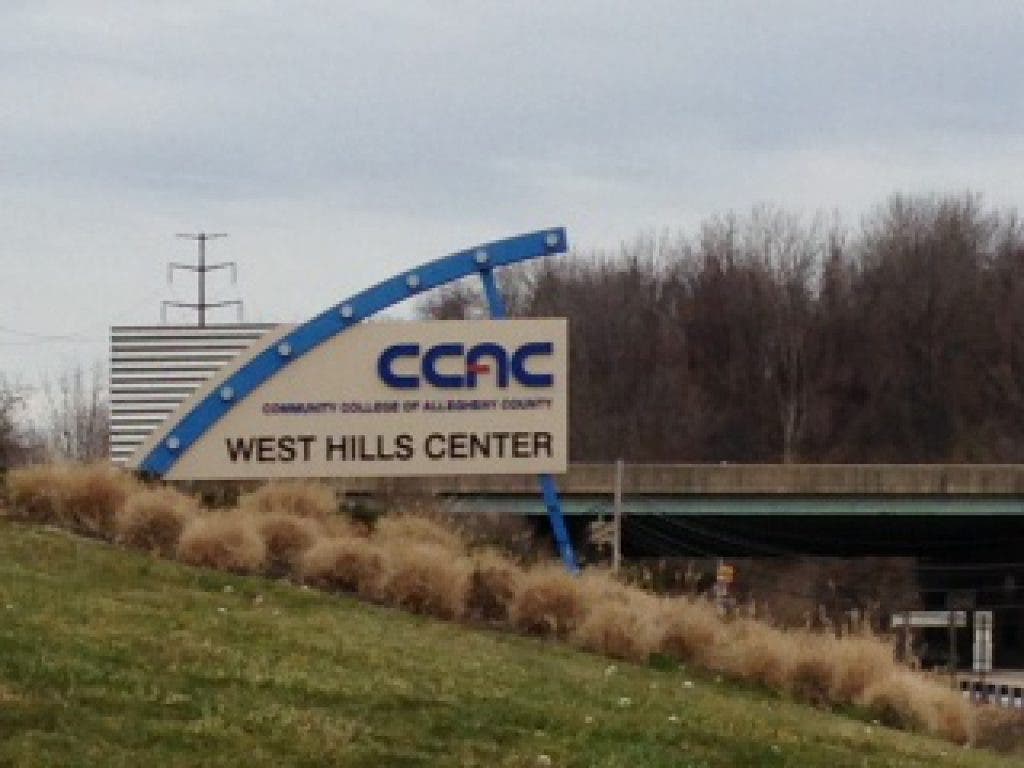
CCAC Trades and Services Fair
“At a Glance”
The Community College of Allegheny held their Skilled Trades and Services Fair on November 20th at the West Hills Center in Oakdale, PA.
Find out what's happening in North Alleghenyfor free with the latest updates from Patch.
Over the lunch CCAC provided for the trades fair attendees, there was opportunity to ask Shirley Reinhart, the Senior Administrative Secretary at CCAC and a few of CCAC’s well-informed educators a few questions:
1. How has the trade’s fair changed over the years?
Find out what's happening in North Alleghenyfor free with the latest updates from Patch.
There has been a tremendous increase in attendance because of the regions job demand and as a result of from CCAC’s providing safe, hands-on, interactive classes for students to personally experience CCAC’s Applied Service and Trade Technologies programs.
West Hills CCAC trade programs offered at West Hills Center include:
Building Construction Supervision
Building Construction Technology
Sheet Metal Worker Apprenticeship
As an example of the popularity of these programs, during the recession, when many dislocated workers came to CCAC, the college’s welding lab was filled to capacity during normal class hours. A retired welder agreed to teach a late night welding class from 11:00pm to 3:00am to help meet demand, and the class ran with full enrollment.
2. What ages of students are seeking these programs, and what challenges affect enrollment?
In an article in the Pittsburgh Tribune Review, “David Hoovler, a spokesman for the Community College of Allegheny County, said that from fall 2006 to fall 2011, the number of 18- and 19-year-old students attending CCAC increased 9 percent, from 3,606 to 3,937. Students ages 30 to 34 were the fastest-growing age group, at 34 percent. The 50 to 64 age group increased 21 percent. ‘The greater growth in the older segments may be attributed to the economic climate, with more people choosing CCAC for retraining or additional education to get or keep a job,’ Hoovler said.”
http://triblive.com/x/pittsburghtrib/news/education/s_778156.html#ixzz2D6nZ9QeU:
One of the hurdles that CCAC has had to work with, explained Tom Cortese, assistant dean of the West Hills Center is the limited public transportation available to the West Hills Center for those wishing to take classes.
ACTA (RideACTA ) offers shuttle service from IKEA to the West Hills Center. Additional Transportation information is available online.
3. Has there been an increased urgency by businesses for educated workers in the fields CCAC offers? Has CCAC anticipated industry needs?
There has been an increased urgency by businesses for educated workers. “According to a 2011 study by the Pennsylvania Association of Private School Administrators, "six of the top 10 fastest-growing occupations in Pennsylvania require at least some post-secondary education."
http://triblive.com/x/pittsburghtrib/news/education/s_778156.html#ixzz2D6lzWpwA
CCAC will provide and develop consistent but flexible curriculum according to industry needs. According to Dr. Alex Johnson, president of CCAC and of the Pennsylvania Commission for Community Colleges, and Dr. Nick Neupauer, president of Butler County Community College and vice president of the Pennsylvania Commission for Community Colleges “Community colleges, are the state's first line of offense when it comes to training the workforce and rebuilding Pennsylvania's economy.” (http://www.bizjournals.com/prnewswire/press_releases/2012/03/01/PH63316)
Some examples of CCAC curriculum updates to meet industry needs are:
4. Who works directly with the high schools to create interest in these opportunities at CCAC?
CCAC staff work with the Allegheny County school districts directly. For more information click here: CCAC opportunities for high school students.
5. Additional information:
The students who graduate from AW Beattie Career and Technical school can use their certificates to transfer to CCAC. Certifications & Credits and CCAC at a Glance 2011-12.
Trade unions work closely with CCAC to provide the skilled training for students and workers.
One recommendation and need provided by Ron Logreco, assistant dean of the West Hills Center, was for businesses to consider offering internships or apprenticeships for students during their time at CCAC. This creates on-the-job training for the students, as well as providing opportunities for businesses to mentor and train the students to the employer’s needs and create potential employees.
“On Second Glance”:
1. W. Scott Main
CCAC Associate Professor/Coordinator Chrysler College Automotive Program
With the increased need for educated automotive technicians CCAC provides continually updated programs that allow students to stay abreast of the auto industry. Mr. Main, one of CCAC’s Automotive Technology instructors has benefited through the Perkins Grant by being able to provide students hands-on hybrid instruction with the Toyota Prius and the Chevrolet Malibu. Mr. Main explains that although the battery technology is not exactly where it needs to be to provide the consistent power needed, the hybrid batteries continue to improve. He is excited that CCAC’s students are being a part of this technology that is changing the face of the automotive industry.
Mr. Main explained that this past October, CCAC partnered with Pittsburgh Regional Clean Cities, Three Rivers Clean Energy and the National Alternative Fuels Training Consortium to raise awareness and foster a greater “understanding of alternative fuels, alternative fuel vehicles (AFV’s) and advanced technology vehicles as part of the DOE Clean Cities Program’s Odyssey Day.”(www.ccac.edu/default.aspx?id=152204)
Also in October CCAC and Pittsburgh Regional Clean Cities provided hybrid training for ALCOSAN mechanics. The Department of Environmental Protection is encouraging companies through grant funding to collaborate with the state to strive toward Pennsylvania’s energy independence.
2. Sarah Hansen
Project Coordinator, CCAC
As one of the tour guides in the mechatronics program for CCAC Skilled Trades and Services Fair, Ms. Hansen mentioned William C. Symond’s “Pathways to Prosperity” report and the importance of introducing more students to vocational training. She explained the opportunities available to students in manufacturing technology. Through a federal grant from the Fund for the Improvement of Post-Secondary Education (FIPSE), CCAC established its mechatronics program, which remains the only certified Level 1 program in Western Pennsylvania. Thanks to the grant, the 300-hour program is tuition-free for qualified applicants. The college has leveraged that funding to expand the program, and with a TAACCCT (Trade Adjustment Act Community College and Career Training) grant, CCAC will be adding Level 2 and Level 3 training.
For more information regarding the Skilled Trades and Services Fair and the programs mentioned in these interviews, please call CCAC–West Hills Center at 412.788.7500 or visit www.ccac.edu.
Interviews provided by Aafke Loney of Business and Education Connected