Community Corner
Digging into the Past in Trappe
A teacher and students excavate pieces of history from Muhlenberg House grounds.


When you drive by 201 W. Main St., what do you think? Do you even notice the little house nestled into the landscape? Maybe you see the sign identifying it as . Maybe you even know the house is the location of the local historical society.
But the old Muhlenberg house by which you are driving is much more than just a place the historical German lived. It is far greater than the offices of those who showcase the area’s history. The house and surrounding area is the history.
Lou Farrell, a teacher at the Upper Perkiomen High School and doctoral student at Temple University, brought his first group of amateur archaeologists to the site a little over a year ago to dig up Henry Muhlenberg’s “summer kitchen.”
Find out what's happening in Perkiomen Valleyfor free with the latest updates from Patch.
The historical society had contacted Temple professor David Orr, looking for someone to help with the dig to commemorate Muhlenberg’s 300th birthday, which will be celebrated soon.
Farrell took the job eagerly, turning to high school students in nearby areas to help with the excavation. This year, the project includes approximately 40 students from Upper Perkiomen, , Norristown, and Methacton high schools.
Find out what's happening in Perkiomen Valleyfor free with the latest updates from Patch.
"If it’s complicated, it makes a whole lot of sense to dig it with a bunch of amateurs,” Farrell said, laughing.
The students with whom Farrell now works, however, are far from complete amateurs. They received archaeological training during the school year and work with Farrell every day in developing their critical thinking skills.
The high school teacher jokingly said that his students on the site have gotten to the point of fearing asking him questions, knowing every interrogative directed at their supervisor will be answered with three other questions.
They learn fast, though, and they learn well. Student Alyssa Hyziak knew nothing coming onto the site just a few short weeks ago, but with the help of other classmates and Farrell, she has become fluent in the history.
Transforming into archaeologists in a matter of months, Farrell’s students have stepped up to the challenge and done a marvelous job.
“I’d put these guys up against a collegiate crew,” the proud teacher commented.
Last summer, Farrell and his crew found the Muhlenberg summer kitchen, complete with dishes, stove, and a mysterious cavity-infested baby tooth. At this location behind the house, though, the old kitchen (with 10,000 artifacts) is not all they found. They also uncovered a blacksmith’s shop, a pottery kiln, a garbage pit and Native American artifacts. These all were from different time periods predating Muhlenberg’s, marking an archaeological goldmine.
This year, though, Farrell returned to the site to head to the side yard of the property, curious what he would find there. This particular piece of land was excavated sometime in the ‘90s, but very few records were kept of the earlier dig, and Farrell was anxious to see what was left behind.
“There’s always more to learn,” he said about the re-dig.
More to learn, there was. With a burnt red soil, indicating a history of fire in the ground, old clay structures covered in glaze, and a kiln-like construction, all signs point to pottery. Farrell has been consulting his European contacts about his findings, and experts there say the findings in Trappe are consistent with what they have found in the Lower Rhine and traced back to the time period of the 1400s.
Though nothing is confirmed, and much work remains to be done before anything can be officially published, Farrell and his students may have uncovered America’s first industrial pottery site right here in Trappe.
Archaeological student veteran Andrew Grasberger compared the two projects, having excavated both sites. He commented that, though the archaeological value may have been higher in digging the kitchen, there was much more to find in the kilns. He also noted that he enjoyed the “cooler stuff” they have been finding this summer.
The project will be put to rest again in time for everyone to get back to school, but Farrell and the Archaeology Club will be back next summer. The students could not be more excited. Chris Grasberger said the whole thing is a “cool experience,” but what makes it remarkable is the history in it. He loves that, instead of just reading everything from textbooks, he is in the action, and he gets to figure out the story for himself.
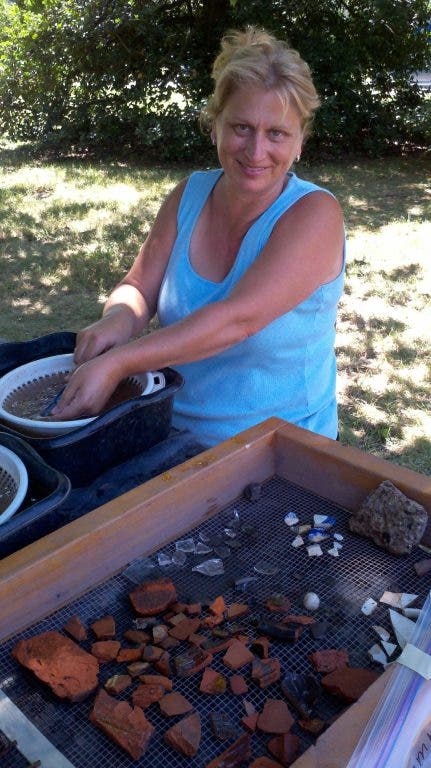
Andrew and Chris’ mother, Anne Grasberger, also helps the project along by processing found artifacts. She loves being a part of the greatness of the dig, but also of sharing her enthusiasm for it with the community, and she also loves meeting the interesting people who come for tours of the findings and sharing an interest in local history with other locals.
This summer’s dig is over, but there is much more to learn. Farrell estimates they have at least two more years before any concrete story can be told, but he says the historical society is the best partner he could have for the project. The society's patience and understanding keeps him and his team going, and will continue the interesting discoveries for the foreseeable future.
The work Farrell and his students have done this summer will not be re-filled like the summer kitchen was last year, so swing by the historical society and check out the fenced-in dig. Breathe the history. Be proud of your home.