Neighbor News
A scientific discovery, about the existence of God at the intersection of science and faith.
There isn't a single scientific discovery that definitively proves the existence of God—but there are discoveries that have pushed scientist

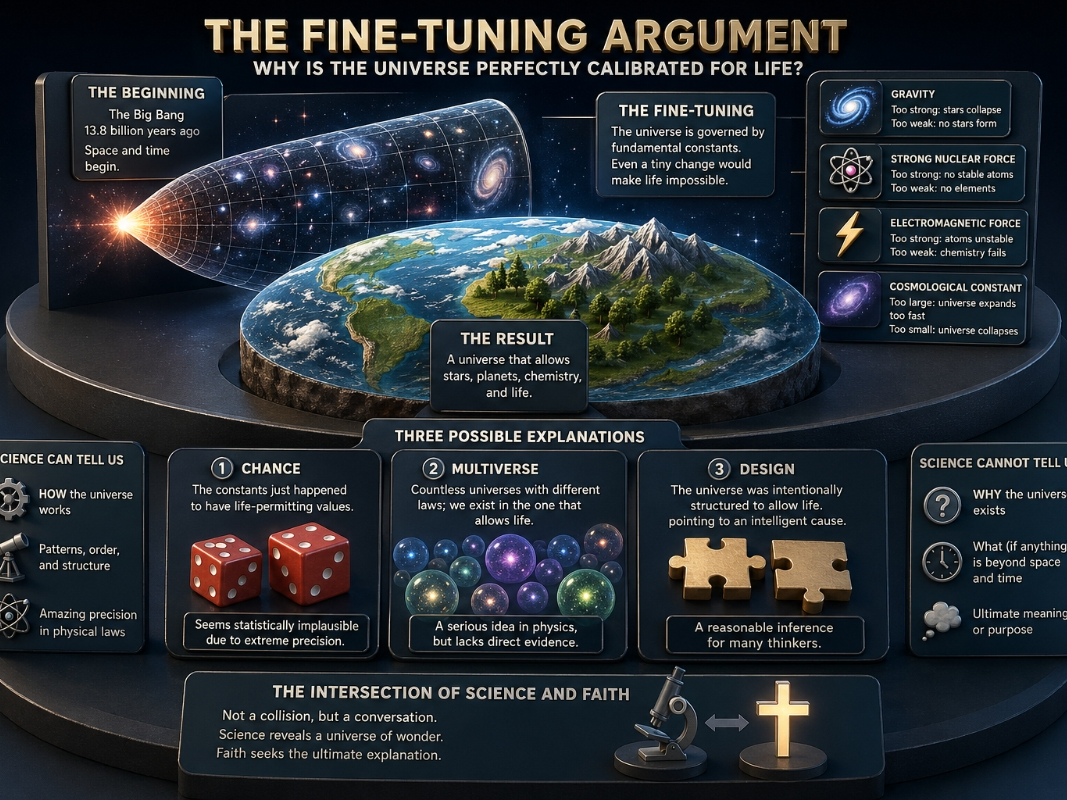
There isn’t a single scientific discovery that definitively proves the existence of God—but there are discoveries that have pushed scientists and philosophers to seriously engage with that possibility. One of the most discussed is the fine-tuning of the universe.
Modern physics shows that the universe is governed by a set of fundamental constants—numbers like the strength of gravity, the electromagnetic force, and the cosmological constant. What surprised scientists is how precisely calibrated these values are. Even the slightest change in many of them would make life impossible. For example, if the strong nuclear force were just a bit weaker, atoms wouldn’t hold together; slightly stronger, and stars couldn’t form properly. The conditions required for life sit in an extraordinarily narrow range.
This realization led to what’s often called the Fine-Tuning Argument. It sits at the intersection of physics, cosmology, and philosophy: why does the universe have the exact conditions necessary for life to exist?
Find out what's happening in Philadelphiafor free with the latest updates from Patch.
There are three main explanations scientists and thinkers consider:
Chance – The constants just happened to fall into the right values. Critics argue this seems statistically implausible given the extreme precision required.
Find out what's happening in Philadelphiafor free with the latest updates from Patch.
Multiverse – There may be countless universes with different physical laws, and we simply exist in the one where life is possible. While this idea is taken seriously in theoretical physics, it currently lacks direct empirical evidence.
Design – The universe was intentionally structured to allow life, pointing toward an intelligent cause.
While science cannot test “design” in the same way it tests physical theories, the fine-tuning observation itself is widely accepted. Even some non-religious physicists have acknowledged how striking it is. Paul Davies once remarked that the laws of physics seem “ingeniously arranged” to permit the emergence of complexity and life.
Another closely related idea comes from the Big Bang theory, which describes the universe as having a beginning roughly 13.8 billion years ago. Before this, space and time as we know them did not exist. This aligns intriguingly with philosophical and theological ideas that the universe is not eternal but had a cause. Some thinkers argue that anything that begins to exist must have a cause beyond itself—raising the question of whether that cause could be outside space and time.
However, it’s important to stay grounded: science, by its nature, explains how the universe works, not why it exists at all. It can point to mystery, structure, and patterns that invite deeper interpretation, but it doesn’t settle metaphysical questions on its own.
So rather than a proof, what science offers is something subtler: a growing sense of order, precision, and intelligibility in the universe that many interpret as compatible with belief in God, while others interpret through naturalistic frameworks.
In that sense, the intersection of science and faith isn’t a collision—it’s more like a conversation, where discoveries raise questions that go beyond measurement and enter the realm of meaning.