Schools
Tuskegee Airmen Faced Battles in the Air and on Home Soil
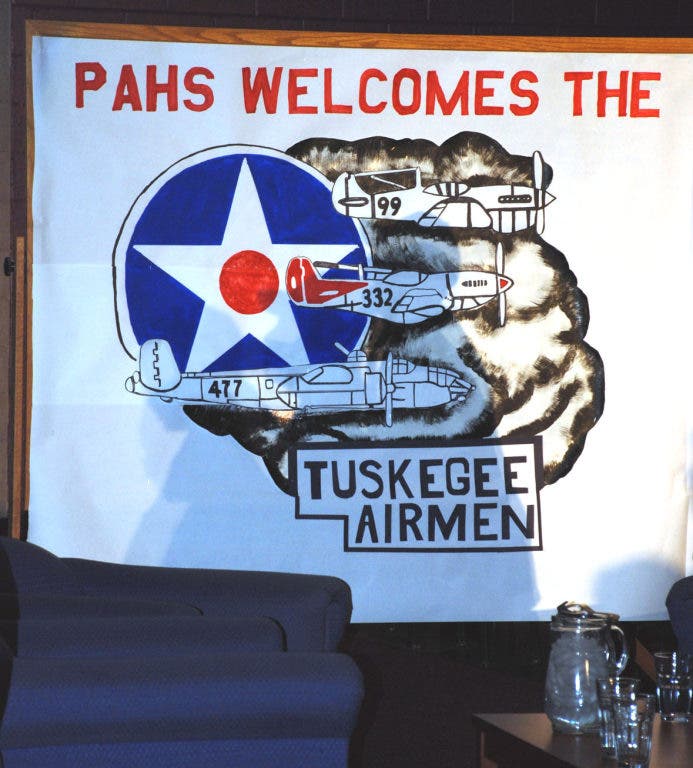
PAHS served as the host site for a video conference honoring historic aviators.


Men who defend their country at a time when their nation doesn’t hold them in equal esteem and those who are inspired to follow in their footsteps fight many adversities on and off the battlefield.
That’s the perspective original Tuskegee Airmen Maj. John Harrison, Roscoe “Coach” Draper and second-generation Tuskegee Airman Aaron Watkins shared Tuesday with students at Phoenixville Area High School as part of a nationwide tribute to these pioneering aviators. Eight schools from across the country participated in a video conference that enabled veterans to share their experiences with students of American history and African American studies.
Like many war veterans, the Tuskegee Airmen of World War II fought a common enemy—fascism in places like North Africa and Italy. As portrayed in the recently released film “Red Tails,” more than 900 African Americans flew 200 strategic bomber escort missions over Europe with the 15th U.S. Air Force without losing a single bomber to enemy aircraft from 1944-1945.
Find out what's happening in Phoenixvillefor free with the latest updates from Patch.
The movie also shows that these early civil rights soldiers battled racism and bigotry among their fellow citizens.
“About 70 years ago, a recruitment officer in Omaha, NE, threw me out,” Harrison said. “He told me ‘we don’t train you people to be pilots.’”
Find out what's happening in Phoenixvillefor free with the latest updates from Patch.
As a young man who had dreamed of flying planes since seeing one fly over a Midwestern corn field, Harrison was not deterred. After training in Tuskegee, AL, where segregated flight training facilities were established, he realized his dream of flying, piloting more than 12 different types of planes around the world.
Acceptance, however, was a tougher battle. When the war ended, Harrison served 23 more years in the U.S. Air Force. During that time, he could walk the streets of foreign cities, in uniform, and be respectfully recognized as a U.S. soldier. Back in the states, however, people identified him as a “black pilot” or a “black major,” acting shocked to see an African American serving in those positions. Even U.S. soldiers stationed oversees failed to recognize the accomplishments of the Tuskegee Airmen.
“As a black officer walking the streets of a foreign city, white enlisted men from the United States would not stop and salute,” Harrison said.
The discrimination continued after his retirement from the Air Force, as he tried to secure employment as a commercial pilot, but was denied once again because of race. However, rejection did not deter him from achieving success. He went on to serve as the leader of the Peace Corps in Swaziland, Africa, where he was named an honorary citizen by King Sobhuza II. Harrison also went on to pave the way for African Americans in the world of corporate banking.
“I had zeal and zeal drives you,” he said. “I had an uncle who told me I could do anything in the world I wanted to. I knew there would be adversity but that didn’t matter.”
Draper faced many of the same challenges as Harrison as he attempted to pursue his career interests. After successfully completing the government-sponsored Civilian Pilot Training Program in 1940, this suburban Philadelphia native was also rejected from the Army Air Corps.
“In the military, you had to deal with civilian discrimination as well as military discrimination,” he said.
However, the Corps’ loss was Tuskegee’s gain, as Draper became an instructor at the institute in 1942, training the first class of airmen to pass through and head out to war. His roster of students included Lee Archer, considered to be the only African American ace pilot, credited with shooting down five enemy planes during World War II.
“I’m proud to say that I was a part of the Tuskegee Airmen,” he said.
Following the war, Draper worked for 23 years with the U.S. Postal Service, but “ached to get back into the air.” In 1979 he transferred to the Federal Aviation Administration, where he became an inspector. He even continued his flight training, learning to fly helicopters at age 60.
At age 93, Draper said he’s now happy to sit back and let someone else do the flying.
Watkins, inspired by the original Tuskegee Airmen, graduated from Tuskegee University and then served in the Vietnam War from 1969-1970 as a helicopter pilot. He heard stories about Draper and other airmen from his ROTC instructors and wanted to follow in their footsteps.
While Watkins experienced an integrated military, it still did not come without adversity. During his first week of flight school an instructor approached him and declared that he would “flunk” the young aviator out of the program. Even though the instructor went on to lie about Watkins score on a “check ride” flight, the airman achieved his goal of learning to fly.
“At graduation, the major said ‘I tried to get to you but you got me back,’” Watkins said.
Watkins told students that his experiences taught him more than just how to fly.
“I learned the three Ds—dream, determination and discipline,” he said. “Apply all three and you will be successful in life.”