Neighbor News
What Went Wrong?
How did cannabis get here, to a place seemingly at odds with ideologies, authorities, and industry?

If cannabis holds true therapeutic value, what went wrong in America? How did cannabis get here, to a place seemingly at odds with ideologies, authorities, and industry? Perhaps we should begin in Pennsylvania and a town soon home to a new dispensary from Lebanon Wellness Center. Harry J. Anslinger was born in Altoona to Swiss and German parents who immigrated to America, testing their will on the Pennsylvania Railroad. Anslinger followed in his father’s footsteps and found himself on the “fast track” as a railroad investigator. It wasn’t long before Anslinger was uncovering international drug rings as the “gold rush” and transcontinental railroad brought Chinese and opiates to American shores. However, this ethnic “profiling” strategy wasn’t exactly new. The year Anslinger was born (1892), the Geary Act upheld the Chinese Exclusion Act of 1882, the first US law banning a specific ethnic group from immigrating to America. And so it remained, there was no longer a place in America for these people or their “substance." More on this later.
Anslinger soon became America’s first “Drug Czar” in 1930, serving as Commissioner for the Federal Bureau of Narcotics (FBN) under five presidents over three decades, including Hoover, Roosevelt, Truman, Eisenhower, and Kennedy. Ten years prior, America embarked on its first national “sobriety” campaign with the 18th Amendment and the prohibition of alcohol. However, the intent never materialized as most "good people" considered the law unnecessary and under-resourced officials were overwhelmed by the economic, political, and economic “underbelly” of the market. Sound familiar?
After three years as Commissioner, the 21st Amendment repealed the 18th, largely to save face with the American people as an acceptable form of “self-indulgence.” Instead, they would focus their resources on stronger regulations to pave the way for a legal alcohol market and subdue any "crop up" competition in the adult-use market. So, after unsuccessfully waging a war on alcohol, Anslinger began a new campaign against cannabis. Going against the recommendation of the American Medical Association, the Marijuana Tax Act (1937) effectively ended the commercial production and sale of cannabis and hemp-based products. You could continue to grow if you had a stamp, but they were pricey and largely unavailable. Oddly enough, Popular Mechanics projected hemp to be America’s “New Billion-Dollar Crop” (1938) due to its use in thousands of products ranging from rope and fine lace to dynamite and cellophane. A new machine called the Decorticator, similar in industrial impact to the Cotton Gin, gained widespread adoption and provided an extremely cost-effective way to process hemp. So what happened?
Find out what's happening in Phoenixvillefor free with the latest updates from Patch.
Beyond Anslinger’s official agenda, industrial stakeholders were concerned how this “green rush” would affect their bottom line. Fellow Keystone native Andrew Mellon was one of the wealthiest Americans of his time and served as Secretary of Treasury under three presidents during the 1920’s. The FBN was formed under the Department of Treasury during the final years of Mellon’s leadership, and in doing so, developed an interesting public dynamic between Anslinger, Mellon, and the federal government. In time, Mellon’s private motives regarding the creation of the FBN and Marijuana Tax came into full-view after investing a considerable amount of capital into a new DuPont product called “nylon” that would directly compete with hemp. So as you can see, the imagination for the Marijuana Tax can be linked to two men, a secretary and his commissioner, and their publicly private interests to regulate “illicit” drugs and shape industrial markets.
The end of prohibition ensured the government would not repeat the mistakes of the past for two hypothetical reasons. First, state and federally regulated markets would allow government agencies to maintain and/or increase their control over the alcohol industry. They wanted the power, so they offered alcohol a protection. Anslinger and the FBN essentially made cannabis the new “public enemy” to help the industry secure a larger stake. Second, as a reward for organizing the market, the government could collect additional tax revenues to expand the size and scope of their operations within and beyond the FBN. Seems like a win-win. But with approximately 88,000 alcohol-related deaths in 2014 (10/hr), nearly 10,000 of which involved a vehicle (+1/hr), are alcohol regulations still headed in the right direction?
Find out what's happening in Phoenixvillefor free with the latest updates from Patch.
Speaking of death, an alarming event recently took place in the healthcare industry. In 2016, pharmaceutical-grade, synthetic opioid overdoses resulting in death quadrupled from 2014 and accounted for more deaths than heroin, nearly 5,000 more. This tragedy is further compounded by a recent report suggesting that several opioid manufacturers were making considerable “donations” to “pain management” advocacy groups. Seems “charitable” until you realize that these advocates ultimately publish materials, host events, and pay doctors to peddle their lethally legal concoctions. In case you haven’t noticed yet, “big pharma” is the other culprit as it shapes the image and culture of American “health.” Advances in medical research are pumping out more medications, helping people live longer; healthier is debatable. These companies have become a powerful force in global economies and lifestyles as they spin “life saving” concoctions in their labs and sway politicized structures to secure their economic demands. In fact, health care costs accounted for over 17% of America’s GDP in 2014 while drug manufacturers spent $240m in 2015 paying lobbyists to shift the market in their favor; nearly $100m more than the second-largest spender, insurance companies. While alcohol and pharmaceuticals keep people “merry and well,” it shouldn’t come at the expense of alternative forms of social and/or medical mediation. We kicked out the Chinese to stop the opium trade, and recently went to war in Afghanistan to stop poppy production from funding terrorism, but by and large, the current opioid epidemic is on us. That batch was “homegrown.”
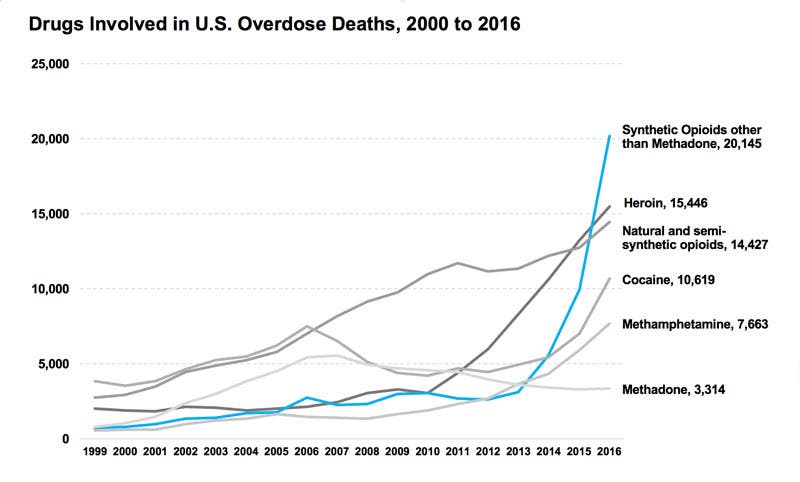
The unforeseen consequences of criminalizing cannabis put the medical industry and our government at odds with opium once again. Now more people are “legally” killing themselves while the “illegal” heroin market continues to grow. It seems Americans have successfully doubled down on opiates while the entertainment, recreation, and restaurant industries believe in the power of “spirits” to facilitate passionate, subdued, or chatty experiences, all at the expense of public safety. The federal perspective should make you wonder why they won’t accept the creativity, thoughtfulness, or passivity facilitated by cannabis. Perhaps they don’t want Americans to figure out what’s really going on or how we could solve systemic problems if only we exercised a little more creativity and/or thoughtfulness. Perhaps they’re worried cannabis is a threat to the military industrial complex. War, not peace, is money after all.
The contemporary cannabis conundrum still beckons the past, largely the result of “guided” consumeristic tendencies and competing ideologies. Alcoholic beverages and pharmaceuticals are two of the most widely endorsed industries in America as our “ads driven” culture is littered with booze that promise to “heighten” your social life and pills that won’t let people know how anxious, stiff, or diabetic you really are. Whether an entertainment spectacle, family reunion, or wedding, alcohol is certainly the acceptable form of intoxication.
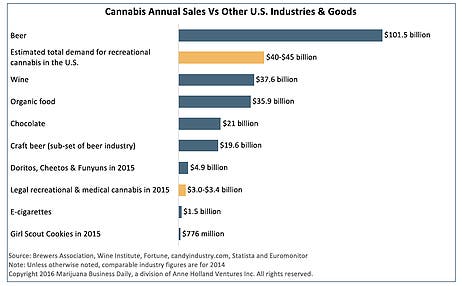
From a “recreational” perspective, alcohol producers, distributors, and retail outlets have a lot to lose if cannabis continues to gain traction. Marijuana Business Daily predicts a $50b demand for “adult-use” cannabis which is more than wine ($38b), craft beer ($20b), and even chocolate ($21b). Perhaps this is why California’s “wine country” is so concerned about the “growers” up north. Vinedressers have the soil while growers have the new “cash crop.” The domestic beer market ($101b) is still more than double that of cannabis but these margins should continue to close with every state that legalizes “adult use” cannabis.
From a “medical” perspective, pharmaceutical companies, doctors, educational institutions, and hospitals also have plenty to lose as the “medicinal” cannabis demand continues to “grow” across America. Doctors work to uphold their hippocratic oath but find themselves surrounded by pharmaceutical companies, health insurance agencies, and government officials dictating care and reaping considerable profits along the way. Cannabis poses a threat to pharmaceutical competitors and the government because of the challenge to regulate the market without the need for a bunch overpaid doctors, researchers, and technicians to spin a plant in the lab.
You see: sun, seed, and soil is all you need to make cannabis medicine.
How can the government regulate a plant that grows in the ground, virtually anywhere? More importantly, how will they make money if they don’t know where it grows, or where it’s sold, and doesn’t require a PhD to cultivate? The answers to these questions will certainly dictate the future of medicinal cannabis in the US and beyond.
Cannabis has gained significant momentum over the past several years, but still has a long way to go. For starters, the DEA still lists cannabis as a Schedule I (most dangerous) drug with the likes of heroin, LSD, peyote, and ecstasy, claiming "no medical benefit, lack of safety, and high potential for abuse." However, drugs like fentanyl, morphine, opium, codeine, and hydrocodone are classified as Schedule II drugs, considered (somewhat) less dangerous though they still run the risk of "high potential for abuse" and/or can "lead to severe psychological or physical dependency." Compounding the issue, since the DEA refuses to reschedule cannabis, research institutions have little to no access to cannabis so the science can play out. With a 2016 death toll comparison of 20,145 (synthetic opioids) to 0 (cannabis), is this still making sense? I suppose it’s crystal clear to government officials who maintain control over the healthcare industry that Americans are so dependent upon. However, with 17 qualifying conditions in PA’s program there is one plant potentially capable of mediating them all. Traditional pharmaceutical companies are lucky to compete for one of these conditions.
In 2016, then US Senator, now Attorney General Jeff Sessions made a public comment about cannabis during the “Caucus of International Narcotics Control.” He stated, “good people don’t smoke marijuana.” Good thing Americans use cannabis. You see, at the heart of this discussion is the ideological perspectives intertwined between individuals, industries, and governance. Unfortunately, these public perspectives rarely include cannabis. Sessions’ rhetorical slang for cannabis (marijuana) reveals a deeply conservative, ethnically-biased perspective to keep certain “things” out of our country as, according to Anslinger, most users are “negroes, hispanics, and filipinos.” Anslinger’s war against the Chinese and opium has now been reimagined with cannabis, Mexicans, and blacks. Perhaps this is why they want to build a wall? With Sessions calling home to Selma, Alabama, he certainly understands the pros and cons of the “racial divide” quite well.
Capitalism is still the pervasive economic and political machine of our age at the expense of private interests, allowing the deepest pockets to dictate ventures and elections. Tax revenues is one of the biggest reasons the states are legalizing cannabis. PA is projected to do $100m annually as the medical cannabis market matures in the coming years. There’s still many of things that will make you cringe concerning cannabis legislation but "Keystoners" are well on their way. With every registered patient, caregiver, and physician, Pennsylvania is one step closer to legitimizing an alternative form of treatment while saving and making the government plenty of money in the process. And with every cultivator and dispensary that opens their doors, we are yet another step closer to reshaping our perception of pharmacology; cannabis, opiates, or otherwise. So in the end, what went wrong? Nothing, seems to be more of the same. Just got to take things one "puff" at a time.
To learn more about Pennsylvania's "budding" medical cannabis program, visit ReLeaf Network's FB page @ www.facebook.com/releafnetwork. ReLeaf Network is PA's independent connection and communication network, creating a comprehensive, patient-centered cannabis care network that promotes safe and affordable access for all patients of PA's 17 qualifying conditions. Be sure to like and share!